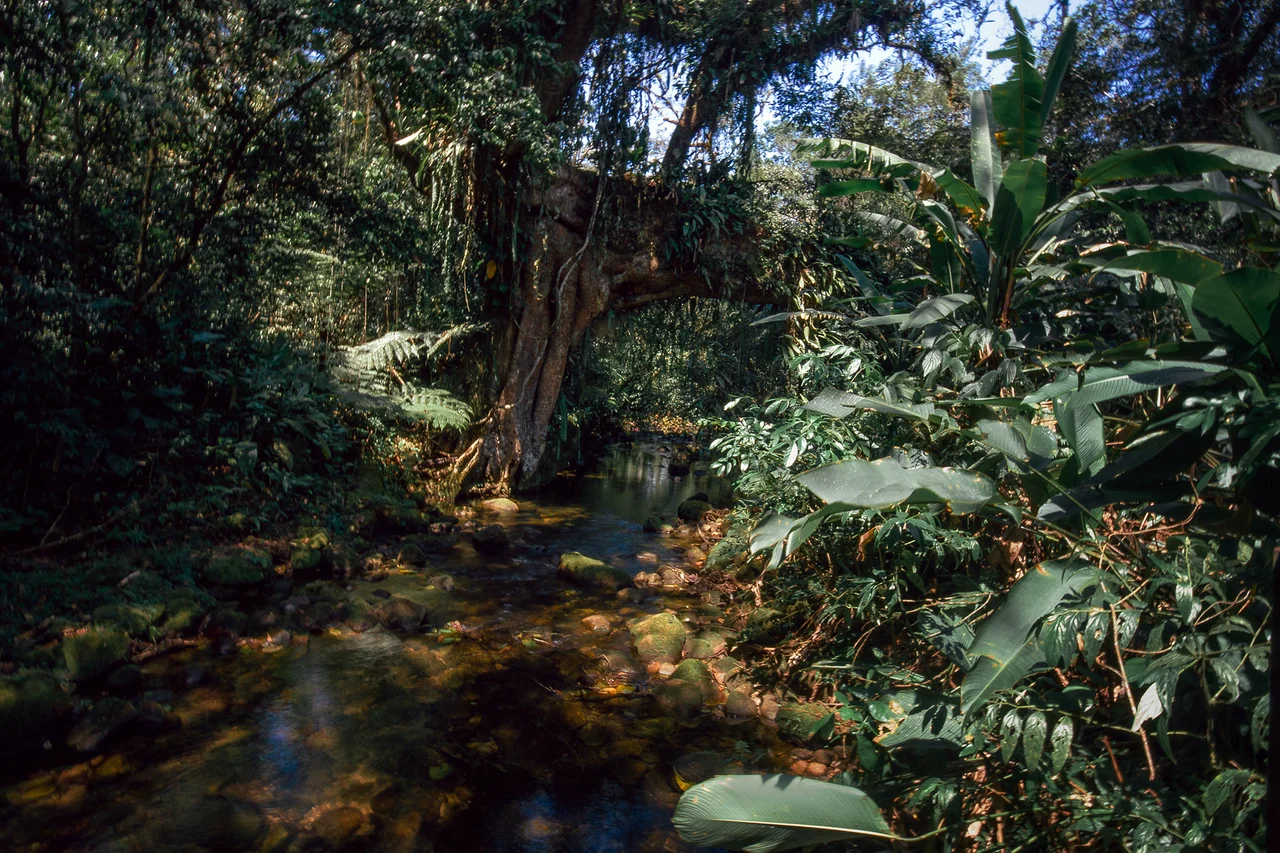

Atlantic Forest
When the Portuguese made landfall on a Brazilian beach on April 22, 1500, they walked straight into the Atlantic Forest. Back then it covered something on the order of one million square kilometers - a green wall stretching from what is now Rio Grande do Norte down to Rio Grande do Sul, and westward far enough to reach Paraguay and the Argentine province of Misiones. It was the second-largest rainforest on the planet, trailing only the Amazon. It was also the first place European colonists altered in the New World, and the pattern they established there five centuries ago has continued ever since. Today, roughly 88 percent of the original Atlantic Forest is gone. Nearly 250 species of amphibians, birds, and mammals have vanished in the past four hundred years. And yet the forest that remains is still one of the most biodiverse ecosystems on Earth.
Many Forests in One
The Atlantic Forest is not a single forest. It is a mosaic of habitats glued together by geography and moisture gradients. On stabilized coastal dunes, restinga forests grow low and dense. Inland, tropical moist forests climb into submontane and montane zones, their canopies dripping with epiphytes. Further west, where the rain thins, the Atlantic dry forests form a transition toward the semi-arid Caatinga. Mangroves occupy the river mouths. Campos rupestres rise on rocky highlands. Araucaria moist forests spread across the cool southern reaches, their odd candelabra pines looking more like a drawing than a tree. The biome spans tropical moist broadleaf forests, tropical and subtropical grasslands, and mangrove ecosystems. Ninety-two percent of it lies in eastern Brazil, with the remainder in Paraguay and Argentina.
A Biodiversity Hotspot
Approximately 40 percent of the Atlantic Forest's vascular plants and up to 60 percent of its vertebrates are endemic - they exist nowhere else on Earth. Biologists have cataloged over 3,000 tree species, 98 bat species, 94 medium-to-large mammal species, over 2,000 epiphytes, 26 primate species, 528 amphibians, 124 small mammals, and over 800 bird species in what remains. Between 1990 and 2006, researchers described more than a thousand new flowering plants. Some species thought lost returned from near extinction - the black-faced lion tamarin, rediscovered in a small population in 1990 after being presumed extinct; the butterfly Actinote zikani, declared extinct in 1981 and found again in 1991. A new blonde capuchin (Cebus queirozi) was identified in northeastern Brazil in 2006. The forest keeps producing surprises, even as it disappears.
Indigenous Hands Shaped the Forest
The Atlantic Forest that Portuguese colonists encountered was not pristine. Researchers now estimate that Indigenous land management had shaped 60 to 80 percent of the forest landscape by 1500. For thousands of years, Indigenous peoples practiced slash-and-burn agriculture, transforming biological corridors into food resources and reshaping plant and animal communities in the process. Portuguese colonists then exploited Indigenous labor and knowledge to harvest Paubrasilia echinata - the brazilwood tree whose red-dye trunks gave the country its name. Sugar plantations, called engenhos, followed in the sixteenth and seventeenth centuries and did more damage to the forest than any previous human activity. The deforestation has continued ever since, but the pattern of heavy human use long predates Europeans. What changed after 1500 was scale, tools, and export economies.
The Tamarin That Sparked a Movement
The golden lion tamarin is a small primate with a face framed by a fiery red-gold mane. By 1970 it was on the edge of disappearing. A few hundred individuals remained in fragmented patches of forest near Rio de Janeiro. The tamarin's plight sparked international attention, and conservation efforts began in earnest - zoo breeding programs, habitat corridors, protected areas. The species is still threatened, but it has rebounded. The tamarin became the animal face of the Atlantic Forest. Its survival story is also the ecosystem's. So is the story of the maned sloth, Bradypus torquatus, endemic to these forests and named for its long dark hair. So is the story of Dendropsophus branneri, the small hylid tree frog that lives in the canopy and calls through the evening.
What Comes Next
Today about 28 percent of native vegetation cover remains. Deforestation continues at roughly 0.5 percent a year, higher in urban areas. Agricultural conversion leads the pressure - sugarcane, coffee, tobacco, soybeans, biofuel crops - followed by logging and hunting. When a forest fragments, larger animals disappear first, which cascades through seed dispersal networks and alters the plants themselves. One study found biomass reduced to 60 percent of normal in fragments smaller than 25 hectares. Against these trends, the Pact for Atlantic Forest Restoration has assembled more than 100 businesses, nonprofits, and government agencies behind a target of restoring 15 million hectares by 2050. The Pontifícia Universidade Católica do Rio Grande do Sul maintains a 3,100-hectare private reserve called Pró-Mata. São Paulo state created the 9,300-hectare Restinga de Bertioga State Park as a wildlife corridor. In 2007, two volunteers named Joao Milanez and Joanne Stanulonis planted 5,500 new trees in the mountains around Gravata. Every hectare returned to forest is a hectare that might support a tamarin, a tree frog, a capuchin. The Atlantic Forest persists in fragments, but the fragments are still there. That is the narrow margin on which biodiversity now depends.
From the Air
The Atlantic Forest biome spans much of eastern Brazil. This viewpoint sits at approximately 16.5°S, 39.25°W near the Bahia-Espírito Santo border. Recommended viewing altitude: 5,000-10,000 feet for a clear view of the fragmented forest patches on coastal mountains and the contrast between protected reserves and agricultural land. Porto Seguro (SBPS) is the nearest airport. Visual landmarks include the Discovery Coast Atlantic Forest Reserves (a UNESCO World Heritage site) and the Serra do Mar mountain chain farther south. The patchwork of dark green forest amid lighter agricultural clearings is visible from altitude.
Nearby Stories
- Central Atlantic Forest Ecological Corridor 7.8 km away
- Jequitinhonha River 51 km away
- SS Principessa Mafalda 100 km away
- Mata Escura Biological Reserve 141 km away
- Nanuque 143 km away
- Vitória da Conquista 188 km away
- Battle of 4 May 330 km away
- 2019 Northeast Brazil Oil Spill 376 km away