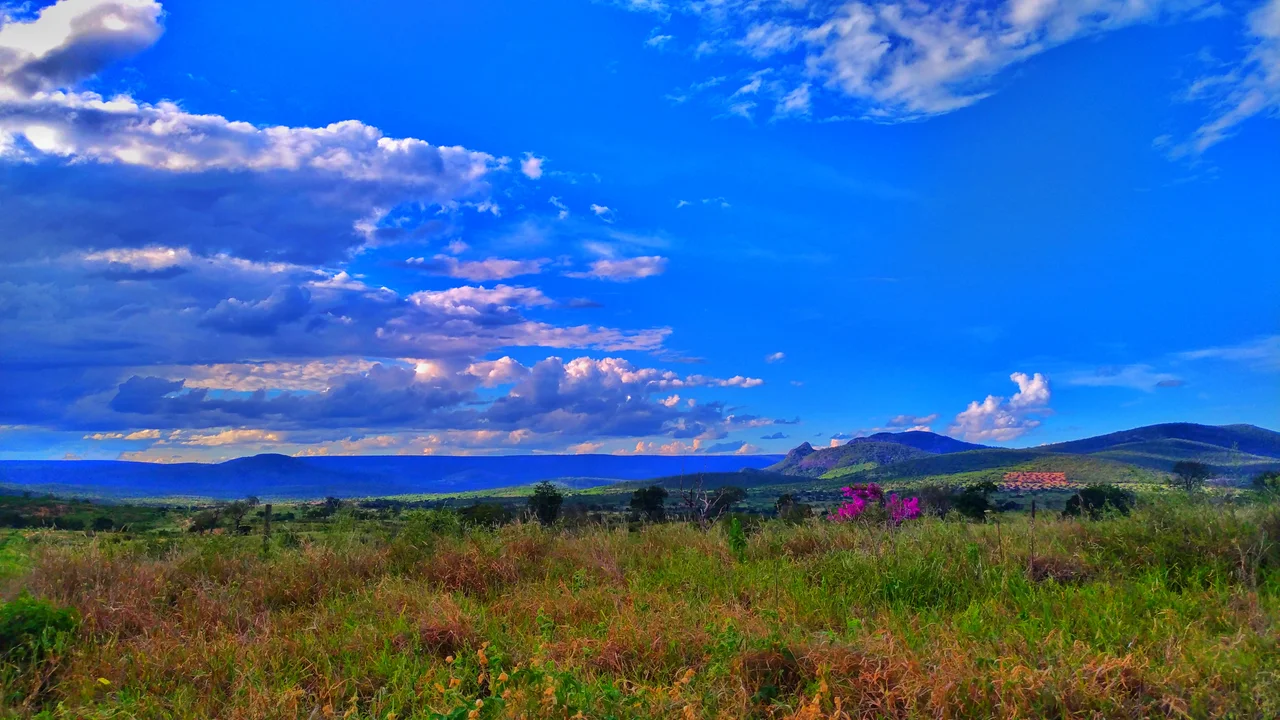

Jequitinhonha River
For ninety years, beginning around 1740, most of the diamonds mined in the world came out of one river valley. Slaves stood in the shallows of the upper Jequitinhonha, washing gravel in wooden pans, and the stones they found passed through Diamantina and up the colonial supply lines to Lisbon and London. The peak faded by 1830. What the river carries now is different. At 1,090 kilometers from its source in the Espinhaço Mountains to its mouth at Belmonte on the Atlantic, the Jequitinhonha flows through a valley that holds about a million people, some of Brazil's best-known folk ceramics, and economic statistics that have become shorthand in national politics for rural hardship.
A Source in the Mountains
The river rises at 1,200 meters elevation near Diamantina, in the Espinhaço range of Minas Gerais, and flows north, then east-northeast across a high uplands. It drops to the coastal plain at Salto da Divisa, where the Cachoeira do Salto Grande falls 43 meters in a single step. The river is joined along the way by the Araçuaí, the Piauí, the São Miguel, the Itacambiruçu, the Salinas, the São Pedro, and another São Francisco, not to be confused with the larger river to the north. By the time the Jequitinhonha crosses into Bahia and opens into the Atlantic at Belmonte, it drains an area of roughly 85,000 square kilometers, a basin larger than Ireland.
Diamonds, Then Decline
The diamond rush that began around 1740 made Diamantina, the town above the upper Jequitinhonha, one of the wealthiest in colonial Brazil. Alluvial gravels in and near the river held stones in remarkable concentration, and the Portuguese Crown reorganized its monopoly specifically to exploit them. Enslaved Africans and their descendants did most of the labor, standing in the water in conditions that were brutal even by the standards of colonial Brazil. By the mid-nineteenth century, South African diamond fields had come on line and cheaper stones flooded the market. Drought in the valley, and the exhaustion of the richer gravels, finished what South Africa had started. The mineral wealth left. The communities that the wealth had built stayed.
The Valley and Its Art
The Jequitinhonha Valley is known across Brazil for its ceramic figures and dolls, shaped in local clay and fired in domestic kilns. These are not tourist souvenirs in origin; they are a living tradition carried by artists, many of them women, whose work has been collected by major Brazilian museums. The valley also holds the Festival of Our Lady of the Rosary of the Black Men in Chapada do Norte and a parallel festival in Minas Novas, religious celebrations rooted in the syncretism of Catholic devotion with the traditions of the enslaved Africans who built so much of the regional culture. João Guimarães Rosa set parts of his fiction here, drawing on the landscape's distinctive character. The valley has its own cuisine, its own dialects, its own songs.
A Name for Hardship
By the mid-twentieth century, the Jequitinhonha Valley had become a national shorthand for rural poverty. The state development authority CODEVALE was founded in 1964 to address it. The results were mixed at best. Eucalyptus monoculture was pushed onto land the old farming communities had worked for generations, displacing people and, according to many residents, degrading the soils and water tables. Development policy came and went, decade after decade, often with consequences the residents had not been asked about. The valley's population is about one million people across roughly eighty municipalities. Diamantina, the old diamond town, is still the largest, with 47,702 people in 2022. The majority of the valley lives in rural areas.
New Water, New Ore
The Irapé Dam on the middle Jequitinhonha, between Berilo and Grão Mogol, was completed in 2006. Its power station, named the Usina Presidente Juscelino Kubitschek after the Minas Gerais statesman, has an installed capacity of 360 megawatts and regulates the river against the floods it periodically produced. The dam also displaced thousands of families, many of them from traditional communities whose claims to their land were not documented in ways federal agencies could easily recognize. The social costs are still being argued. More recently, lithium mining has opened in the valley as global demand for battery materials climbs, offering new income and raising familiar questions about who benefits and who lives downstream of the tailings. The river that once gave Europe its diamonds is, once again, carrying a commodity the rest of the world wants.
From the Air
The Jequitinhonha River flows 1,090 km from its source at 18.18°S, 43.62°W near Diamantina in the Espinhaço Mountains (1,200 m elevation) to its Atlantic mouth at Belmonte, Bahia (approximately 15.85°S, 38.86°W). The river makes an excellent linear navigation reference. Best viewing between 5,000-8,000 ft AGL to appreciate the valley's scale and the contrast between upper mountainous terrain and lower coastal plain. The Salto Grande falls at Salto da Divisa (43 m) and the Irapé Reservoir between Berilo and Grão Mogol are dramatic visual landmarks. Nearest major airports include Diamantina's Juscelinão Kubitschek (SNDT) upstream and Ilhéus (SBIL / IOS) near the coast.
Nearby Stories
- Porto Seguro 39 km away
- Serra das Lontras National Park 76 km away
- SS Principessa Mafalda 103 km away
- Mata Escura Biological Reserve 179 km away
- Vitória da Conquista 179 km away
- Nanuque 239 km away
- Battle of 4 May 266 km away
- Praia do Forte 372 km away