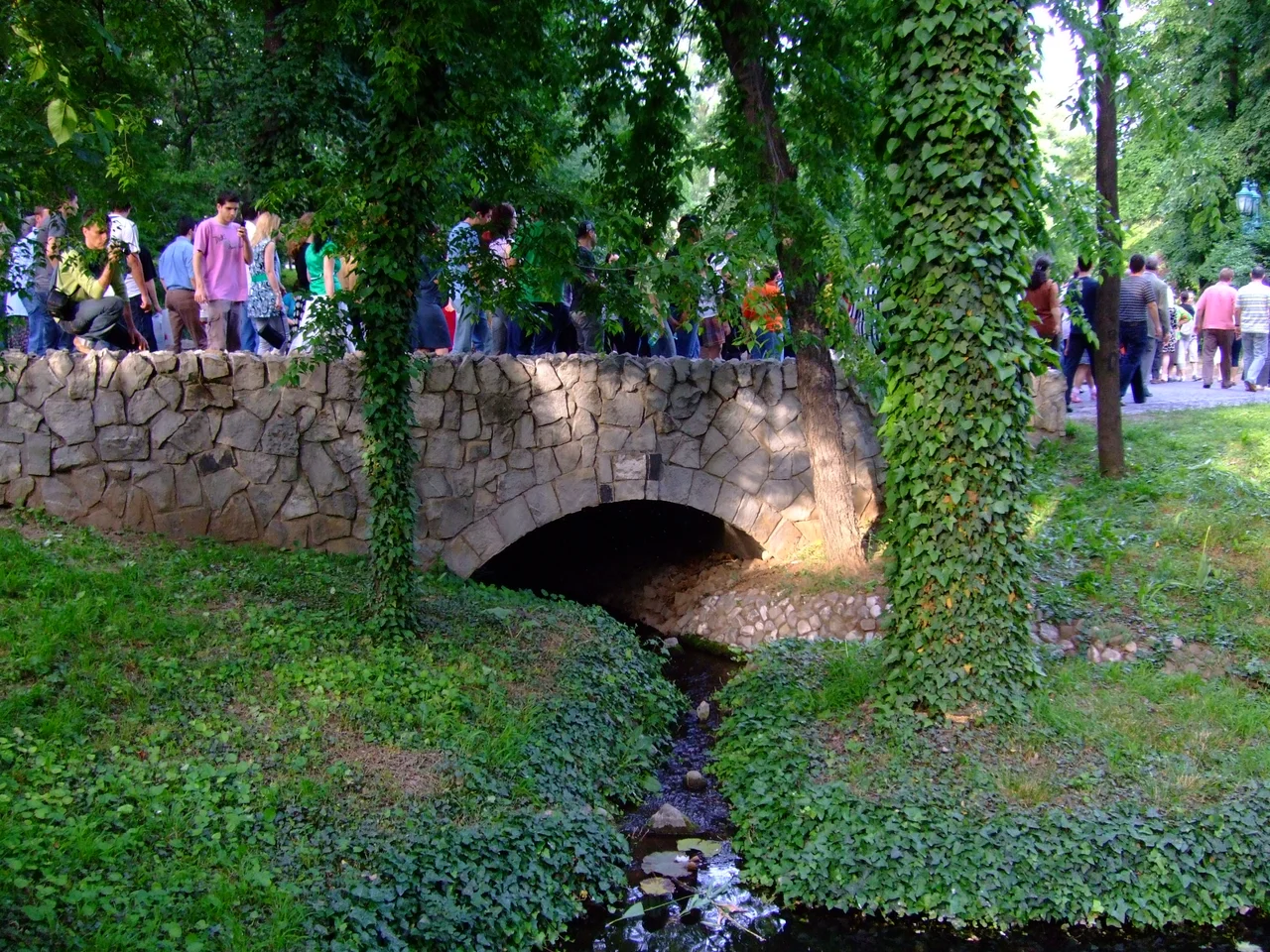

Cotroceni Palace
There is a hill in western Bucharest called Cotroceni, and on its slope a palace has stood in some form since 1679. Romania's rulers have used it for almost three and a half centuries. Princes built a monastery there. A king tore the monastery down and put up a French-architect-designed palace in its place. Queen Marie redecorated half of it in her own taste. The communist government turned it into the Pioneers' Palace and let around a thousand objects walk out the door. Ceaușescu used the building as a guest house. Since 1991 it has been the official residence of the President of Romania, and the rooms not in active state use are open to the public as the National Cotroceni Museum. To walk through it is to walk through every Romanian regime of the last three centuries, in order, with the wall coverings to prove it.
From Monastery to Royal Palace
Serban Cantacuzino, the Wallachian prince who reigned from 1678 to 1688, built a monastery on Cotroceni Hill in 1679, the first year of his rule. The hill had previously held an old wooden hermitage. Cantacuzino's monastery was completed in 1682 and became a frequent stop for pilgrims and a regular subject for chroniclers. For two centuries afterward, Cotroceni was the residence of various Romanian rulers and their guests, with the monastery at its heart. In 1883 King Carol I, the Hohenzollern prince who had taken the Romanian throne in 1866 and led the country to independence in 1881, decided he wanted something grander. He took possession of the residences on the hill, ordered them demolished, and commissioned the French architect Paul Gottereau to design a new palace meant to house the future heirs to his throne. Construction began in 1893.
Marie's Palace
When Carol's nephew Ferdinand inherited the throne in 1914, his English wife Marie made Cotroceni her own. She was a granddaughter of Queen Victoria on one side and of Tsar Alexander II on the other, raised between Eastbourne and Coburg, and she arrived in Romania in 1893 as a teenager and never left. She was, by every account from the period, formidable. She redecorated the palace's function rooms to her taste, requested a north wing extension to house the maids of honor and adjutants in duplex apartments, and oversaw the architect Grigore Cerchez's additions through the 1920s, including a Grand Reception Hall and several gazebos and loggias. Many of the rooms still preserve her decorative choices. The Royal Dining Room, designed by Cerchez in the Neo-Romanian style, features a Neo-Byzantine round table that Marie designed herself. The Flowers Room, formerly the Golden Salon, retains her gilded stucco floral decoration. Her art collection is on display throughout the museum sections of the building.
The Pioneers' Palace
King Michael I abdicated under communist pressure on December 30, 1947. Within a few months the new government had decided what to do with the royal palaces. On June 18, 1948, the Council of Ministers ruled that Cotroceni Palace, with its five buildings, 150 rooms, and park, would be passed to the state and administered by the Ministry of Interior. About a thousand objects, paintings, sculptures, icons, furniture, rugs, draperies, dishes, and decorative pieces, were promptly removed by a special commission. Some went to other state ministries. Some disappeared. The palace was repurposed as Palatul Pionierilor, the Pioneers' Palace, where children of the Romanian Workers Party were trained in chess, miniature aircraft, automobiles, radio, photography, painting, choreography, dance, history, and ceramics. Workshops were carved out of former apartments. Plaster ornaments were knocked down or covered with clay and paint. Stucco columns were perforated for electrical wiring. Marie's German-style living room and Golden Salon were destroyed. Ferdinand's dormitory was completely dismantled. In 1976 Ceaușescu transferred the building again, this time to the State Protocol agency to use as a luxury guest house for visiting foreign dignitaries.
After 1989
The Romanian Revolution of December 1989 ended the Ceaușescu regime in a few violent days. In 1991 the new government made Cotroceni Palace the headquarters of the Romanian Presidency, and the older portions of the complex were opened to the public as the National Cotroceni Museum. Restorers spent years undoing the damage of the communist decades, recovering what they could of the original Carol I and Ferdinand-Marie interiors. The collection now numbers around twenty thousand objects across plastic arts, decorative arts, numismatics, medals, history, and archaeology. Highlights include Sevres, Meissen, and Kuznetzov porcelain in the ceramics collection, Marie's Neo-Byzantine table service in glass, Bukhara and Sumak Shirvan carpets in textiles, and works by the painters of the early-twentieth-century Artistic Youth society Marie patronized. On August 6, 2025, the palace hosted the lying-in-state of former president Ion Iliescu, the first president of post-communist Romania, who had died days earlier. The visiting hours run Tuesday through Sunday. The classic guided tour lasts an hour. The complete one runs a hundred minutes and includes the medieval cellars and the chapel of the original monastery, which is still where it always was.
From the Air
Located at 44.4341 N, 26.0617 E in western Bucharest, on Cotroceni Hill in Sector 5. Recommended viewing altitude: 2,000 to 3,000 feet AGL. Visual landmarks include the Carol Davila University of Medicine and Pharmacy directly adjacent and the enormous Palace of the Parliament about three kilometers east. The Dambovita River runs nearby. Nearest airport is Henri Coanda International (LROP), about 17 km north. Restricted airspace: as the working presidential residence, expect protected-airspace constraints around the palace; consult current notams before any low-level approach.
Nearby Stories
- National Transport Museum, Bulgaria 34 km away
- Slanic Mine 68 km away
- Sinaia 79 km away
- Great Basilica, Pliska 87 km away
- Sinaia Monastery 108 km away
- Holy Forty Martyrs Church, Veliko Tarnovo 115 km away
- Shumen Fortress 126 km away
- Danube Delta 227 km away