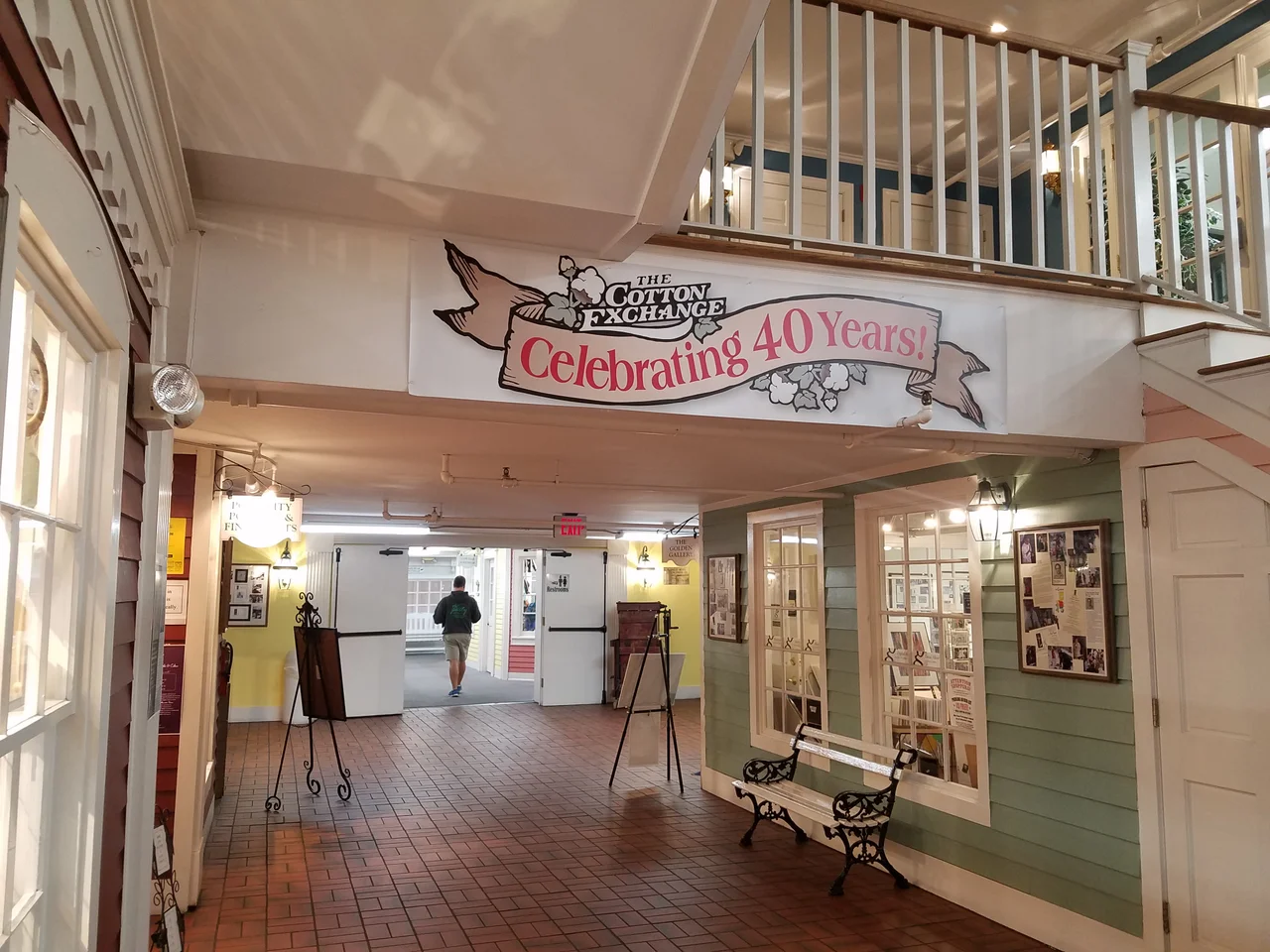

Cotton Exchange of Wilmington
The wooden beams overhead are 40 feet long, hand-hewn, two centuries old, and they still show the adze marks where someone shaped them by hand. The walls are made in places of old ship's ballast: stones brought across the Atlantic in the bellies of empty cargo ships, dumped on Wilmington's docks, then mortared into the foundations of warehouses that handled cotton, corn, peanuts, and flour. The Cotton Exchange survived because in 1974, when the wrecking crews were already scheduled, two local partners bought the buildings for $242,416 and decided to renovate instead. The complex they opened in 1976 is one of the earliest examples of historic adaptive reuse on the East Coast.
The Cotton the Name Recalls
The Cotton Exchange takes its name from one of its component buildings: the Old James Sprunt Cotton Exchange, which until its dissolution in 1950 claimed to be the largest cotton exporter on the East Coast. That trade did not happen in a vacuum. The cotton that moved through Wilmington's wharves in the 19th century was grown by enslaved African Americans on plantations across eastern North Carolina, and after Emancipation by Black sharecroppers and tenant farmers locked into the systems that replaced slavery without quite ending its economic logic. Sprunt's success, and Wilmington's status as a major cotton port, were built on that labor. The buildings still stand, beautifully restored, with the small brass plaques that tell their architectural history. The plaques do not always say where the cotton came from or who picked it. The buildings carry that history whether anyone reads it in the plaques or not.
The Block on Nutt Street
Most of the buildings in the original Cotton Exchange complex sat on a stretch of what was then Nutt Street, now North Front Street, in numbers 308 through 316. Each had a working life. 308-308½ was a wholesale grocer and warehouse for the Boney and Harper Mill, the dominant industry on the block. 310½ held flour by 1900, though it had begun in 1893 as part of an outdoor beer garden next to a saloon. 310-312 was a two-story boarding house and saloon by 1886, after the original three-story mariner's saloon on that spot burned in the fire of February 21, 1886. By 1900 the building was owned by Cooper Wholesale Grocers, who used it to shell and clean peanuts. 314 housed a steam engine that powered the Boney and Harper mill next door, running until 1915. 316 was the Boney and Harper Hominy and Corn Mill, founded around 1886, which by 1912 was reportedly the only mill of its kind east of Tennessee, producing 4,000 bushels of pearl hominy, grits, and corn meal a day.
The 1974 Rescue
By the 1970s, downtown Wilmington was in real trouble. The Atlantic Coast Line Railroad had moved its headquarters to Jacksonville, Florida, in 1960, taking a major chunk of the city's economy with it. The Wilmington Redevelopment Commission's response was to start tearing buildings down. Demolition ran $21 per square foot. Renovation cost $26 per square foot. Demolition was cheaper, so demolition was the policy. By 1974, several blocks were gone and the eight buildings of what is now the Cotton Exchange were scheduled to come down next. They were being used as furniture storage. Two general partners, J.R. Reaves and M.T. Murray, bought the lot from the Redevelopment Commission and pulled it off the demolition list. They toured Charleston, Savannah, Atlanta, and San Francisco for ideas. What they came back with was a plan to keep most of the original structures intact, expose the old beams and ballast walls, and rent the spaces to small shops and restaurants. They called it a Historic Adventure in Trade.
What's There Now
The Cotton Exchange opened in 1976 and was already winning preservation awards in its first year, from the North Carolina chapter of the American Institute of Architects and the North Carolina Preservation Society. It brought more than 200 jobs to a downtown that had been shedding them for fifteen years. Jean and John Bullock bought the complex in 1990 and continue to own it. The buildings now hold more than twenty independent shops and restaurants. Paddy's Hollow, a restaurant occupying what was a 19th-century pub and brothel, is one of several spots where the building's history shows through the renovation. The customs house lamps that Reaves and Murray installed at the entrance in 1976, salvaged from Wilmington's old federal customs house, still light the way in. The complex stands as a kind of proof that the alternative to demolition is sometimes simpler than it looks: keep the building, rewire it, and let the next century in.
From the Air
The Cotton Exchange sits at 34.240 N, 77.949 W on the Cape Fear riverfront at the north end of downtown Wilmington, along North Front Street. From 1,500-3,000 feet AGL the complex reads as a cluster of low brick warehouses one block in from the river, between Walnut and Grace streets. Wilmington International (KILM) lies about 5 miles north.
Nearby Stories
- Ocean Isle Beach house fire 4.7 km away
- Pender County, North Carolina 6.6 km away
- Bald Head Island 13 km away
- Marine Corps Base Camp Lejeune 16 km away
- Lake Waccamaw, North Carolina 17 km away
- The Robesonian Takeover 59 km away
- Swansboro 59 km away
- Mercury-Redstone 4 726 km away