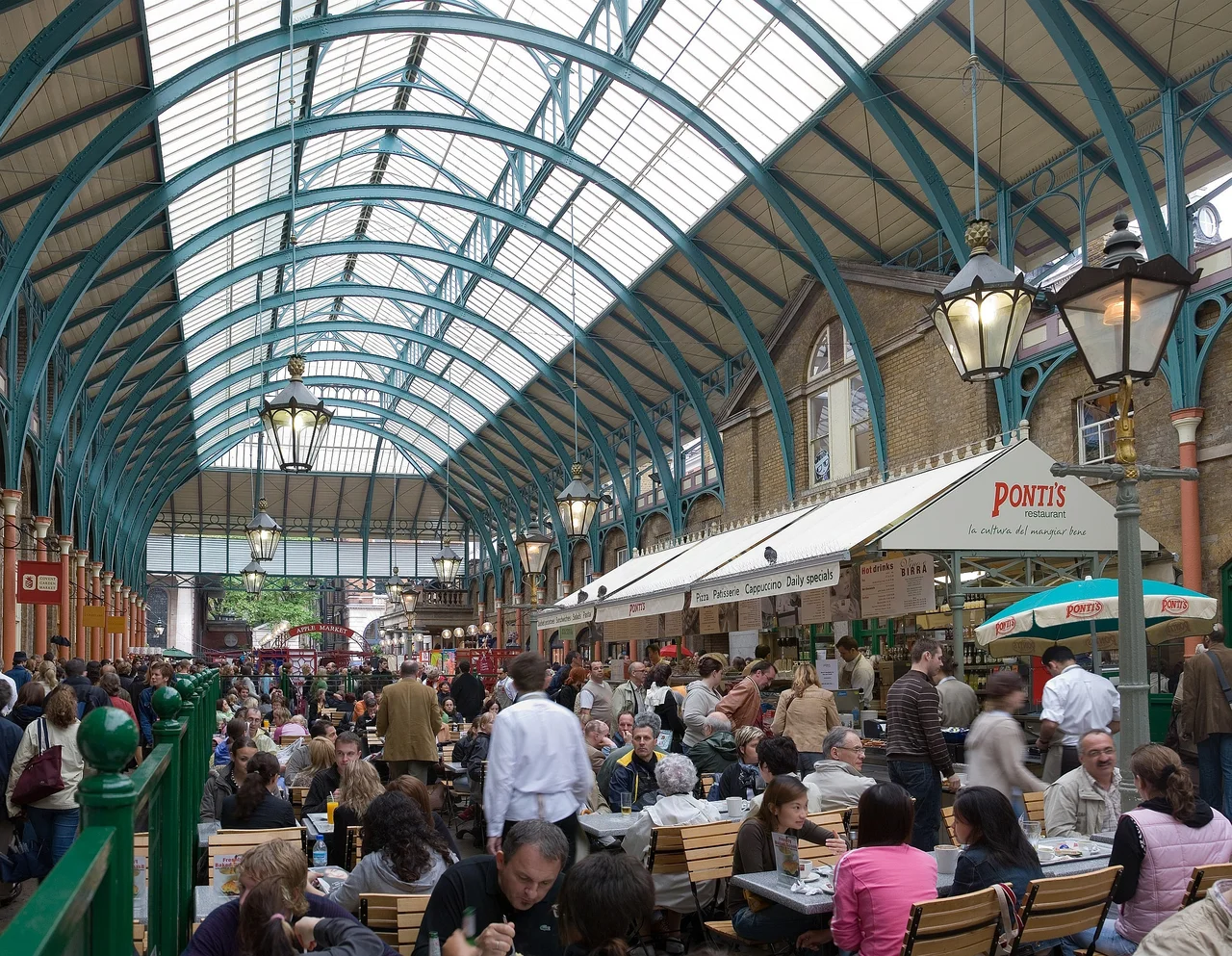

Covent Garden
The name is older than London likes to admit. "Covent" is Anglo-French for a religious community, equivalent to convent or monastery. Before there was a piazza, before there were street performers and Apple Stores, this was a forty-acre walled garden belonging to the Benedictine monks of Westminster Abbey, growing fruit, grazing pasture, sitting quietly behind a high wall between modern St Martin's Lane and Drury Lane. In 1515 the Abbey leased it out and the document called it "a garden called Covent Garden." By 1540 the monks were gone, the garden was crown property, and a piece of London was about to begin its strangest transformation.
Inigo Jones Builds a Square
In 1630 Francis Russell, 4th Earl of Bedford, paid Charles I £2,000 for a licence to build "as many new houses on his land as he shall thinke fitt." The king had grown irritated by the dilapidated state of Long Acre and used the situation to extract a fee from the wealthy. Russell commissioned Inigo Jones to design a church and three terraces of fine houses around a large open square. The result, completed by 1637, was the first modern square in London, a flat piazza with low railings inspired by the squares of Italy. St Paul's Church, the actors' church, was the first building, begun in July 1631. Seventeen of the houses had arcaded portico walks, which became known as the Piazza, the name eventually transferring to the whole development. London town planning was changed forever by this one experiment.
The Casual Market
By 1654 something less elegant had appeared. Traders had set up wooden stalls against the garden wall of Bedford House, selling produce informally. The wealthy residents began to leave. In 1670 Charles II granted the Earl of Bedford a charter to hold a market every day except Sundays and Christmas, and the casual market became permanent. The wooden stalls grew into a disorderly warren that lasted nearly two centuries. Charles Fowler's elegant neo-classical hall, the one that still stands, was built in 1830 to bring order. More buildings followed: the Floral Hall, the Charter Market, the Jubilee Market in 1904. The cheese sellers, fruiterers, and flower girls who worked these halls became part of London's identity. Eliza Doolittle, George Bernard Shaw's flower girl in Pygmalion, was selling here in fiction; thousands of real women were doing exactly the same.
Harris's List
The eighteenth century turned Covent Garden into a notorious red-light district, the central hub of London's sex trade. Harris's List of Covent Garden Ladies, published annually from the 1750s, was a directory of prostitutes with descriptions of their appearance, location, and prices, marketed as "the essential guide and accessory for any serious gentleman of pleasure." Working women like Betty Careless and Jane Douglas became famous in their own right. The district was also home to early coffee shops, with Old Slaughter's running from 1692 to 1843, and to the Sublime Society of Beef Steaks, a club co-founded in 1736 by the artist William Hogarth. Newspaper adverts of the period reveal another reality: enslaved Africans lived and worked here, sometimes runaways. A 1746 notice describes "Sarah," a young enslaved woman who fled her mistress Mary Vernon at Fisher's Warehouse on Tavistock Street, branded on the shoulder with the initials I and V, her humanity reduced to property in the language of the time.
The Move to Nine Elms
By the 1960s the market had outgrown its home. The streets could not handle the lorries. Lorries could not handle the streets. Redevelopment of the whole estate was proposed, and most of the historic buildings around the square would have been flattened. In 1973 the Covent Garden Community Association mounted such effective protests that the Home Secretary Robert Carr gave dozens of surrounding buildings listed status, blocking demolition. The market itself relocated in 1974 to New Covent Garden Market at Nine Elms, about three miles southwest. The old halls fell silent. Then in 1980 they reopened, transformed: cafes, pubs, small shops, an Apple Market for crafts, the Jubilee Hall selling antiques. In 2010 the world's largest Apple Store at the time opened in the Piazza. The peppercorn rent for the head lease is one red apple and a posy of flowers, paid annually.
Theatres and Pepys
Covent Garden has 13 theatres in a square mile. The Royal Opera House, originally Theatre Royal, was built here in 1732 for Edward Shepherd. Handel's first season of operas began the year after it opened. The current building dates to 1858, the third on the site after fires in 1808 and 1856. The Theatre Royal, Drury Lane traces back to 1663, making it the oldest continuously used theatre in London. Mozart never appeared in Covent Garden, but Nell Gwyn did, and David Garrick, and Edmund Kean, and the comedy troupe Monty Python who recorded a concert album there. Street performance has continued for centuries. In May 1662 Samuel Pepys recorded in his diary the first mention of a Punch and Judy show in Britain, performed in this square. Today licensed buskers still audition for slots in the North Hall, West Piazza, and South Hall Courtyard, the last reserved for classical music. The market may have moved to Nine Elms, but Covent Garden never stopped putting on a show.
From the Air
Located at 51.5125 degrees N, 0.1225 degrees W between Charing Cross Road and Drury Lane, just north of the Strand. The area is visible from the air as a dense block of restored Victorian and Georgian buildings centred on the rectangular Piazza with Fowler's central hall. Nearest airport: London City (EGLC) about 6 nm east. Best viewed from 1,500 to 3,000 feet over the West End.
Nearby Stories
- Stevenage 5.7 km away
- Malling Abbey 5.7 km away
- 1952 Farnborough Airshow Crash 7.7 km away
- Ingatestone Hall 8.2 km away
- Hellfire Caves 9.1 km away
- The Carrington Event: The Solar Storm That Could Happen Again 9.8 km away
- Bletchley Park 16 km away
- Castle Hedingham 23 km away