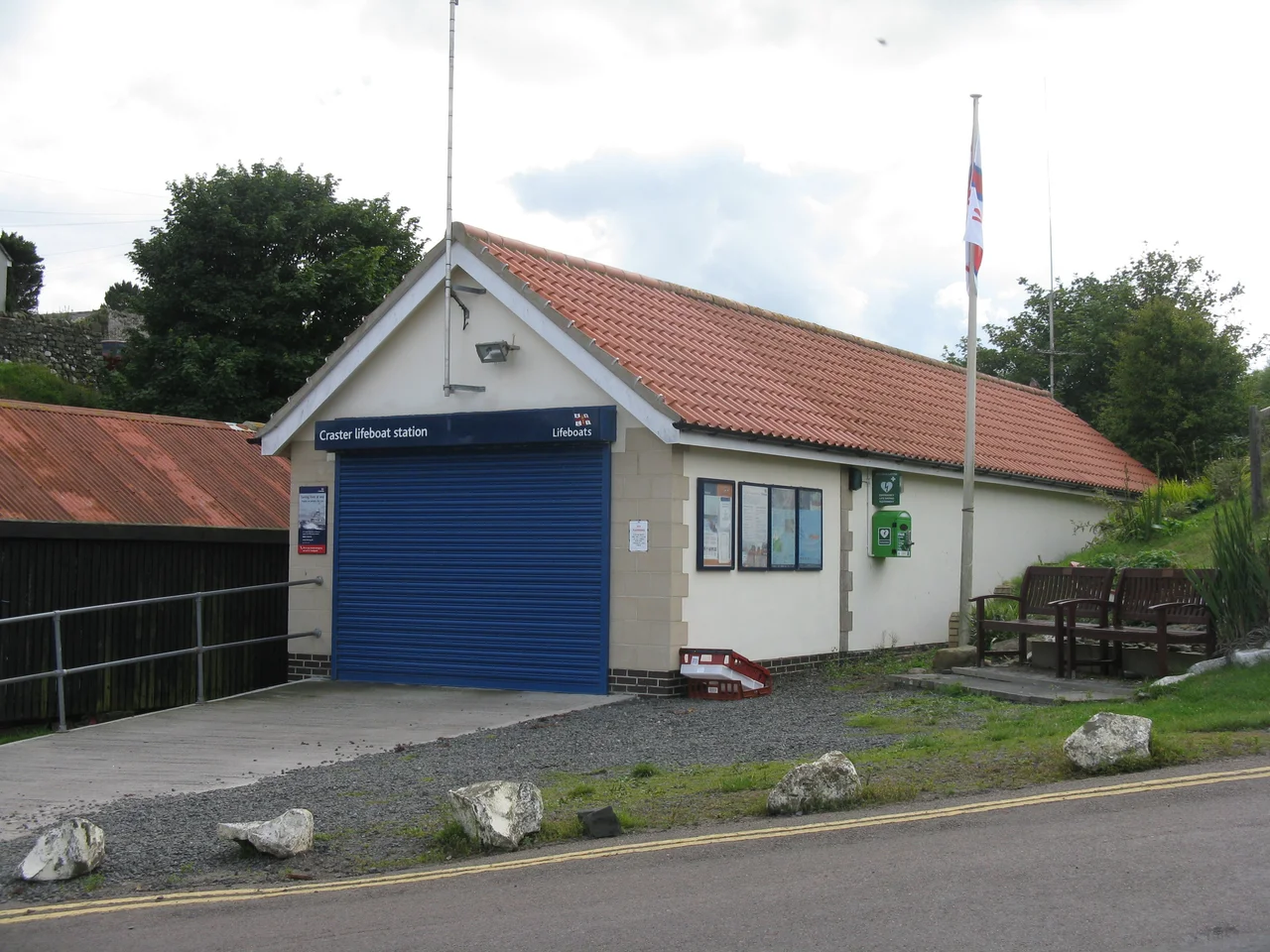

Craster Lifeboat Station
On a July afternoon in 1977, the stage and screen actress Joyce Grenfell, perhaps best remembered as Police Constable Ruby Gates from the St Trinian's films, sat in the small harbour village of Craster on the Northumberland coast and signed autographs to raise money for the local lifeboat. The fete around her raised one thousand five hundred and thirty-one pounds that day. Sixteen of those pounds came from her own signatures. The Craster Lifeboat Station was eight years old at the time, a recent addition to the RNLI's network of fast inshore lifeboats, and it ran almost entirely on small fundraising events like this one. The boat she helped fund kept the village's volunteer crews on the water for two more decades.
A New Kind of Lifeboat
In 1964 the Royal National Lifeboat Institution made a calculated bet on the future of leisure sailing. They placed twenty-five small fast inshore lifeboats at strategic points around the British coast. The boats were inflatable, light enough to be launched by a small team in a few minutes, and ideal for the kind of incident that had begun to fill the institution's call logs as more amateur sailors took to the water. Five years later, in August 1969, Craster received its own inshore lifeboat, the unnamed D-130. The station has operated continuously since then, although the boats themselves change every few years. D-130 was replaced in 1975 by D-228, then by AB-One in 1999, then by the current boat in 2019. Each one a little newer, a little faster, designed for the same kind of inshore work that the original prototypes were built to do.
The Day at Newton Haven
On Saturday 1 May 1982 the Craster lifeboat was called at 11:10 in the morning to a fishing boat at Newton Haven, four miles north. The crew of the fishing boat had tried to row their dinghy ashore in gale-force-seven conditions and the wind had driven them onto the rocks. An RAF Search and Rescue helicopter was scrambled as well, but Helm Neil Robson decided he could reach the men before the helicopter could winch them off. With three men aboard, he manoeuvred the inshore boat into the surf between the rocks and pulled them off, landing them in Newton Haven Bay. By 12:40, with the same crew and the same boat, he was launched again, to a different emergency: a man reported in the water at the same spot after another dinghy had capsized. They could not find him. The lifeboat beached at Newton Haven and Robson learned, with some relief, that the man had already made it to shore on his own. He and crewman Keith Williams were each presented with framed letters of thanks signed by the chairman of the RNLI.
The Youngest Person to Name a Lifeboat
In 1999 a new lifeboat arrived at Craster, funded by John Bagley. Bagley had raised over sixteen thousand pounds through a series of lectures and presentations about his own adventures sailing the British Steel Challenge round-the-world yacht race. At the naming ceremony, his grandson Adam Bagley, aged two and a half years, christened the boat AB-One, and became the youngest person ever to name an RNLI lifeboat. The fact reads now as a small, slightly absurd piece of charity history, the sort of thing that lifeboat stations tell new volunteers in the boathouse on a quiet evening. The boat itself served Craster for twenty years, until the present lifeboat, Skpr James Ballard RNVR DSC, arrived in 2019.
Captain Ballard and the Trawler
The current Craster boat, D-839, was named at a ceremony on 12 October 2019. The name commemorates Captain James Ballard of the Royal Naval Volunteer Reserve, who held the Distinguished Service Cross for his command of an armoured trawler that captured German sailors off the north-east coast of Scotland during the First World War. The boat was funded from the legacy of Charles B. Campbell. Ballard would probably not have recognised the inflatable that now bears his name. The principle, however, has not changed: small boats, crewed by volunteers, going out from a small harbour to do what they can. Craster's herring smokehouse, which has perfumed the harbour with hot oak smoke for more than a century, sits a few yards from the lifeboat house, and the same families have often worked in both.
From the Air
Craster Lifeboat Station sits at 55.47 degrees north, 1.59 degrees west, on the Northumberland coast about 8 miles north-east of Alnwick. From the air the small harbour, the stone breakwaters, and the basalt cliffs of the Whin Sill running south to Cullernose Point provide clear visual references. The ruins of Dunstanburgh Castle stand about a mile and a half north. Newcastle International (EGNT) is roughly 40 miles south. Best viewing at lower altitudes in clear conditions, when the harbour, the surrounding rocky coast, and the path north to Dunstanburgh are all visible together.
Nearby Stories
- Ashington 1.8 km away
- Cheviot Hills 3.4 km away
- Battle of Nesbit Moor (1402) 12 km away
- Hadrian's Wall Path 18 km away
- Berwick-upon-Tweed Lifeboat Station 27 km away
- Saltburn Pier 68 km away
- German submarine U-2367 84 km away
- Alexander L. Kielland (Platform) 271 km away