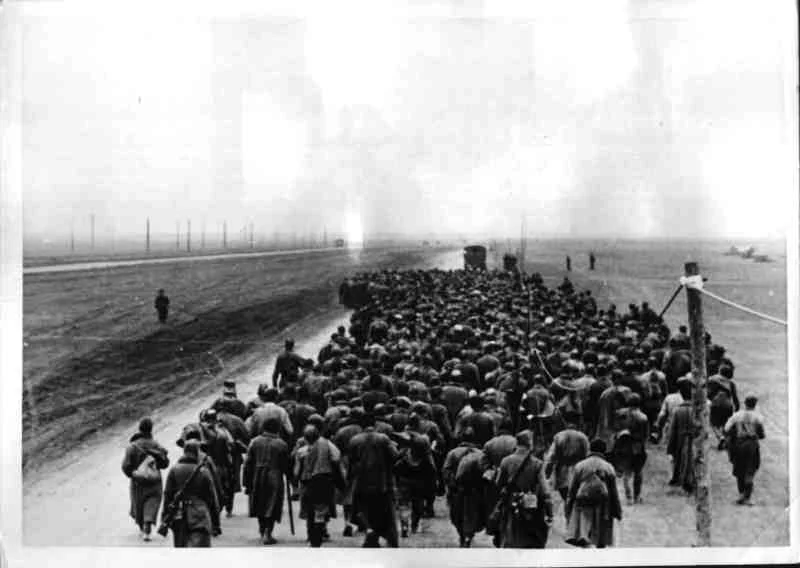

Crimean Campaign
When Sevastopol finally fell on 4 July 1942, a handful of Soviet soldiers refused to accept it. Their commanders had already been flown out or slipped away by submarine, the inner defenses were breached, the city was lost - and still, for five more days, these last men held out in caves beyond the city, fighting on until the 9th. Their stubbornness was the closing note of a siege that had lasted 250 days, the longest and bloodiest ordeal of the Second World War's struggle for Crimea. The peninsula, that warm diamond of resorts and vineyards, had become one of the eastern front's grimmest battlegrounds.
The Axis Turns South
The campaign opened on 26 September 1941, part of the vast German invasion of the Soviet Union known as Operation Barbarossa. Germany's 11th Army, joined by the Romanian Third and Fourth Armies, pushed onto the peninsula against the Soviet 51st Army and elements of the Black Sea Fleet. The Axis offensive routed the defenders and swept across Crimea - but two cities would not fall easily. Kerch, in the east, changed hands more than once. And Sevastopol, the great naval fortress on the southwest coast, became the obsession of the whole campaign. For its long resistance the Soviet government would later crown it a Hero City, one of the highest honors the state could bestow on a place and the people who defended it.
A City Under the Gun
Sevastopol was first assaulted on 30 October 1941 and threw the Germans back with a counterattack. Reinforced by troops evacuated from besieged Odessa, the defenders held through renewed attacks in November and December, each one broken, sometimes at the last possible moment. Frustrated, the Germans hauled in extraordinary firepower - among the artillery brought to bear was Schwerer Gustav, an enormous railway gun, one of the largest ever built, firing shells that could shatter fortifications from miles away. Against such weapons the defenders endured through the winter and into summer. Only at the end of June did German forces finally penetrate the inner defensive lines, and on 4 July the city surrendered - after eight and a half months in which ordinary soldiers and sailors had absorbed everything a modern army could throw at them.
A Duel at Sea
The fighting was not confined to land. In the dark early hours of 6 November 1941, the Romanian submarine Delfinul, under Constantin Costachescu, torpedoed and sank the Soviet cargo ship Uralets a few miles south of Yalta. What followed was a nerve-shredding escape: Soviet forces hunted the submarine relentlessly, and the crew slipped along the Turkish coast, enduring as many as eighty depth charges - each one a jolt through the hull, each one a chance the boat would not survive - before finally reaching the Romanian port of Constanta the next day. It was a small episode in a huge war, but it captures the whole theater in miniature: the Black Sea itself contested inch by inch, survival often a matter of nerve and luck as much as strength.
The Long Way Back
Sevastopol's fall opened three years of German occupation across Crimea - a hard time for the peninsula and its peoples. The reckoning came in 1944. From 8 April to 12 May, the 4th Ukrainian Front drove the Axis out in a swift, powerful offensive built from a series of linked operations that had begun the previous autumn at Kerch and Eltigen and ended at Sevastopol's own walls. In a matter of weeks, the Soviets undid what had taken the Germans eight months and a monstrous siege to achieve. The peninsula that had been so bitterly defended, then lost, then occupied, was reclaimed. Behind the shifting front lines and operation names lies the older truth of all such places: the ground was won and lost in the lives of the people who fought over it.
From the Air
The campaign ranged across the whole Crimean Peninsula, centered near 44.933 N, 34.100 E. Its focal point, Sevastopol, sits on the deeply indented southwest coast - its complex natural harbor is the standout landmark from the air, best appreciated from about 4,000-6,000 feet. To the north, the flat land pinches to the narrow Perekop isthmus, the peninsula's land gateway; to the east lies the Kerch Strait. Simferopol (UKFF) is the main regional airport, roughly in the peninsula's center.
Nearby Stories
- Juma-Jami Mosque 2.8 km away
- Kokkoz Jami Mosque 11 km away
- Taigan Safari Park 16 km away
- Kalamita Bay 19 km away
- Russian Battleship Ekaterina II 39 km away
- Battle of Eupatoria 44 km away
- Aeroflot Flight 6515 63 km away
- 1976 Anapa Mid-Air Collision 226 km away