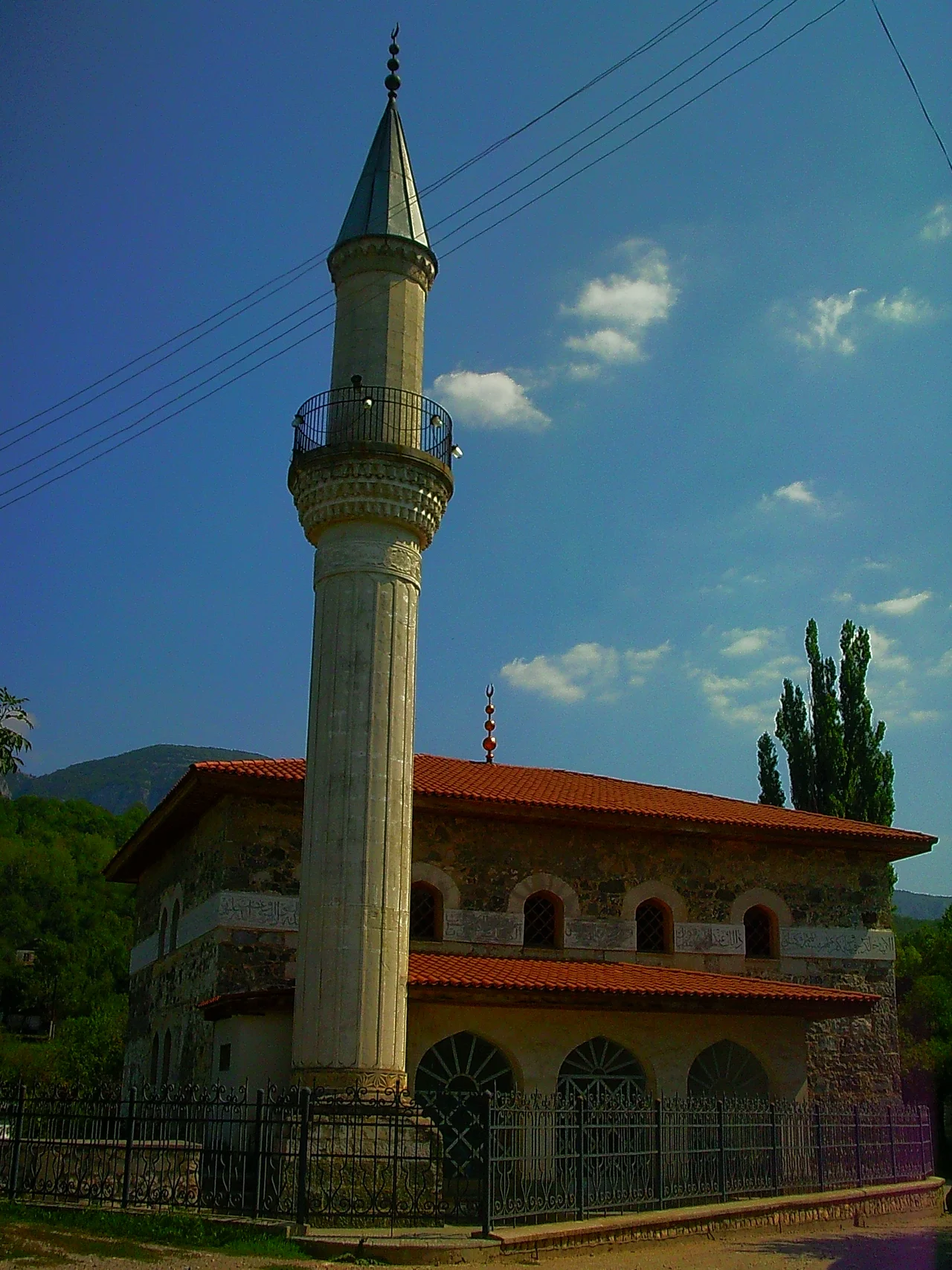

Kokkoz Jami Mosque
In a green mountain valley in southwestern Crimea sits a village whose name means falcon. The Crimean Tatars call it Kökköz; the Ukrainian and Russian names carry the same meaning, and today it appears on maps as Sokolyne. At its heart stands a mosque with a curious origin story: it was paid for not by the Muslim community that prayed in it, but by an Orthodox Christian prince, one of the wealthiest men in the entire Russian Empire. The Kokkoz Jami Mosque, still known as Yusupov's Mosque, is a monument to an unlikely gesture of patronage across the boundaries of faith.
A Prince's Gift Across Faiths
The mosque was built in 1910 under the patronage of Prince Felix Yusupov, whose family fortune was legendary even by the standards of the Russian aristocracy. To design it, he turned to Nikolay Krasnov, the same architect behind the imperial Livadia Palace on the coast. The mosque rose near Yusupov's mountain hunting lodge, in a valley he clearly loved. At the start of the twentieth century it had become fashionable among the Russian nobility, overwhelmingly Orthodox Christian, to fund the building of mosques in Crimea, and Yusupov, one of the empire's richest men, appears to have followed the trend. Whatever the motive, the result was a graceful house of worship gifted to a Crimean Tatar community by a prince who did not share their religion.
Arabic Inscriptions and Falcon Light
The building itself is a rectangular structure of the basilican type, its lines more austere than ornate. Its walls carry inscriptions in Arabic and are pierced by two tiers of lancet windows, their pointed arches drawing the mountain light into the prayer hall. Overhead runs a roof of clay tile, warm against the green of the surrounding hills, and beside the main building rises a slender minaret. There is a quiet harmony to the design, the work of an architect more accustomed to imperial palaces turning his hand to a village mosque. In the falcon valley of Kökköz, the mosque became both a spiritual center and a small architectural jewel.
Silenced Under Soviet Rule
The mosque's fortunes turned sharply in the twentieth century. In 1930 the Soviet authorities closed it and turned the sacred building into a warehouse. After the Second World War it was pressed into service as the village clubhouse and cinema, its prayer hall filled with the flicker of film reels rather than the murmur of worship. The regime even drew up plans to demolish its minaret, a common fate for religious architecture under Soviet rule, but for reasons lost to record, that demolition was never carried out. The tower survived, standing over a building stripped of its purpose, waiting through the long decades for the community it had been built to serve to return.
The Long Road Home
That community had been torn away. In 1944 the Crimean Tatars were deported en masse from their homeland, a forced exile that scattered families across distant regions and cost many their lives. Only decades later, after 1990, were the survivors and their descendants able to begin coming home. Among the first things they sought was the return of their mosque. Their petition to reclaim the building was finalized in 1997, restoring Yusupov's Mosque to the people it was made for. Since then it has been carefully renovated and kept in fine condition. Standing once more as a place of prayer, the mosque in the valley of the falcon is a testament to endurance, a building that outlasted the silencing, and a community that outlasted the exile.
From the Air
Located at 44.550 degrees N, 33.960 degrees E, in the village of Sokolyne (Kökköz) in the Crimean Mountains, southwest of Bakhchysarai. Best viewed from around 3,000 to 5,000 feet, where the mosque's minaret and clay-tiled roof stand out in the green mountain valley below the Ai-Petri ridge. The nearest major airport is Simferopol (UKFF), roughly 40 km to the northeast.
Nearby Stories
- Crimean Campaign 18 km away
- Taigan Safari Park 25 km away
- 1988 Black Sea Bumping Incident 27 km away
- Kalamita Bay 29 km away
- Russian Battleship Ekaterina II 36 km away
- Novyi Svit Winery 47 km away
- Januarius MacGahan 357 km away
- Abkhazia 545 km away