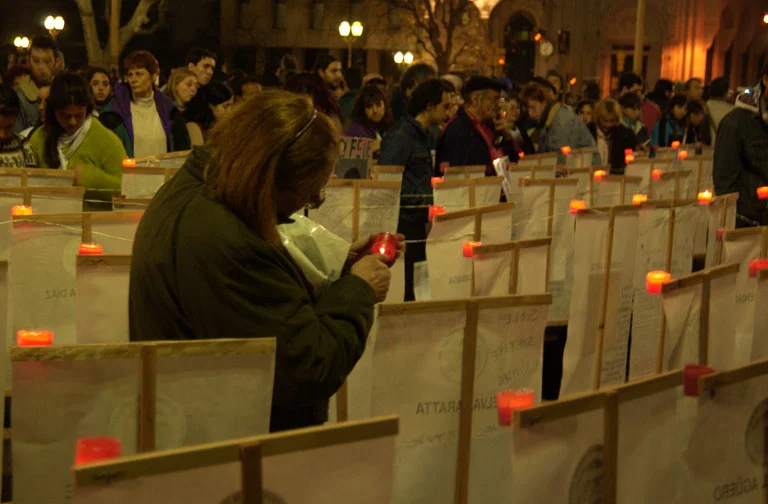

Cromañón Nightclub Fire
They came to hear a rock band on the last Tuesday of 2004, three days before New Year's. Most were teenagers and people in their twenties, the kind of crowd that fills a hall with sweat and noise and the sense that the year ahead belongs to them. Some had brought their small children and left them in a back room a few of the parents had turned into a makeshift nursery. By the time the night was over, 194 of them were dead and 1,492 were injured, and Argentina had a wound that has never fully closed. The people of Buenos Aires do not call what happened at República Cromañón an accident. They call it a massacre.
The Last Tuesday of the Year
República Cromañón was a concert venue on Bartolomé Mitre street in Balvanera, run by the entertainment promoter Omar Chabán. On the night of 30 December 2004 the band Callejeros was playing - the same band that had opened the club eight months earlier. The hall was packed far beyond what it should have held. Somewhere in the crowd, a fan lit a pyrotechnic flare, the kind sold cheaply for New Year's celebrations across Argentina. Both Chabán and the band's singer had warned the audience not to set off flares indoors. Someone did anyway. The flare struck a shade sail of polyester netting strung beneath the ceiling, and the netting caught.
A Building Built to Kill
The fire would have been survivable in a safer building. This was not a safer building. The ceiling materials were flammable - wood, styrofoam, acoustic panels, polyester - and in places the insulation was nothing more than teddy-bear stuffing used as a cheap substitute for proper wool fiber. The netting melted as it burned and fell on the crowd as a rain of fire. Worse than the flames was the smoke: investigators later found the toxic air would have reached cyanide concentrations high enough to kill within minutes, a poison one expert compared to a gas chamber. And there was almost nowhere to run. Of the six front doors, four were locked. One emergency exit was chained shut; another was blocked by a fence in front of the stage. Of fifteen fire extinguishers, ten were empty and useless. The club's fire-safety license had expired the month before. People died not because they could not move fast enough, but because the doors that should have saved them had been sealed against them.
The Names Behind the Number
It is easy to let a figure like 194 stay a figure. The reality was a generation of a neighborhood gone in a single night. Rescuers pulling people from the smoke found teenagers and young adults, and then, devastatingly, they found children and babies from the room their parents had used as a nursery so they could watch the show. In the days that followed, families walked through morgues to identify sons and daughters. President Néstor Kirchner declared three days of national mourning. Across the city, nightclubs went dark. Pope John Paul II sent his condolences to the grieving. But for the mothers and fathers and the survivors who carried burns and grief out of that hall, no decree could answer the question of why the exits had been locked at all.
A Reckoning, and a Vow
The grief turned into a demand for accountability that reshaped Argentine public life. Investigators found that Cromañón had been overdue for inspection since November and that the city's entire safety-inspection system was broken. The mayor of Buenos Aires, Aníbal Ibarra, was ultimately removed from office through impeachment over the failures. Omar Chabán was sentenced to twenty years in prison; after appeals, members of the band were convicted as well, and in all some eighteen people were jailed. Argentina rebuilt its nightlife safety culture from the ground up. Today, 194 trees stand planted in memory of the dead, and the families who survived - organized under the cry 'Que No Se Repita,' that it never happen again - keep their children's names alive. Two decades on, Buenos Aires still gathers each 30 December to remember a night when the music stopped and the doors would not open.
From the Air
The site of República Cromañón stands at 34.609 degrees south, 58.410 degrees west, on Bartolomé Mitre street in the dense Balvanera neighborhood of central Buenos Aires, a few blocks west of the National Congress. This is tightly packed urban grid, best understood from the air by the nearby Congress dome and the broad sweep of Avenida Rivadavia. The nearest airport is Aeroparque Jorge Newbery (ICAO: SABE) on the Río de la Plata, about 6 km northeast; Ministro Pistarini International Airport at Ezeiza (ICAO: SAEZ) lies roughly 24 km to the southwest. This is a place of mourning rather than a sight to seek out - a quiet point on the map worth a moment's reflection on those who were lost.
Nearby Stories
- Ezeiza Massacre 1.9 km away
- Luján, Buenos Aires 5.1 km away
- Curutchet House 13 km away
- Colonia del Sacramento 17 km away
- Martín García Island 28 km away
- Atucha Nuclear Power Plant 37 km away
- Lobos 43 km away
- Cry of Asencio 87 km away