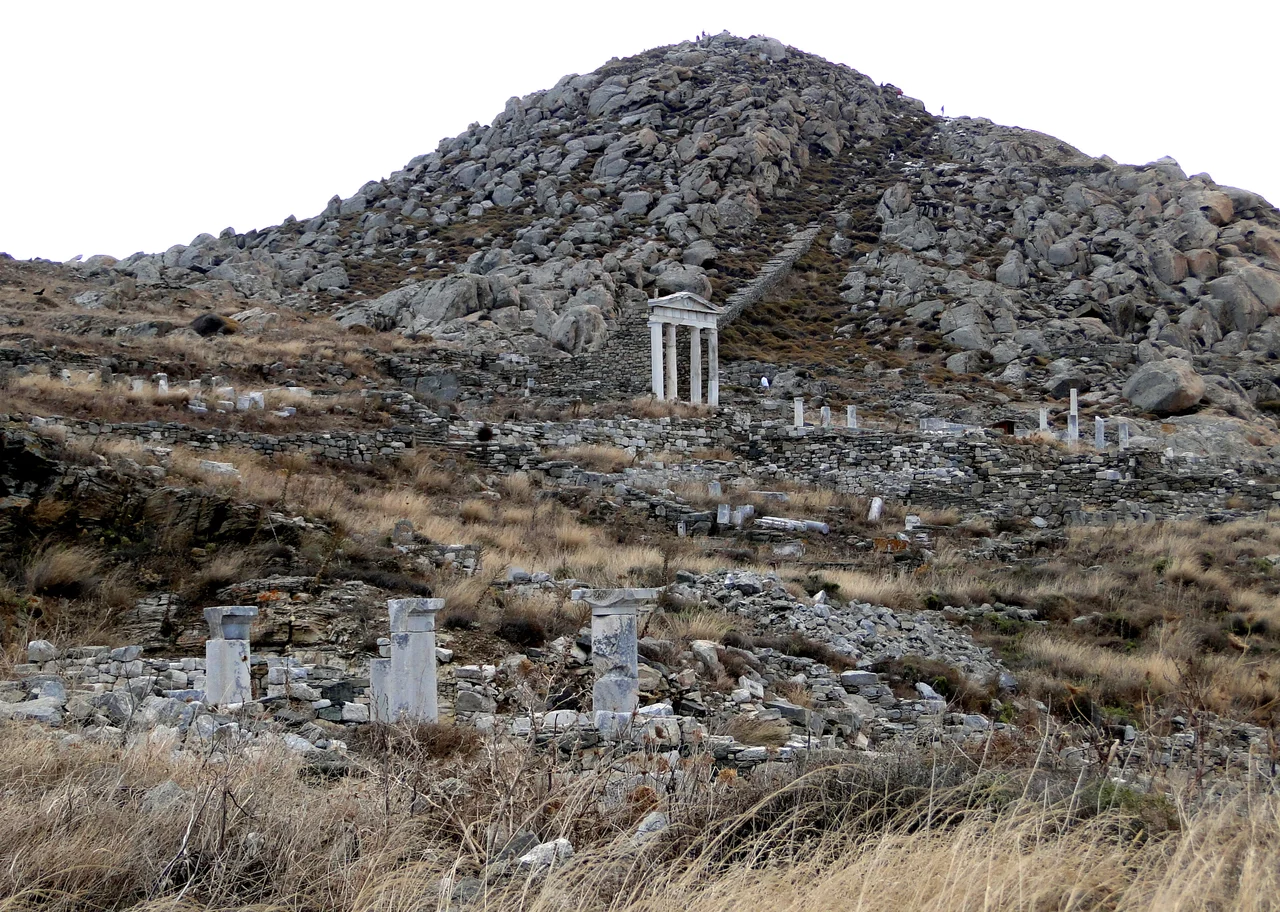

Mount Cynthus
The name Cynthia comes from here. So does Cynthius. Two of the most enduring epithets in classical mythology — names still given to children two and a half millennia later — derive from a bare granite hill on a small island that rises no more than about 120 metres above the Aegean. Mount Cynthus is not dramatic by the measure of mountains. What it is, mythologically, is the most important peak in the ancient Greek world: the hill upon which Leto, exhausted and homeless and shunned by Hera's jealousy, finally gave birth to Apollo and Artemis. The god of light and the goddess of the hunt were born on Delos, and they carried this hill's name forever after.
Where the Gods Were Born
The myth is straightforward in its cruelty before it becomes triumphant. Leto, pregnant with Zeus's children, was driven from land to land by Hera's wrath — no stable ground would receive her, because Hera had forbidden any place touched by the sun to give her refuge. Delos was different. The island was a wanderer itself, unanchored and floating, and so not technically subject to the ban. Delos received Leto. She gave birth on the slopes of this granite hill — Apollo first, then Artemis, in some tellings — and the island was thereafter sacred. Apollo became Cynthius; Artemis became Cynthia. The name was later applied to Selene, the moon goddess, through her association with Artemis, and from there to Diana in the Roman tradition. English poetry of the Renaissance kept the name alive for centuries. Today it survives as Cynthia, a woman's given name in use across the English-speaking world, carrying without knowing it the memory of a birth on a rocky hill in the Cyclades.
The Acropolis of Delos
Mount Cynthus probably served as the acropolis of the ancient city of Delos — its high ground, defended and significant. Ancient accounts describe a wall running around it. Two staircases once led to the summit: one from the north, one from the west. The western side preserves an ancient gate, its roof formed by two stones leaning against each other at a shallow angle, spanning more than sixteen feet. On the summit, the foundations and scattered column fragments of a large Ionic-order building remain. What that building was is not entirely clear. What is clear is that the hill was treated as a place apart — elevated, bounded, reached by formal paths. Marble fragments lie across its slopes, testifying to structures that have been quarried and carried away over centuries.
The Theatre and the Temples
Below the hill, the ancient city of Delos arranged itself across the terrain. The theatre stood at the western foot of Mount Cynthus, facing the nearby island of Rheneia, not far from the Stoa of Philip. Its marble seats are long gone — carried away for building material over the centuries — but the stone substruction that supported them remains, and the semicircular form of the orchestra is still readable. The theatre's diameter, including its distinctive extended projections, measured 187 feet. Partway up the hillside, in a small valley leading toward the summit, archaeologists found the remains of what appears to have been a temple of Isis: an altar dedicated by a priest named Ctesippus, inscribed with bulls' heads and festoons, accompanied by inscriptions mentioning Sarapis, Anubis, Harpocrates, and the Dioscuri. Delos was a cosmopolitan place — a trading hub where Egyptian, Greek, and Roman religious traditions overlapped in the same sacred landscape.
The View from the Summit
Mount Cynthus sits at the nominal centre of the Cyclades archipelago, and from its summit the claim becomes visible. On a clear day — and clear days are common in the Aegean — the innermost islands of the Cyclades are all in view: Mykonos to the northeast, Naxos and Paros to the south, Syros to the west, Rheneia close by to the west. It is a panorama that explains why Delos mattered. The island sits where the Aegean's geometry converges, equidistant from the arc of islands that surround it. Ancient sailors could navigate by it. Ancient merchants could gather at it. Ancient pilgrims could make their way to it from any direction across the sea. The view from the granite summit makes the logic plain: this small, sacred, resource-poor island commanded the centre of a world.
Delos Now
No one lives on Delos today. The island is an open-air archaeological museum, managed as a UNESCO World Heritage Site, accessible by boat from Mykonos. Visitors walk among the ruins of sanctuaries, houses, warehouses, and temples — the remains of one of the ancient Mediterranean's great sacred and commercial centres. Mount Cynthus rises above all of it, still bare, still granite, still offering the same panoramic view it offered to the pilgrims who climbed it two thousand years ago. The marble is gone, mostly. The gods their mother named after this hill are everywhere: in the museums, in the textbooks, in the given name that a grandmother in Ohio or Osaka or Johannesburg might still carry, unaware that its origin is a hilltop on an uninhabited island in the Greek Aegean.
From the Air
Mount Cynthus and the island of Delos lie at approximately 37.40°N, 25.27°E, roughly 2 kilometres west of Mykonos. The hill itself rises to around 120 metres and is the highest point on an otherwise low-lying island. From the air, Delos is visually distinct — densely marked by archaeological excavations, with no modern buildings or vegetation except scrub. The nearest airport is LGMK (Mykonos National Airport), approximately 6 kilometres to the northeast. Delos is accessible from Mykonos by regular ferry service; there is no airstrip on Delos itself. An altitude of 1,000–1,500 feet from the east gives an excellent view of the hill, the theatre below it, and the ancient harbour area to the west. The Sacred Lake — now dry — is visible as a shallow depression northeast of the central sanctuary. Overflight should respect any archaeological site protection zones.
Nearby Stories
- Panagia Ekatontapiliani 1.5 km away
- Panagia Kanala 15 km away
- Andros 30 km away
- HMHS Britannic 30 km away
- Kimolos 33 km away
- Amorgos 34 km away
- Ikaria 51 km away
- Emporio, Chios 71 km away