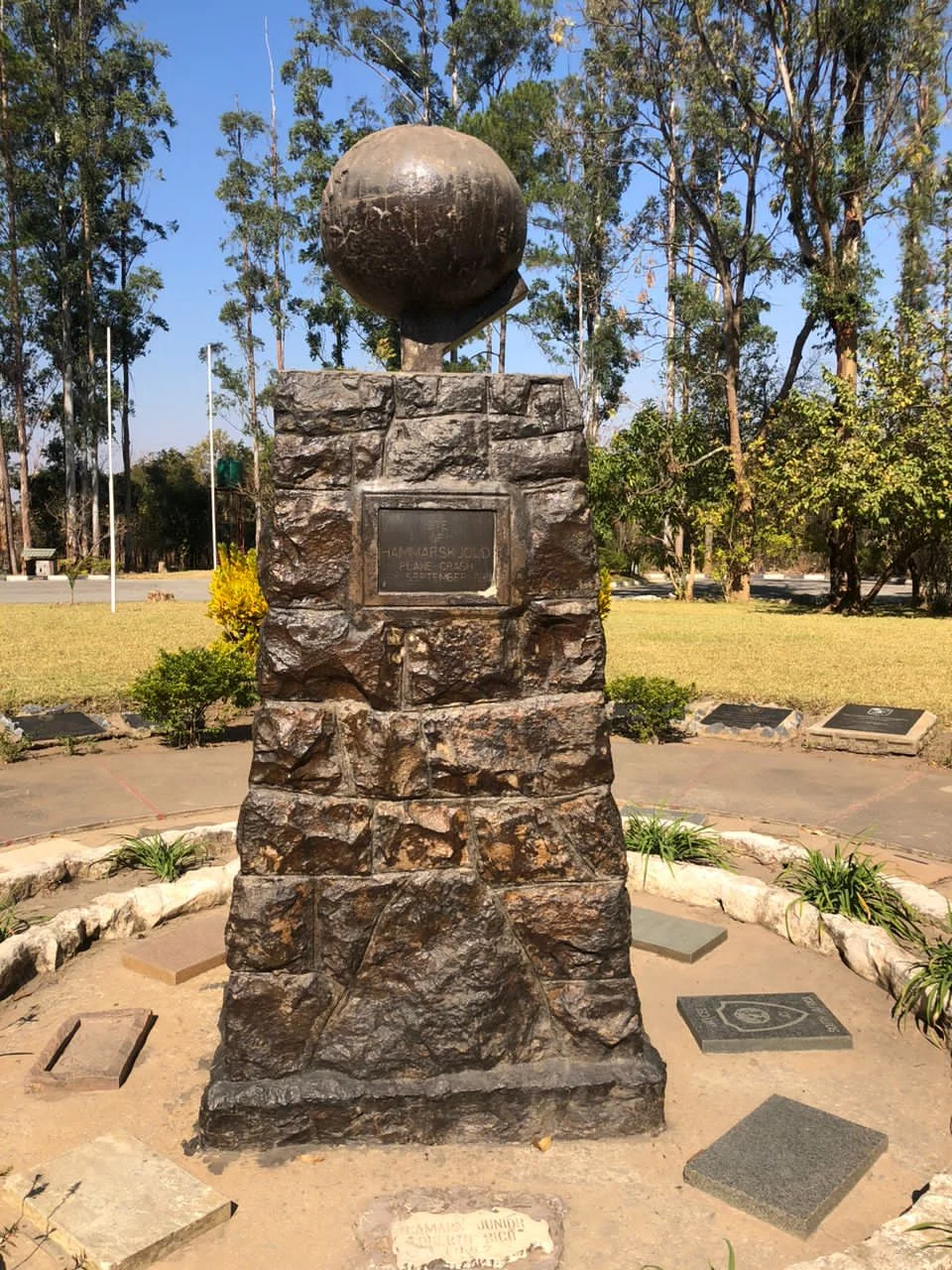

Dag Hammarskjöld Crash Site Memorial
At 00:13 local time on the morning of 18 September 1961, a Douglas DC-6B named Albertina disappeared from the sky above the Northern Rhodesian bush west of Ndola. Aboard was Dag Hammarskjöld, the second Secretary-General of the United Nations, flying in darkness toward a planned ceasefire meeting in the Katanga secession crisis. The aircraft came down in woodland near the Ndola airport, killing fifteen of the sixteen people on board. The sole survivor died of his injuries days later. A quiet memorial garden now marks the spot, 10 kilometers west-northwest of Ndola, with a cairn at its center and trees planted in a belt around a simple lawn.
Why He Was Flying
The Congo Crisis had been unfolding since the country's independence from Belgium in June 1960. Within weeks of that independence, the mineral-rich southern province of Katanga had declared its own secession, backed by Belgian mining interests and a contingent of white mercenaries. The UN Security Council authorized a peacekeeping operation - ONUC - and by 1961 UN forces were engaged in active fighting against the Katangan gendarmerie. Hammarskjöld was on his way to a meeting with Katanga's secessionist leader Moïse Tshombe, hoping to negotiate a ceasefire. The meeting was set for Ndola, inside Northern Rhodesia, just across the border from Katanga. The flight from Léopoldville (now Kinshasa) was deliberately routed long, via Luanda, to avoid Katangan airspace where the UN flight might be targeted by Katangan aircraft flown by European mercenary pilots.
What the Witnesses Saw
The Albertina never made its approach to Ndola. Ground controllers heard the crew acknowledge sighting the airport lights. Then silence. Search parties did not find the wreckage until the next afternoon, despite the crash having occurred within 15 kilometers of the airport. Several witnesses - charcoal burners and local villagers working near the crash site - reported hearing or seeing unusual things that night: a second aircraft in the sky, flashes of light, gunfire. Those accounts were collected by local authorities and have been re-examined repeatedly in the decades since. The official Rhodesian inquiry of 1962 concluded pilot error. A parallel UN inquiry in 1962 left the cause open. A Zambian inquiry in 2015 found that the existing evidence was incomplete and recommended further investigation. The question of what brought the Albertina down has never been closed.
The Investigation That Continues
In 2011, Swedish researcher Göran Björkdahl published findings from interviews he had conducted with witnesses near the crash site in the 2000s, along with his study of archival documents from the Katanga crisis. Björkdahl concluded that he believed Hammarskjöld's death was a murder, committed in part to protect the interests of mining companies such as Union Minière du Haut Katanga. That claim was controversial but helped push the UN to open a new inquiry, which continues to examine declassified documents and witness testimony. Subsequent UN reports have found that the possibility of foul play cannot be excluded. The cumulative weight of the evidence - witness accounts of another aircraft, the presence of mercenary pilots flying armed planes over Katanga, the strategic stakes of the Katanga mines, the anomalies in the approach - has kept the case alive. For the people of Zambia, the question is not merely academic. A man traveling on a peace mission died on their soil, and the truth about his death has been a long time coming.
The Memorial Garden
Zambia declared the crash site a national monument in 1970, under notice number 14 of that year. The Dag Hammarskjöld Foundation Committee, formed in 1964, shepherded the memorial's development. At the center is a cairn - a simple stack of stones - ringed by lawn and a planted belt of indigenous shrubs and trees. A small museum was built at the site and officially opened in 1981. It holds fragments of the Albertina and documents relating to Hammarskjöld's life, his work at the UN, and the Katanga crisis. A plaque unveiled by Secretary-General Kofi Annan in 2001, on the fortieth anniversary of the crash, marks the spot where Hammarskjöld's body was found. The memorial was added to UNESCO's World Heritage Tentative List on 11 June 1997 in the Cultural category.
Why He Matters Here
Hammarskjöld was Swedish, not Zambian. He died before Zambia existed as an independent state - Northern Rhodesia would not become Zambia until October 1964. Yet the memorial's location on Zambian soil has made his legacy part of Zambia's own story. The Dag Hammarskjöld Chair at the Copperbelt University extends his interest in peace and conflict into Zambian academic life. The memorial is a place of reflection for visiting diplomats, UN officials, and ordinary Zambians who come to stand beside the cairn in the quiet woodland. Hammarskjöld had once written that 'never measure the height of a mountain until you have reached the top. Then you will see how low it was.' He did not live to reach the top of his peace mission in Katanga. The garden where his journey ended is a place that honors both what he tried to do and the unanswered questions that remain about how it ended.
From the Air
Located at 12.98°S, 28.52°E, approximately 10 kilometers west-northwest of Ndola, Zambia, just south of Simon Mwansa Kapwepwe International Airport (NLA). NLA is the nearest airport and sits directly along the flight path the DC-6B was making on its final approach. From cruise altitude the memorial itself is too small to identify, but Ndola's urban footprint and the elevated Copperbelt plateau are clear reference points at roughly 1,270 meters elevation. The terrain is classic miombo woodland - rolling bushveld with scattered villages. The memorial sits on the Dag Hammarskjöld Memorial Access Road off the T3 (Ndola-Kitwe Dual Carriageway). Good VFR conditions prevail in the dry season (May-October).
Nearby Stories
- Chambishi 8.2 km away
- Kalulushi 9.2 km away
- Lake Kashiba 36 km away
- Congo Pedicle 43 km away
- Central Province, Zambia 98 km away
- Kasanka National Park 144 km away
- Zambezian flooded grasslands 173 km away
- Bangweulu Wetlands 177 km away