
Dáil Éireann
On 21 January 1919, twenty-seven men gathered in the Round Room of Dublin's Mansion House and declared themselves the parliament of a country that did not officially exist. They were Sinn Féin MPs who had been elected the previous December to seats at Westminster -- and had refused to take them. Instead they convened in Dublin, swore allegiance to an Irish Republic nobody else recognised (except, oddly, Lenin's Russia), and read out a Declaration of Independence in three languages. Within eight months the British had banned them, and they were forced to meet underground in safe houses. Today their successors -- 174 Teachtaí Dála, or TDs -- still meet under the unbroken numbering that runs from that First Dáil. The current parliament is the Thirty-Fourth.
Assembly of Ireland
The word dáil is gloriously ordinary in Irish: it just means a meeting, a tryst, an encounter of any kind. The men who chose the name in 1919 were making a point. The grand title of 'Parliament' belonged to the institution at Westminster they had abandoned; this new body would be something more rooted, more native. They had won 73 of Ireland's 105 seats in the 1918 general election on a manifesto promising exactly this: a 'constituent assembly comprising persons chosen by Irish constituencies as the supreme national authority'. Many of the elected members could not attend the first meeting. They were already in prison. The 27 who did show up read the names of the absent into the record with the words ar dteacht ('imprisoned by the foreigners'). The Dáil's translator that day was the young Eamon de Valera's lieutenant; de Valera himself was in Lincoln Jail in England, and was sprung two weeks later in an escape Michael Collins helped organise.
The Long Walk to Leinster House
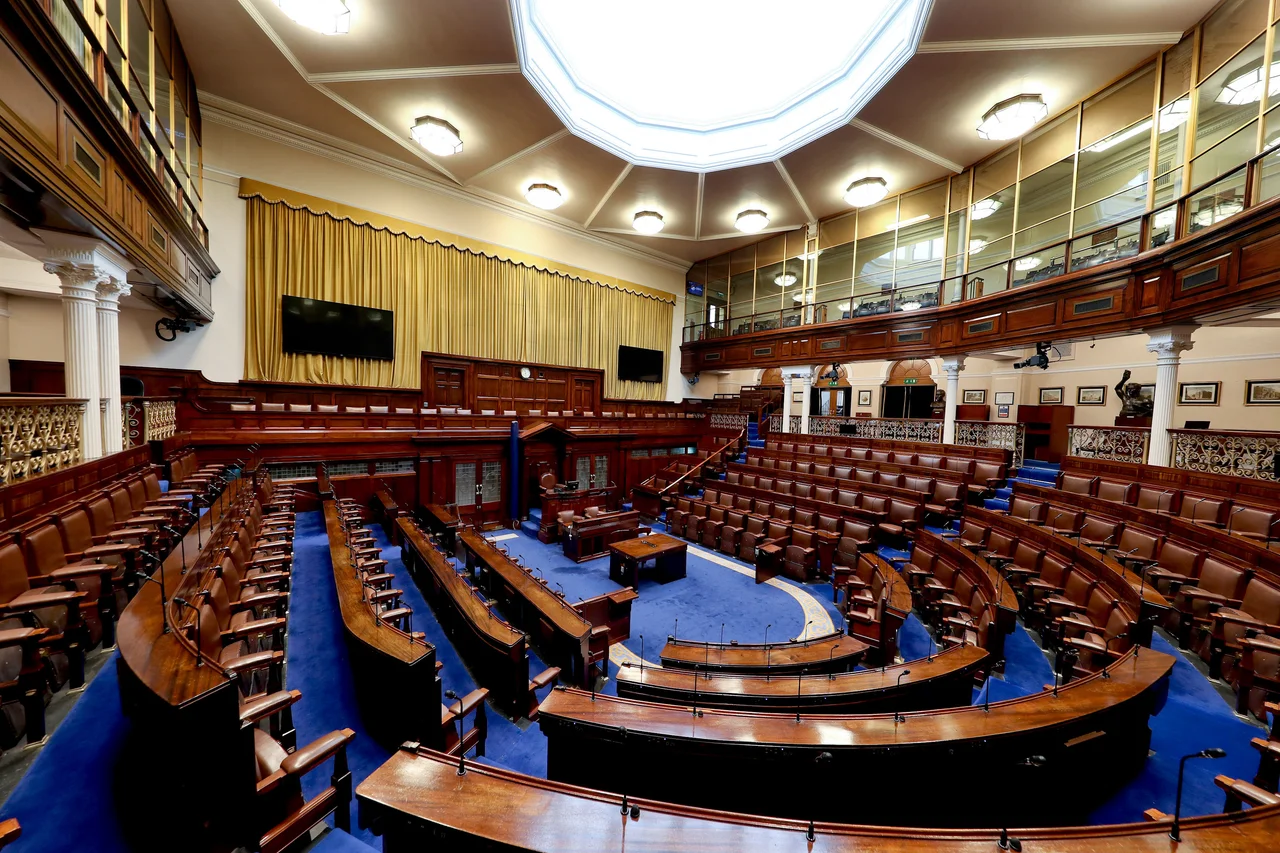
The First Dáil met in the Mansion House. The Second Dáil met wherever it safely could; the British had outlawed it, and meetings shifted between houses and offices as raids closed in. The Anglo-Irish Treaty of December 1921 ended the War of Independence, and on 6 December 1922 the Third Dáil convened as the lower house of the new Irish Free State -- this time in Leinster House, a Georgian townhouse on Kildare Street built in 1745 for the Earl of Kildare. The duke who built it had been told the south side of the Liffey was beneath him; he supposedly replied, 'Where I go, fashion will follow.' He was right. The Dáil has met in his old ballroom-turned-lecture-theatre ever since. The chamber's confrontational benches reflect its borrowed Westminster habits, but the curved end softens them into a partial hemicycle -- a small architectural compromise between two political traditions.
Tá and Níl
Voting in the Dáil still begins in Irish. The Ceann Comhairle -- the chair, currently the independent TD Verona Murphy -- puts the question, and members shout Tá or Níl (Yes or No). If anyone disputes the voice vote, the cry goes up: Vótáil! Division bells ring for six minutes around Leinster House, doors lock four minutes later, and TDs press electronic buttons at their desks. On the most contentious votes -- motions of no confidence, usually -- the Dáil reverts to physical division lobbies, members walking through Tá and Níl doorways to be counted. The chair's neutrality is fiercely protected: by tradition a sitting Ceann Comhairle is automatically re-elected to their constituency without contest. The list of words a TD may not call another TD is its own piece of folk literature: brat, buffoon, chancer, communist, corner boy, coward, fascist, gurrier, guttersnipe, hypocrite, rat, scumbag, yahoo. 'Handbagging' a female deputy was banned in 2009.
The Single Transferable Vote
Ireland chose its electoral system at independence and has refused to change it twice. Constituencies return three, four or five TDs apiece using PR-STV -- proportional representation by single transferable vote -- in which voters rank candidates and surplus votes from successful candidates transfer downward. The system rewards local effort. It also forces candidates to compete with running mates from their own party, a peculiarity that has produced both ferocious local service and accusations of parochial politics. Twice -- in 1959 and again in 1968 -- governments led by Fianna Fáil proposed switching to British-style first-past-the-post. Both times the electorate voted no. Coalition governments have been the norm since the 1990s; before then, single-party Fianna Fáil majorities ran the country for decades. The 2024 election expanded the chamber to 174 seats, the largest in its history, working out to one TD for every 29,593 people.
An Old Lecture Theatre
Visit Leinster House today and you sit in what was originally a lecture theatre, adapted in 1922 to do duty as the cradle of a nation. The Dáil typically sits Tuesday, Wednesday and Thursday when the Oireachtas is in session, with Wednesdays running from 9.12 in the morning until around 11.30 at night. Three hours each week are reserved for opposition motions designed to embarrass the government; the government, with the votes, almost always amends them into harmlessness. Debate happens mostly in English, but a TD may switch to Irish at any moment and often does. The Dáil controls everything important: it nominates the Taoiseach, approves ministers en bloc, passes the budget, ratifies treaties, declares war. The Seanad and the President are partners on paper; in practice the Dáil is where the country happens. The 27 men in the Mansion House in January 1919 would recognise very little of modern Ireland. They would probably recognise the row.
From the Air
Leinster House, seat of the Dáil, lies at 53.341N, 6.254W in the heart of Georgian Dublin, on Kildare Street between Merrion Square and St Stephen's Green. From altitude the building shows as a wide Georgian block at the centre of a tight grid of streets, flanked by the National Library and National Museum on either side. Trinity College's playing fields lie a few hundred metres north. Nearest airport: Dublin (EIDW), 9 km north. Recommended viewing altitude 1,500-2,500 ft AGL for the Georgian street grid.
Nearby Stories
- Wicklow Mountains 12 km away
- Mornington 14 km away
- German submarine U-1051 16 km away
- Abbey of Kells 18 km away
- Irish Military Intelligence Service 20 km away
- HMS Manners (K568) 37 km away
- Templemore 42 km away
- Irish Sea Bridge 43 km away