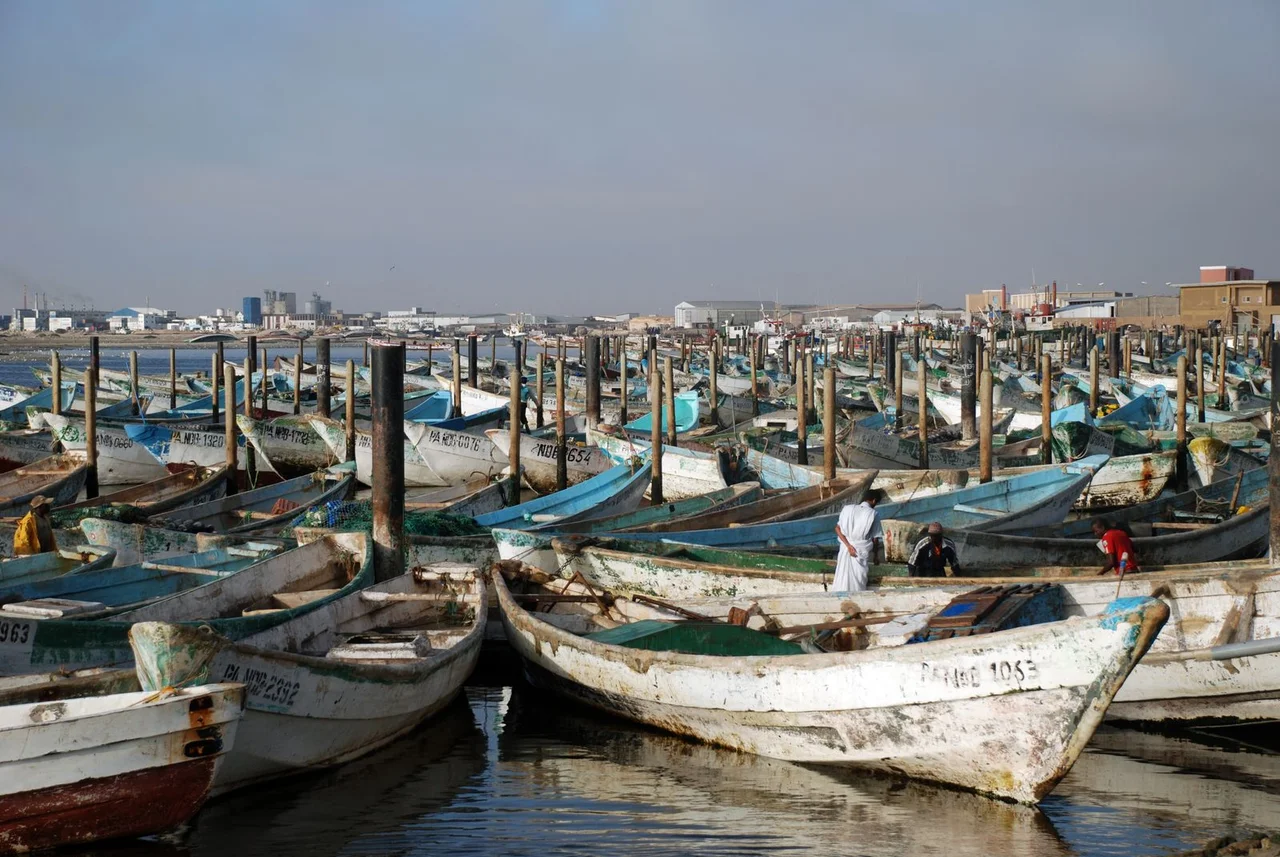

Dakhlet Nouadhibou Region
Look at a map of Mauritania's western edge and you will find a peninsula pointing south into the Atlantic like a thin grey finger, split lengthwise by a colonial border drawn more than a century ago. This is Cap Blanc, the heart of the Dakhlet Nouadhibou region, and almost everything about it lives in tension. Iron ore and fish. Desert and ocean. A booming port on one shore and, on the other, sea caves sheltering one of the rarest mammals on Earth. Nearly the entire region empties into a single city at the peninsula's tip; the rest is sand, sea, and silence.
Where the Desert Meets the Sea
Dakhlet Nouadhibou is the westernmost region of Mauritania, and almost all of it is desert. Average elevation hovers around 460 meters, but it is the coast that defines the place. The Bay of Arguin spreads along the western shore, and to the south lies the Banc d'Arguin National Park, a vast shallow stretch of tidal flats and islands that ranks among the most important bird sanctuaries on the planet. The region holds nearly all of Mauritania's islands, including Tidra, the largest. Rain barely falls here, perhaps a hundred millimeters a year near the Tropic of Cancer, and the temperature swings hard, baking by day and dropping toward freezing at night.
A City of Iron and Fish
Nearly 95 percent of the region's people, out of a population of roughly 184,000 (2023 census), live in Nouadhibou at the peninsula's northwestern tip. The city exists for two reasons, both pulled from the earth and the water. SNIM, the national mining company, runs one of the world's longest trains, more than three kilometers of ore wagons hauling iron from the interior mines down to the coast for export. The Atlantic supplies the other engine: the cold, fish-rich current off Cap Blanc makes this one of West Africa's great fishing grounds. Everything else, the sparse shoreline villages and the empty desert east, fades to almost nothing by comparison.
The Last Refuge of the Monk Seal
On the rocky western shore of Cap Blanc survives something the wider Mediterranean has nearly lost. The Mediterranean monk seal, one of the most endangered marine mammals in the world, maintains a true colony here in the sea caves of the peninsula. It is one of only two places on Earth where the species still gathers in colony numbers rather than scattered individuals. The colony nearly vanished, falling to around a hundred animals in the late 1990s, but sustained protection has brought it back; several hundred now haul out on these shores to rest, pup, and nurse. For a creature this close to extinction, Cap Blanc is not one refuge among many. It is the refuge.
Lines on the Sand
The region carries the marks of borders and history. To the north lies Western Sahara, a disputed territory, and the peninsula itself is divided by the old line France and Spain agreed upon in 1912, running straight down the middle. The administrative structure that governs the region is inherited from French colonial practice, organized into communes, departments, and districts. People here were nomads for most of their history, moving with the seasons across the desert; the droughts of the 1970s and early 1980s pushed many permanently into the city. The Sahara itself keeps advancing, the rains keep retreating, and the desert that was always close presses a little nearer each decade.
From the Air
The Dakhlet Nouadhibou region centers on the Cap Blanc (Ras Nouadhibou) peninsula at roughly 20.91°N, 17.05°W, a long thin headland pointing south into the Atlantic. Key visual features from altitude: the city and port of Nouadhibou at the northern tip, the iron-ore rail line running inland, the shallow turquoise expanse of the Bay of Arguin to the south, and the abrupt boundary where ochre desert meets dark ocean. The airport is Nouadhibou International (GQPP). Skies are often hazed by Saharan dust; clearest visibility follows a wind shift off the sea.
Nearby Stories
- Arguin 26 km away
- Guerguerat 38 km away
- Banc d'Arguin National Park 57 km away
- Chami 120 km away
- Inal, Mauritania 164 km away
- SS Noemijulia 307 km away
- Sao Miguel 2003 km away
- Rocas Atoll 3267 km away