
Dartmoor Kistvaens
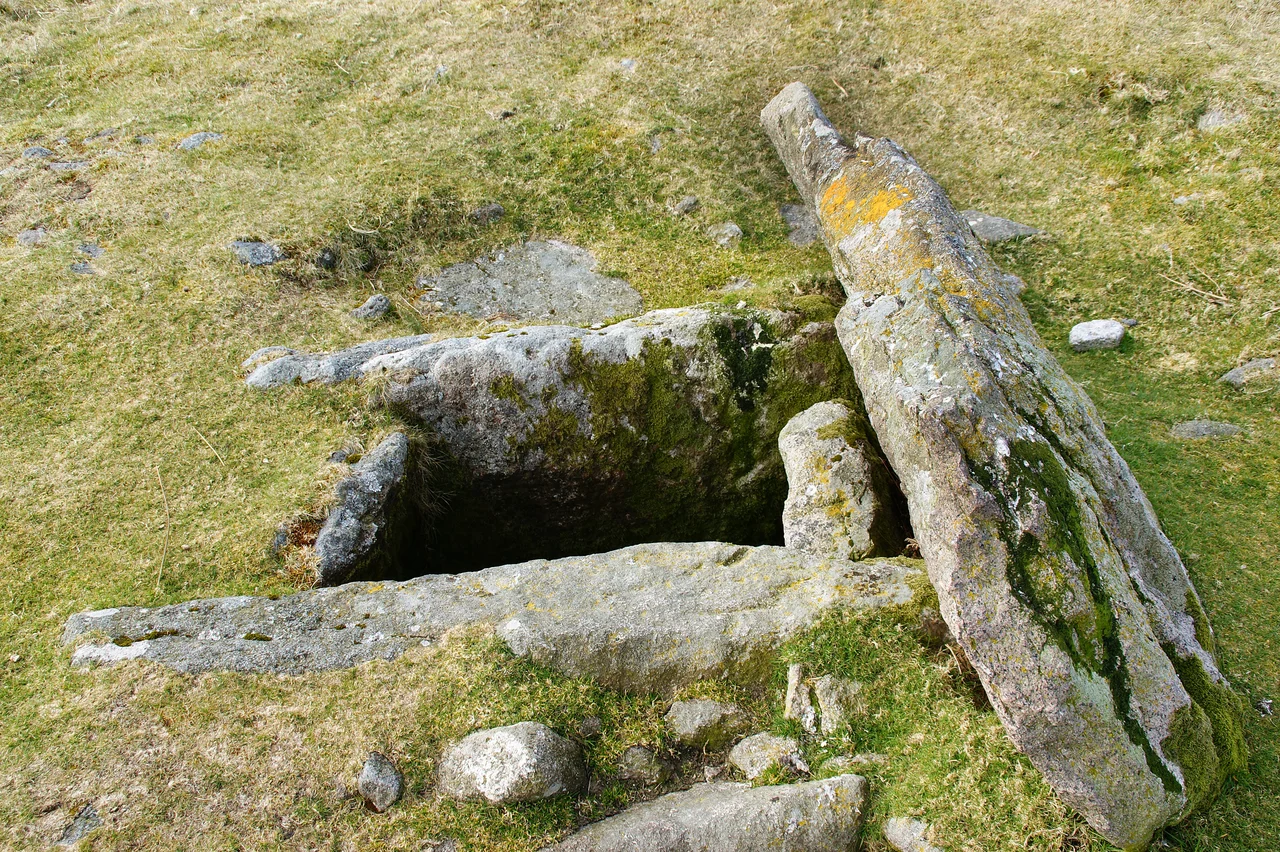
Four slabs of granite stand on edge, a fifth lies across them as a lid, and inside this stone box someone was buried four thousand years ago - knees drawn to chest, face turned toward the sunrise. Over 180 of these kistvaens dot the 954 square kilometers of Dartmoor, more than have been found anywhere else in southwest Britain. Bodmin Moor has 58. Exmoor has two. The Quantock Hills have none at all. Something about this granite upland in south Devon called the Late Neolithic and early Bronze Age dead - or called the living who buried them - more strongly than any other corner of the region.
A Stone Chest for the Dead
The word itself carries the meaning. Kistvaen comes from the Cornu-Celtic cist-veyn, with a Welsh cousin in cist-faen: cist for chest or box, maen for stone. A stone chest. The builders set four or more flat slabs upright to form the sides and ends, then capped the construction with a heavier flat stone. Many were placed at the center of a cairn circle, ringed by standing stones that marked the burial as something more than a hole in the ground. Others stand alone now, though that solitude may be deceptive - the cairn that once covered them may have eroded into the moor over the millennia. When archaeologists examined the orientations, a pattern emerged: the Dartmoor cists were positioned so the dead would face the sun.
Bodies and Ashes
What went inside depended on how the body had been treated. An uncremated corpse was placed in the kistvaen in a contracted position, knees folded toward the chest like someone curled asleep. A cremated body became a different kind of offering: the ashes were gathered into a cinerary urn, and the urn was set inside the stone chest. Either way, the dead were not abandoned. They were sealed in, capped with granite, and ringed with stones that announced their presence to anyone walking the moor for the next several thousand years. The orientation toward the sun suggests something the builders cared about - whether a literal rising or a more metaphorical one, the dead were facing toward the light.
Money Pits and Crocks of Gold
Almost every Dartmoor kistvaen that has been examined was opened long before any archaeologist arrived. The contents are missing. Later generations called these structures by names that betray what they were after - money pits, money boxes, crocks of gold, Roman graves. The first recorded mention of someone searching tumuli in Devon dates to 1324, when Edward II granted permission for the work. The tomb-robbers found what they expected to find in some cases, and nothing in many others, but the practice continued. In one of the rare burials to survive untouched, the Whitehorse Hill cist on northern Dartmoor was excavated in 2011 and yielded extraordinary Bronze Age artefacts of organic materials - basketry, woven bands, animal pelt - preserved by the acidic peat that had grown over the burial for thousands of years.
The Parson's Bargain
Dartmoor folklore took a dim view of grave-robbing, and one legend in particular found its way into the moor's oral tradition. A man known only as the parson - the title may have been a nickname rather than an actual clerical office - made a map of every kistvaen he could find, marking each as a black dot. The map grew so spotted, the story says, that it resembled a ladybird's wing. The parson and a few accomplices opened every grave on the map. After that, neighbors saw him counting money in his window each night. Then came the storm. Lightning and thunder rolled over the moor in a single sustained roar that kept the whole village awake. By morning every house stood intact - except the parson's, which lay in smoking ruins. Some claimed they smelled brimstone in the air.
Standing on the Moor Today
To walk Dartmoor and find a kistvaen is to find something that does not announce itself. A few flat stones at knee height, half-sunk in heather, sometimes ringed by a barely-perceptible circle of weathered granite - this is what survives of the burial chambers. Some sit beside the great stone rows that march across the moor at Merrivale and elsewhere. Others stand utterly alone in the open, miles from any modern path. The capstones have often been slid aside or removed entirely, leaving the interior open to the sky. The people who built these chambers lived in the hut circles that still pockmark the moor at places like Grimspound, herding cattle and burying their dead with a care that the centuries have not erased.
From the Air
Dartmoor National Park spans roughly 50.5N, 4.0W, a granite upland rising to 621m at High Willhays. Recommended viewing altitude 2,000-3,500 feet AGL to make out the cairn-and-cist pattern in the open moor; the kistvaens themselves are too small to see from above, but the tors, stone rows, and hut circles read clearly. Nearest airport is Exeter (EGTE) about 25nm east-northeast; Plymouth (EGHO) lies to the southwest. Expect persistent low cloud, mist, and rapid weather changes over the moor - visibility can collapse from CAVOK to IFR within minutes.
Nearby Stories
- Bodmin Moor 4.1 km away
- South Devon Railway sea wall 4.8 km away
- Tiverton Castle 12 km away
- Hope Cove Lifeboat Station 14 km away
- Caerhays Castle 20 km away
- Holsworthy 22 km away
- HMS Formidable (1898) 32 km away
- HMS Montagu 41 km away