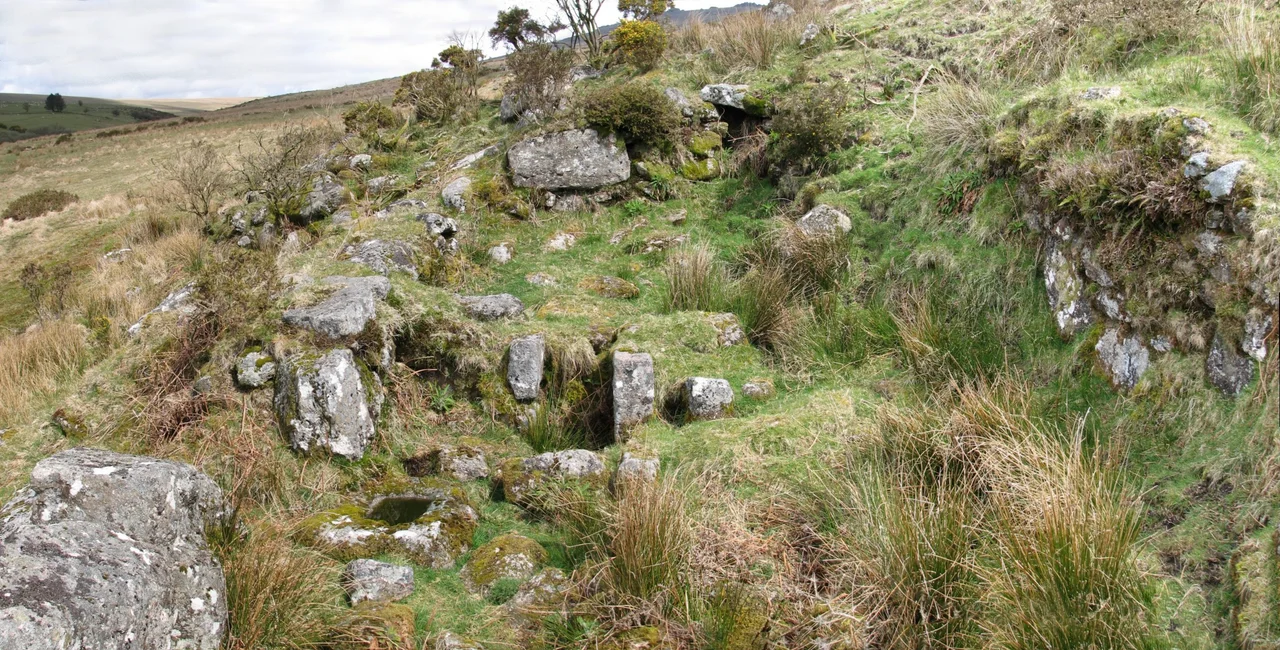

Dartmoor Tin Mining
Stand at Crockern Tor on a clear day and you are standing on the floor of a parliament. In 1494 the tin miners of Devon began meeting here in the open air, on the bare granite at 1,300 feet of elevation, to make laws that applied to no one but themselves and their industry. They had been doing some version of this since the 12th century. They had royal recognition from Edward I, who in 1305 established formal stannaries at Tavistock, Ashburton, and Chagford. They had their own gaol at Lydford for anyone who crossed them. And they had reason to believe their work mattered: the cassiterite buried in the granite under their feet had been pulled, smelted, and traded out of Dartmoor since before the Romans arrived.
How the Granite Made the Tin
Tin is locked inside cassiterite, a mineral that crystallizes in hydrothermal veins running through granite. Dartmoor is granite - 954 square kilometers of it, emplaced during the Carboniferous period and slowly eroded ever since. The lodes generally trend east-northeast to west-southwest, often in association with tourmaline and, in the moor's center, with specular haematite that glints like dark mirrors when broken. As wind and rain wore down the upper granite over hundreds of millions of years, the cassiterite from those vanished lodes washed into the river gravels and concentrated there. With a specific gravity around 7, more than twice that of the surrounding quartz and feldspar gangue, the tin ore settled in the streambeds and waited. That waiting is what the first miners exploited.
Streaming the Valleys
The earliest method left the most visible scars on the moor. Tinners would identify a valley with cassiterite in its gravels, divert a stream of water down through it by means of a leat, and dig a trench called a tye at the lowest end to let the fine gangue wash away. Then they worked upstream, picking the bed apart and letting the current carry off everything that wasn't tin. The result, preserved across vast stretches of the southern moor, is a landscape of parallel ridges and scarps where the gravels were turned over again and again. A study of the Erme valley found a phase of aggradation between the 4th and 7th centuries, hard physical evidence of late Roman or early post-Roman tinning. The 13th century saw a boom in production that the documents and the disturbed ground both record.
Beamworks and Wheal Fortune
By the 15th century the easy stream tin was running out, and miners began following the lodes themselves - down from the surface in massive open-cut gullies called beamworks, openworks, or gerts. Some still bear their old names: Gibby Beam, Willabeam, Scudley Beam. When the Industrial Revolution demanded more metal than streaming and beamworks could supply, the moor sprouted shafts. Forty-eight mines are known to have produced tin in the late 18th and 19th centuries, many of them under hopeful Cornish names - Wheal Fortune, Wheal Lucky, Wheal Prosper, the prefix Wheal meaning simply mine in the old Celtic. Most went bust. A few, like Eylesbarrow and the Vitifer-Birch Tor complex, ran for decades. To pump water out of the deepening shafts, the miners built waterwheels low on the hillsides and carried the power uphill through flatrod systems whose double-stone tracks still cross the moor at Eylesbarrow and Hexworthy.
Crushing, Crazing, Knacking
Once the ore was out of the ground it had to be broken down. Streamworkers used a hand mortar and pestle for the relatively pure gravels. As lode mining grew, the tinners built crazing mills - two flat circular stones, the upper rotating against the lower like a quern, fed ore through a hole in the top - until the rock they were processing got too coarse for grinding. Then came the stamping mills, sometimes called knacking or knocking mills. At least 60 once operated on Dartmoor. Vertical timber stamps with iron-shod tips were lifted by cams on a waterwheel shaft and dropped onto ore lying on a granite mortarstone. By the 1900s the Cornish stamp, the Californian stamp, and Holman's Pneumatic competed for the work. Walk almost any Dartmoor valley today and you can find the mortarstones still lying where they were used, semi-circular hollows worn into their faces.
The Last Mine and the Three Hares
The discovery of vast tin deposits in British Malaya in the late 19th century drained Dartmoor's miners toward Asia, and the moor's commercial tin mining ground to a halt. Golden Dagger Mine, the last to work the ore directly, closed in November 1930. Some work continued during the Second World War, and Hemerdon Ball over near Plympton was reopened in 2015 as a tungsten and tin operation, though it closed again in 2018 when the operating company entered administration. The stannary courts had been reformed in 1836 and finally abolished in 1896, long before the last shaft closed. What the miners left behind is hard to miss: ruined blowing houses, leats threading the hillsides, mortarstones in the heather, and one strange motif that may have come up with them. The three hares - three rabbits chasing each other in a circle, sharing only three ears between them - appears on roof bosses in nearly thirty Devon churches. On Dartmoor it is called the Tinners' Rabbits. A particularly fine example is set into the ceiling at Widecombe-in-the-Moor.
From the Air
Dartmoor centered near 50.57N, 4.00W, granite upland up to 621m at High Willhays. Recommended viewing altitude 2,000-4,000 feet AGL to see the parallel tinning ridges in the southern valleys (Erme, Plym, Avon catchments) and the cut gullies of the beamworks. Nearest airport Exeter (EGTE) about 25nm east-northeast; Plymouth (EGHO) lies southwest. The relict mining landscape shows best in low-angle morning or evening light when the linear earthworks throw shadows. Expect rapid weather changes - mist and orographic cloud routinely close the higher tors.
Nearby Stories
- Bodmin Moor 4.1 km away
- South Devon Railway sea wall 4.8 km away
- Tiverton Castle 12 km away
- Hope Cove Lifeboat Station 14 km away
- Caerhays Castle 20 km away
- Holsworthy 22 km away
- HMS Formidable (1898) 32 km away
- HMS Montagu 41 km away