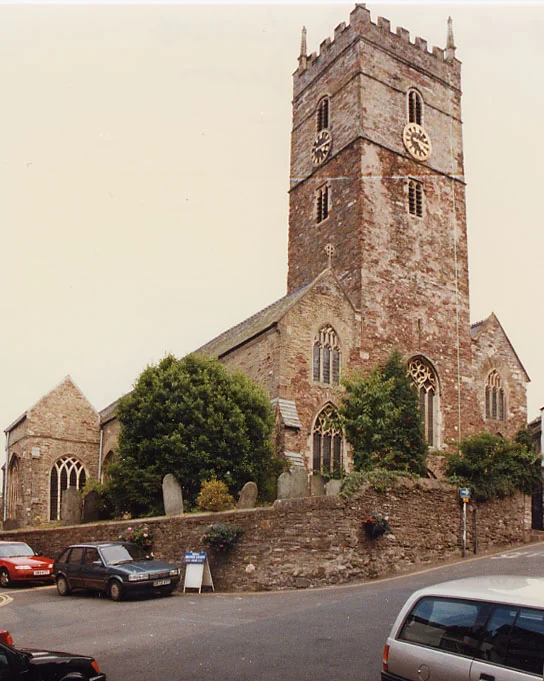

Dartmouth Friary
In 1329 the vicar of Townstal, the parish church on the hill above Dartmouth, was said to have drowned himself. The Bishop of Exeter responded by placing the church under interdict for two years, forbidding any religious services in it. For the ordinary people of Dartmouth, this was awkward in an unusual way. To attend the Eucharist they had to climb a steep hill in all weathers to reach a church that was now closed. The bishop made provisions for a wealthy burgess to hold services in his house, but the general public got nothing. Out of that small bureaucratic cruelty grew one of medieval England's stranger short-lived institutions: a riverside Augustinian friary that lasted just sixteen years, was excommunicated, papally rescued by an apparently fraudulent bishop, and finally demolished by order of an ecclesiastical court in Avignon.
The Hill Problem
Dartmouth is built on the steep western bank of the River Dart, with the historic parish church of Townstal high above the water. From about 1198 the church had belonged to Torre Abbey, granted shortly after the abbey's founding by the Premonstratensian order. When the bishop of Exeter clamped his interdict on Townstal after the vicar's death, William Bacon, one of the wealthiest burgesses in town, was given a private dispensation to hold services in his house. Everyone else suffered. In 1330, King Edward III visited Dartmouth and was petitioned by the burgesses to allow them to build a new church down by the waterside because of the "very great fatigue of their bodies" in climbing to Townstal. The king granted a charter on 16 February 1330 authorising Bacon to assign Torre Abbey an acre of land in Clifton, near the river, to "build anew the parish church." Both Torre Abbey's canons and the bishop of Exeter opposed the new church, and nothing was done. In 1331, permission was extended to "aged and infirm parishioners" to celebrate mass at the chapel of St. Clare in the lower town, but everyone else was still expected to climb.
Bacon's Friars
Dissatisfied with the impasse, William Bacon took a different route. Early in 1331 he negotiated to give the same acre of land in Clifton to two Augustinian Hermits, on which they were to build an "oratory and dwelling houses." They built promptly. By the end of 1331, Bishop Grandisson of Exeter was already ordering action against two men "posing as priests" at Dartmouth, and he excommunicated Bacon. By 1334 the bishop softened. He lifted Bacon's excommunication and the following year permitted the friars to use their newly built chapel, but only for preaching, not for the celebration of mass and not to hear confessions. It was an awkward, partial recognition. In 1340, a widow named Elena Cove won a case at the Exeter assizes against the friars, Bacon, and other Dartmouth burgesses, accusing them of depriving her of a house and half-acre of land at Clifton. The land was restored to her, cutting the chapel's holding in half. By 1344, Bishop Grandisson and the Arches court of Canterbury had ordered the friars to demolish their chapel altogether on the grounds that it stood on land "belonging to the Abbot and Convent of Torre."
The Bishop of Damascus
Before the final decision came back from the appeal at Avignon, the friars' fortunes briefly and dramatically turned. In March 1344, a Bishop Hugo of Damascus OSA arrived in Dartmouth. He was a suffragan bishop "in partibus," meaning he held the title of a see in non-Christian territory but had no actual diocese there. By Bishop Grandisson's own register, Hugo consecrated the friary church and grounds, claiming the authority of the pope. He then heard confessions, granted indulgences, absolved excommunicates, and confirmed and anointed children. After this whirlwind of sacramental activity he went into several Dartmouth taverns, where he drank and showed people his ring, which he said the pope had given him personally. The episode reads now like a medieval con: a wandering ecclesiastical opportunist exploiting a contested cause and gullible parishioners. Whatever Hugo really was, his interventions did not save the friary. When the appeal from Avignon arrived, it confirmed the order to leave. The Augustinian Friars were forced out, and the chapel was demolished.
The Other Side of the Dispute
Beneath the comedy and the canon-law detail, there are real people. The widow Elena Cove deserves a moment. She held property at Clifton near the river, and the burgesses and friars effectively dispossessed her in the rush to build the new chapel. She went to court, fought her case alone against the most powerful men in Dartmouth, and won. The medieval English legal system was capable of remarkable cruelty, but it was also capable of restoring a half-acre of land to a widow whose home had been taken. Her victory cut the friars' holdings in half and probably contributed to the bishop's decision against them. She does not feature in any of the celebrated histories of medieval Dartmouth. She should.
Resolution, and a Church That Stayed
The dispute over a parish church at the waterside was not settled until 1372. A charter dated 4 and 5 October that year recorded the assent of the Abbot of Torre and the vicar of Townstal to consecrate the chapel, provided that the parishioners themselves bore the cost of services, and with the proviso that the chapel would be closed if it was favoured over the mother church at Townstal. Bishop Brantingham consecrated the building to the Holy Trinity on 13 October 1372. A chantry chapel of St. Saviour is mentioned by 1496, and over the centuries this second dedication took over. The church standing on the site today is known as St Saviour's. Two pairs of columns with pointed arches at the west end of the nave may be survivals of the fourteenth-century building. After all the excommunications, fraudulent bishops, and Avignon appeals, the Dartmouth burgesses got their church beside the river. It just took them forty-two years.
From the Air
The site of Dartmouth Friary, now St Saviour's Church, sits at 50.342 degrees north, 3.566 degrees west, on the western bank of the Dart estuary in the lower town of Dartmouth. From the air, look for the dense waterfront of Dartmouth on the steep west bank, with the church visible within the historic centre near the harbour. Exeter Airport (EGTE) is roughly 28 nautical miles to the north-northeast. A coastal approach at 2,000-3,000 feet shows the relationship between the historic parish of Townstal high on the hill and the lower town along the waterfront; the contrast that drove the original 14th-century dispute is still obvious from the air.
Nearby Stories
- St Germans Priory 7.6 km away
- Launceston, Cornwall 9.6 km away
- Castle Drogo 12 km away
- HMS Formidable (1898) 17 km away
- Siege of Lyme Regis 19 km away
- Battle of Plymouth (1652) 40 km away
- German Submarine U-672 48 km away
- Goonhilly Satellite Earth Station 69 km away