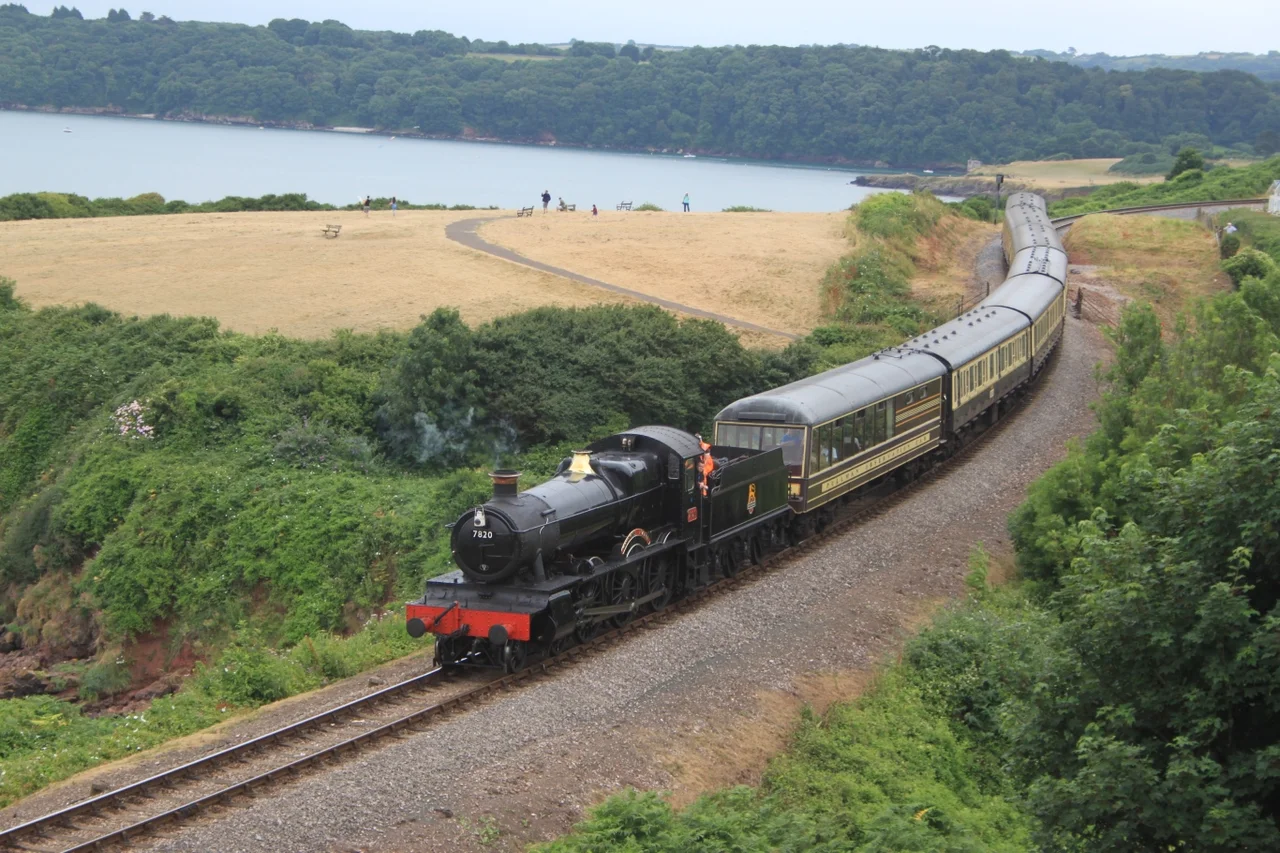

Dartmouth Steam Railway
Dartmouth railway station, on the west bank of the River Dart, has never seen a train. It was built around 1889 in a style favoured by Isambard Kingdom Brunel, although Brunel had been dead for thirty years by then, and it is now Grade II listed. Passengers arrived not by rail but by ferry from Kingswear on the opposite bank, where the trains actually stopped. It is one of British transport's most charming anomalies, and it still works that way. Step off a steam-hauled coach at Kingswear, walk a few paces to a pontoon, take a small ferry across the Dart, and you can buy a coffee in the station that never had a platform. The Dartmouth Steam Railway is the line that brought you there, a 6.7-mile survivor that should have closed in 1972 and didn't.
The Branch That Brunel Almost Built
The line was the work of the Dartmouth and Torbay Railway, opening to Brixham Road on 14 March 1861 and reaching Kingswear on 10 August 1864. The Dartmouth and Torbay was always operated by the South Devon Railway and was absorbed into it on 1 January 1872. That arrangement lasted barely four years before the South Devon itself was swallowed by the Great Western Railway on 1 February 1876, putting the Kingswear branch into the largest of the Victorian railway empires. Brixham Road became a junction in 1868, renamed Churston, when the short independent line to Brixham opened. The branch was built to broad gauge, then converted to standard gauge on 21 May 1892, one of the late conversions of Brunel's seven-foot empire. Masonry viaducts at Broadsands, Hookhills, and Greenway carried the line over awkward valleys; lower timber viaducts crossed two creeks south of the Greenway Tunnel. In 1923 the line was rerouted inland around those creeks, both to remove the rotting timber spans and to make room for the Philip and Son shipyard to expand.
A Halt for the Princes
On 18 October 1877, the railway opened a strange short halt at the level crossing leading to the Dartmouth Higher Ferry. It was less than one carriage long. Its purpose was specific: the Prince of Wales, the future Edward VII, used it to bring his sons down to enter the naval college based on HMS Britannia, which was moored close by on the river. The halt was first called Kingswear Crossing Halt, later Britannia Halt. In its later working life it served workers commuting to the Philip and Son shipyard at Noss. By the heritage-railway era the cost of maintaining it could not be justified, and it was demolished. The Britannia name survives at the level crossing where the signal box for the entire line now sits. The royal princes who first used the halt are dead. The college on the hill is still in business.
The Closure That Wasn't
By 1968, British Rail Western Region was looking to close the line. Costs were given as fifty-four thousand five hundred pounds, income as just over seventeen thousand. The Transport Users Consultative Committee approved closure subject to bus replacement. But the figures were disputed. A December 1968 letter from the Bristol divisional manager to Paddington gave contributory revenue, the value of traffic feeding onto the main line, as fifty-four thousand pounds. Including that, the line ran at a profit. The closure was not, in the end, proceeded with at that point. Negotiations began in 1971-72 between British Rail and Dart Valley Light Railway, an outfit already operating the heritage line at Buckfastleigh that later became the South Devon Railway. The line was officially closed on 28 October 1972. On 30 December 1972 it was sold to Dart Valley for two hundred and fifty thousand pounds plus twenty-five thousand pounds for signalling alterations. A winter service ran from 1 January 1973, principally for the children of Churston Grammar School. By the next summer it was purely seasonal. Much of the purchase price was recouped from the sale of surplus land, mainly at Goodrington, later developed as flats, and at Kingswear, which became a marina.
Riding the Line
From Paignton's Queens Park platform, the train climbs out behind the beach huts that line Goodrington Beach. The 630-mile South West Coast Path runs alongside on the right; the bay opens out, and the panoramic views of the UNESCO Global Geopark geology begin. The train passes Saltern Cove, a Site of Special Scientific Interest for its geology and marine biology, and Armchair Rock. Then come the masonry viaducts, the 72-yard Broadsands and 148-yard Hookhills, and the line climbs to its summit at Churston, with the steepest gradient one-in-sixty on the approach. Beyond Churston the line drops down through Greenway Halt and into the 495-yard Greenway Tunnel. On leaving the tunnel the gradient steepens to one-in-sixty-six, the River Dart appears on the right, and the train crosses Greenway Viaduct, the National Trust's Long Wood spreading below. The track turns east, then west across the early-1920s embankment over Longwood Creek, with Noss Marina on the right, and rejoins its original course. The Britannia Crossing over the A379 announces the final approach to Kingswear, where the platform is covered partly by an umbrella roof and partly by a wooden train shed in the Brunelian style. The ferry to Dartmouth leaves from the pontoon next door.
The Engines That Worked
The heritage railway is unusual in being a commercial operation that does not depend on volunteer labour, though a few volunteers help at Churston. The locomotives are mostly Great Western veterans rescued from the long row of rusting hulks at Woodham Brothers' scrapyard in Barry, the unintentional preservation depot where dozens of withdrawn engines waited out the 1960s and 70s. 4277 Hercules, a GWR 4200-class built at Swindon in 1920, worked South Wales freight until withdrawal in 1964; it sat at Barry until 1986 and arrived on the Dartmouth line in 2008. 5239 Goliath, also a Swindon engine of 1924, came via the Dart Valley Railway and entered service in 1978 as the most powerful tank locomotive in preservation. 4555 Warrior, a 4500-class of 1924, arrived at Paignton in 1973 and is now on loan. 75014 Braveheart, a BR Standard Class 4 built at Swindon in 1951, was sold for scrap in 1964 and not restored to service until 1994, eventually coming to Dartmouth in 2002 after years on the North Yorkshire Moors Railway. Diesels include D6975, transferred from the South Devon Railway in 2018 because it could pull the heavier trains, and 37703, which arrived at the end of 2023. Heavy overhauls happen at Churston, where there is a locomotive workshop on one side of the line and a paint shop and turntable on the other. The line still pays. The trains still climb. And the station at Dartmouth still waits, patient and unused, for the train that will never arrive.
From the Air
The Dartmouth Steam Railway runs from Paignton Queens Park to Kingswear, roughly along the coast at 50.375 degrees north, 3.581 degrees west at its midpoint. From the air, follow the South Devon coast south from Paignton; the line traces the cliffs above Goodrington Sands and Broadsands, crosses masonry viaducts at Broadsands and Hookhills, dives through the 495-yard Greenway Tunnel, and runs along the east bank of the Dart estuary to Kingswear opposite Dartmouth. Exeter Airport (EGTE) is roughly 25 nautical miles to the north-northeast. A coastal track at 2,000-3,000 feet gives clean views; in summer, look for the white steam trail above the tunnel mouth at Greenway when a train is running.
Nearby Stories
- St Germans Priory 7.6 km away
- Launceston, Cornwall 9.6 km away
- Castle Drogo 12 km away
- HMS Formidable (1898) 17 km away
- Siege of Lyme Regis 19 km away
- Battle of Plymouth (1652) 40 km away
- German Submarine U-672 48 km away
- Goonhilly Satellite Earth Station 69 km away