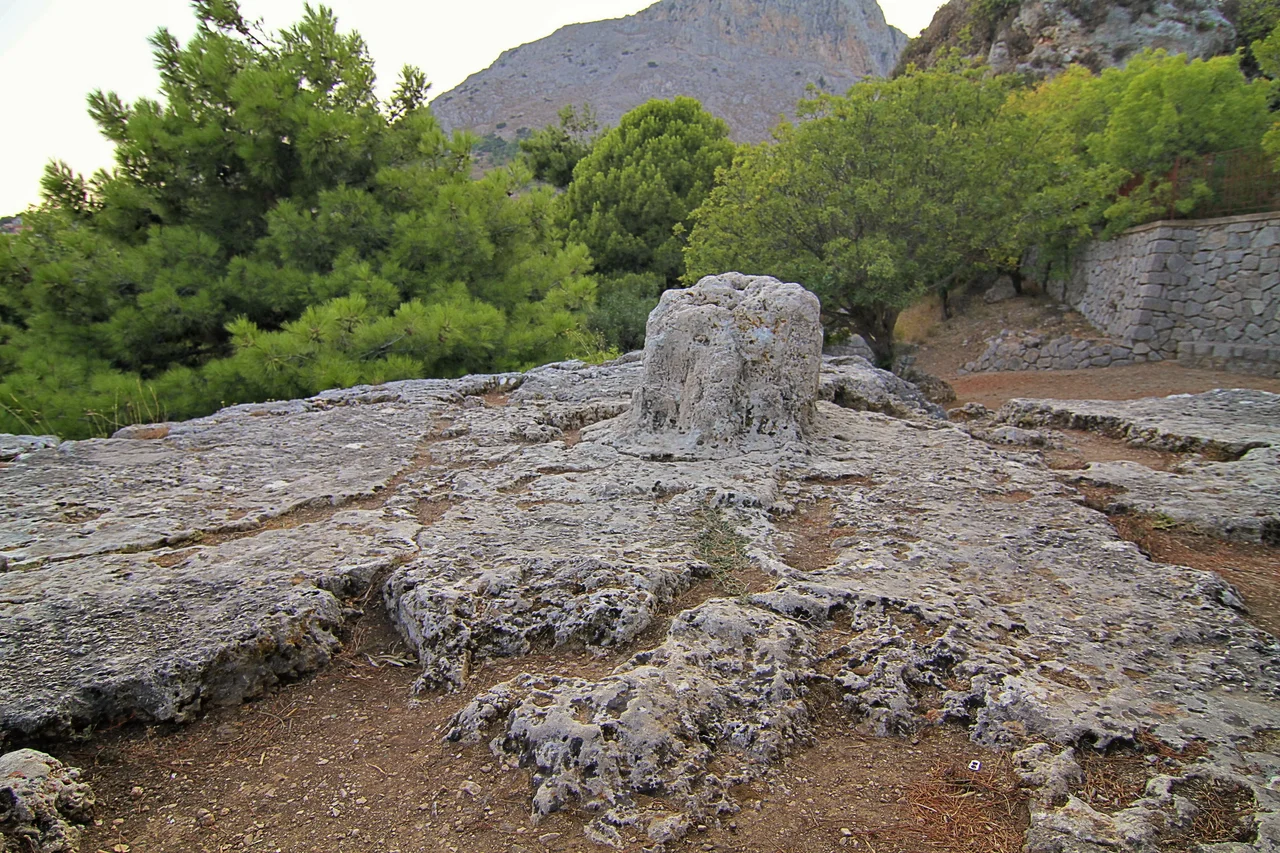

Daskalopetra monument
For centuries the people of Chios have called this carved stone above the water Daskalopetra, the Teacher's Rock, and they have meant a particular teacher: Homer. The tradition says the blind poet sat here, on a seat cut into the living rock near the village of Vrontados, and recited his verses to students gathered around him. No archaeologist can confirm that any such lesson ever happened. But the name has stuck for so long, and the spot looks so exactly like a place where someone might gather listeners by the sea, that the legend has outlived every attempt to correct it.
What the Stone Actually Is
The truth carved into the rock is older and stranger than the Homer story, and in its way more remarkable. Daskalopetra is not a teacher's chair at all but a shrine, cut from a natural rock formation beside a spring sometime in the late sixth or early fifth century BC. At its heart is a niche holding a seated female figure, facing east, her feet resting on a footstool. Early travelers who saw the carving before it weathered reported that she once held a lion in her lap. Flanking the niche are two pillars whose bases are shaped like a lion's paw, supporting a low pediment, and on the outer walls, a striding lion is carved on each side. Opposite the figure is a rock-cut bench that may have served as an altar, with two more benches framing the sacred space.
The Goddess from the Mountains
The seated woman is Cybele, the great mother goddess who came into the Greek world from Phrygia, in the highlands of Anatolia, during the sixth century BC. She was a deity of mountains, fertility, and wild nature, and her companions were always lions. What makes the Daskalopetra shrine extraordinary is its age: although a few scattered votive offerings to Cybele are older, this appears to be the earliest known cult site and image dedicated to her anywhere in the Greek world. It captures the precise moment when an Anatolian goddess was crossing the narrow water to become Greek, on an island that sits within sight of the Asian coast she came from.
Where Two Worlds Meet
Look closely and the shrine wears its dual heritage openly. The way it is carved directly into the rock face, framed by an architectural niche and guarded by lions, echoes the rock-cut monuments to Cybele back in Phrygia, the homeland from which her worship spread. Yet the architectural details, the pillars, the pediment, the proportions, are unmistakably Ionian Greek, the style of the eastern Aegean cities. Chios lies almost exactly on the seam between these two worlds, the Greek and the Anatolian, and Daskalopetra is that seam made stone: a Phrygian goddess given a Greek frame, on an island that was forever a meeting point between the two.
A Name That Endured
Somewhere across the long centuries, the memory of Cybele faded from this rock and the memory of Homer took its place. The figure in the niche eroded until the lion in her lap vanished, and visitors who no longer knew the goddess gave the worn stone a new story, one fit for an island that proudly claimed the poet as its own. The result is a single small monument carrying two of the deepest currents in Chian identity at once: the worship of an ancient goddess at the edge of the Greek world, and the cherished local belief that the father of Western poetry once taught here, with the Aegean spread out at his feet.
From the Air
Daskalopetra sits on the east coast of Chios near the village of Vrontados, at roughly 38.42 N, 26.13 E, just north of the main town and harbor. The rock-cut shrine stands close to the shoreline overlooking the Chios Strait toward the Anatolian coast. The nearest airport is LGHI, a short distance south near Chios town. From the air, look for the coastal strip north of the harbor where Vrontados spreads along the water; the monument itself is a small feature best appreciated at low altitude or on the ground, set against the sea it has faced for some 2,500 years.
Nearby Stories
- Psara 18 km away
- Battle of the Oinousses Islands 28 km away
- St. Helena Church 35 km away
- Battle of Corycus 35 km away
- Greek Islands 60 km away
- Temple of Artemis at Ephesus 61 km away
- Adramyttium 94 km away
- Skyros 101 km away