.jpg)
Daya Bay Reactor Neutrino Experiment
On March 8, 2012, a collaboration of physicists announced a discovery from inside a mountain in Guangdong Province. They had measured something that had eluded the world's particle physicists for decades: the precise value of the neutrino mixing angle known as θ13. The result was not only definitive — a 5.2-sigma confidence level, the gold standard in physics — it was surprisingly large, opening new experimental possibilities that the field had not dared to count on. The announcement came from eight detectors buried underground near Daya Bay, 52 kilometers northeast of Hong Kong, where the reactors of two nuclear power plants pour out an invisible flood of antineutrinos around the clock.
What a Neutrino Is, and Why It Matters
Neutrinos are among the most abundant particles in the universe and among the most elusive. Trillions pass through your body every second without leaving a trace. They were long thought to have no mass at all — but in the late 1990s, experiments revealed that neutrinos oscillate: they change from one of three types, or "flavors," into another as they travel. Oscillation requires mass, which was a surprise. And oscillation is governed by mixing angles — parameters that describe how strongly the different flavors blend. Two of those three mixing angles were measured by earlier experiments. The third, θ13, remained the hardest to pin down. It controlled whether future experiments could probe an even deeper question: whether neutrinos behave differently from antineutrinos in a way that might help explain why the universe contains more matter than antimatter. Without a precise value for θ13, the whole program was uncertain. Daya Bay was built to find it.
Eight Detectors, Six Reactors, One Mountain
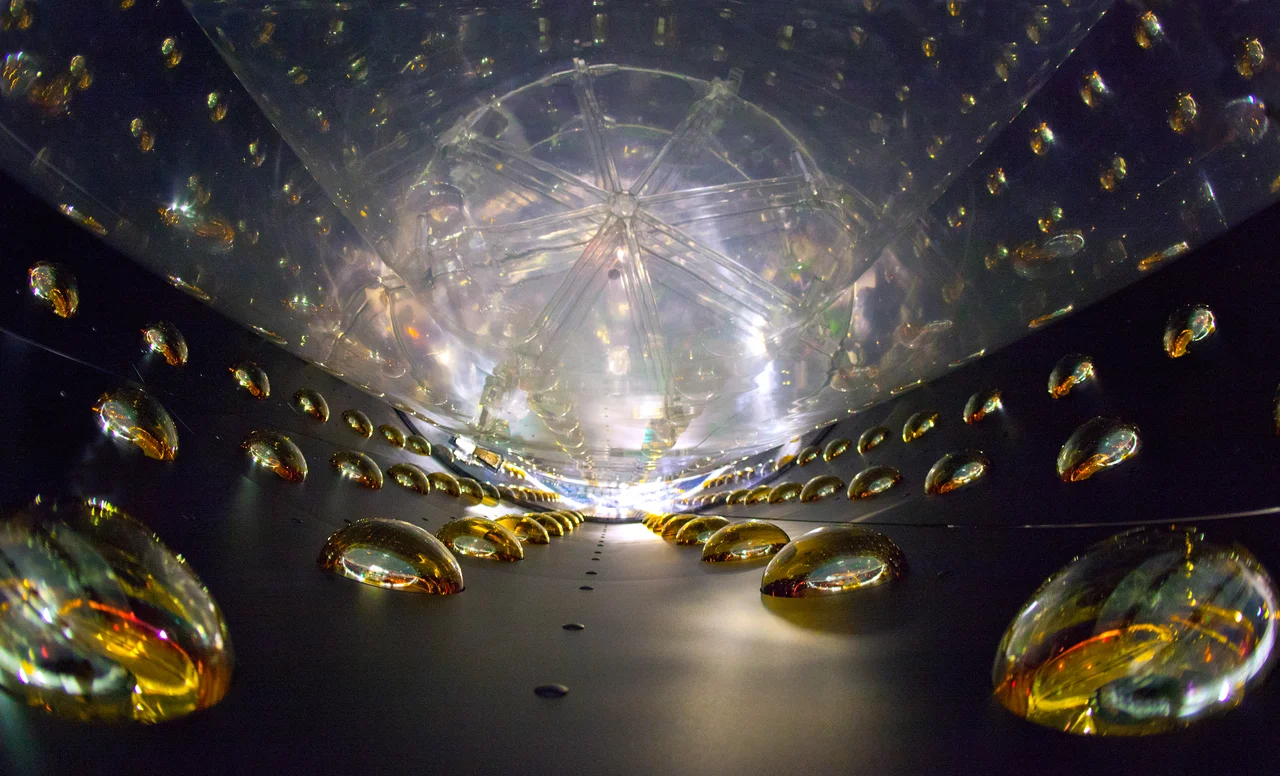
The experiment's design is elegant in its logic. Nuclear reactors produce enormous quantities of antineutrinos as a byproduct of fission — clean, reliable, and impossible to turn off. By placing detectors at different distances from multiple reactors, physicists can observe how the antineutrino flux changes with distance, and from that change, calculate the mixing angle. Each of the eight Daya Bay detectors contains 20 tons of liquid scintillator: a specially formulated oil laced with gadolinium, which fluoresces when struck by a particle. Surrounding the scintillator are hundreds of photomultiplier tubes, devices so sensitive they can detect a single photon. The detectors are clustered in three underground halls — positioned within 1.9 kilometers of the six reactors of the Daya Bay and Ling Ao nuclear power plants. The mountain above provides shielding from cosmic rays, which would otherwise drown the signal in noise.
A Measurement That Changed the Field
The 2012 result was decisive. θ13 was not zero — and it was larger than many theorists had predicted. The value meant that upcoming experiments like NOvA had roughly a 50% chance of being sensitive to the neutrino mass hierarchy, a question about the ordering of neutrino masses that connects to the deepest puzzles in cosmology. It also meant that CP violation — the asymmetry between matter and antimatter behavior — was potentially within experimental reach. Daya Bay continued refining its measurements over the following decade. By April 2023, the collaboration published its final precision results: sin²(2θ13) = 0.0851 ± 0.0024. The collaboration noted that this measurement would likely remain the world's most precise value of θ13 for the foreseeable future. Along the way, Daya Bay also found an unexpected excess of antineutrinos near 5 MeV in energy — a discrepancy with theoretical predictions that suggests the Standard Model of particle physics is not quite complete.
A Multinational Experiment at a Nuclear Bay
The Daya Bay experiment is a collaboration that spans six countries and multiple institutions: China, the United States (funded by the Department of Energy's Office of High Energy Physics), Taiwan, Russia, Chile, and the Czech Republic. The experiment's name comes from its host site, and both are freighted with meaning — this stretch of Guangdong coast is home to two operating nuclear power plants, their cooling systems drawing water from the same bay where the detectors hunt for particle oscillations. An affiliated underground laboratory in Hong Kong's Aberdeen Tunnel measures cosmic muons that could interfere with the main experiment. The science is global; the setting is distinctly local. And it has spawned a successor: the Jiangmen Underground Neutrino Observatory (JUNO), a far larger detector facility being built inland from Guangdong, designed to push the questions Daya Bay opened into new territory.
Legacy Underground
The hills above Daya Bay contain, invisibly, one of the most significant physics experiments of the early 21st century. From the outside, the site looks like any other stretch of mountainous Guangdong coast — forested ridges dropping toward a bay where reactor domes and cooling towers mark the nuclear complex below. But inside those hills, the detectors did their work: recording the faint flicker of antineutrinos disappearing and reappearing, building a statistical picture precise enough to answer a question that cosmology had carried for decades. The data is now fully analyzed, the papers published, the detectors retired. What remains is knowledge — and the framework for the next generation of experiments to ask even harder questions about why the universe is the way it is.
From the Air
The Daya Bay Reactor Neutrino Experiment is located at approximately 22.60°N, 114.54°E, on the coast of Daya Bay in eastern Guangdong Province. The nuclear power complex — including the Daya Bay and Ling Ao plants — is visible from altitude as a cluster of reactor domes and cooling towers on the bay's western shore, backed by forested hills where the underground detector halls are buried. At 5,000 feet, the full curve of Daya Bay is visible, with the Dapeng Peninsula forming its western boundary. Nearest major airport is ZGSZ (Shenzhen Bao'an International), approximately 50 km to the west. VHHH (Hong Kong International) lies about 60 km to the southwest. The experiment site sits roughly 52 km northeast of Hong Kong and 45 km east of central Shenzhen.
Nearby Stories
- Basalt Island 7.1 km away
- Ngong Ping 360 7.5 km away
- China Southern Airlines Flight 3456 11 km away
- Huizhou (Guangdong) 27 km away
- Dongguan 27 km away
- Battle of Penghu 471 km away
- Penghu Air Raids 477 km away
- Checheng Fu'an Temple 593 km away