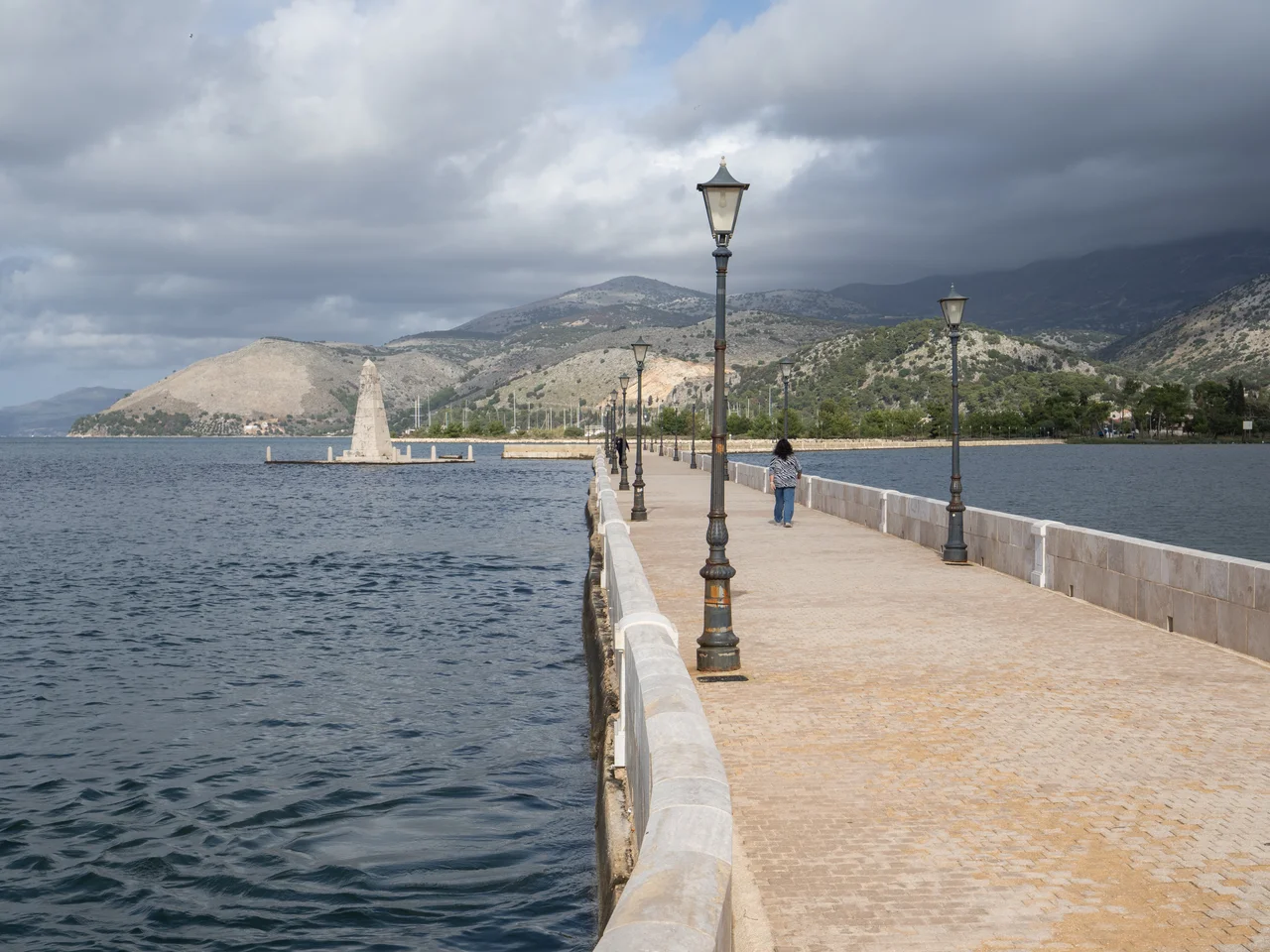

De Bosset Bridge
The council had objections. The bridge's northern end led into unpopulated country, and unpopulated country invited robbers to make an easy escape. Charles Philippe de Bosset — Swiss-born military officer, provisional governor of Cephalonia under British patronage — considered these concerns for a moment, then struck his sword on the table. If necessary, he said, he could disperse petty concerns himself. Construction began the following year. At 689.9 metres, the bridge he built across the Bay of Argostoli became the longest stone bridge crossing the sea anywhere in Europe, a title it holds to this day.
The Man Who Built It
Charles Philippe de Bosset served as the island's governor from 1810 to 1814, during the period when Cephalonia was part of the United States of the Ionian Islands under British protectorate. He was a practical man with an engineer's eye, and he set about improving Cephalonia's roads and bridges with the systematic thoroughness of a military administrator. Ravines were spanned; connections shortened. But the largest project was the one he had to fight for: a crossing of the Bay of Argostoli to the Drapano shore on the far side, which would cut the journey to Lixouri and the northern part of the island. In 1812, he presented his plan to the island council. Their concerns about robbers using it as an escape route seemed to him unworthy of serious engagement. He won the argument at the table, and then he won the engineering problem in the field.
Wood First, Then Stone
The bridge was built in stages, as many great engineering projects are. First came timber — a wooden structure thrown across the lagoon to prove the concept and provide immediate utility. Then, piece by piece, the wood was replaced with sandstone, the pavement loaded onto 16 low stone arches, one of which is filled. The transformation took time. Four years after the initial construction, stone arches were added; after some 26 years, the entire structure had been rebuilt in stone. In the middle of the crossing, De Bosset placed a small man-made island bearing an obelisk — a monument to British patronage over the Ionian Islands, planted in the water between Argostoli and Drapano, halfway across a landlocked sea. The bridge separates the Koutavos Lagoon from the bay proper, an engineering act that altered the hydrology of the shoreline as much as the convenience of travellers.
The Earthquake and What It Left
In August 1953, the earthquake that destroyed virtually all of Cephalonia reached the bridge too. Parts of the structure collapsed. Engineers repaired the damage by backfilling — using concrete where sandstone had stood — and straightening the pavement. The repairs kept the bridge functional, but they were visible: the concrete patches remained distinguishable from the original sandstone, a scar that made the earthquake's reach legible in the fabric of the structure itself. In 1970, the bridge was listed as a historical monument. By 2005, engineers were recommending that the concrete fillings be replaced with sandstone to restore the original material. From 2011 to 2013, a full renovation was carried out: the concrete came out, new sandstone went in, the asphalt surface was replaced with paving, and the light poles anchored in the water were replaced with replicas of the original lanterns. When the work was done, the bridge reopened — not to cars, which had been excluded since 2009, but to pedestrians.
A Bridge Transformed
The De Bosset Bridge had been in continuous use since its construction, carrying generations of Cephalonians across the lagoon to Drapano and the road to Lixouri. For nearly two centuries it bore horses, carts, automobiles, trucks. By the time it was closed to heavy vehicles in 2009, the bridge's utility had begun to work against it: it funnelled traffic directly into the heart of Argostoli, complicating the city centre rather than relieving it. Closing the bridge to cars solved that problem, and the pedestrianization that followed transformed it. Today walkers cross at any hour, loggerhead turtles circle the lagoon beneath the arches, and the stone obelisk on its artificial island marks the midpoint of a 689-metre promenade over water — De Bosset's improbable gift to the city he briefly governed.
From the Air
The De Bosset Bridge lies at 38.175°N, 20.496°E, visible from the air as a thin stone causeway crossing the narrow throat of the Koutavos Lagoon on the eastern edge of Argostoli Bay. It is one of the most distinctive aerial landmarks on Cephalonia, easily identifiable at altitudes below 5,000 feet. The obelisk on its midpoint man-made island is visible in good visibility. Kefalonia International Airport (LGKF) is approximately 10 km south; on approach, the bay and bridge are visible to the northwest. The bridge runs roughly north–south, connecting Argostoli on the south to the road toward Drapano and Lixouri in the north.
Nearby Stories
- Glarentza 5 km away
- The Septinsular Republic 5.8 km away
- Battle of the Echinades (322 BC) 8.1 km away
- Hellenic Trench 19 km away
- Ionian Islands 22 km away
- Stratos 27 km away
- Achilleion (Corfu) 119 km away
- Corfu 153 km away