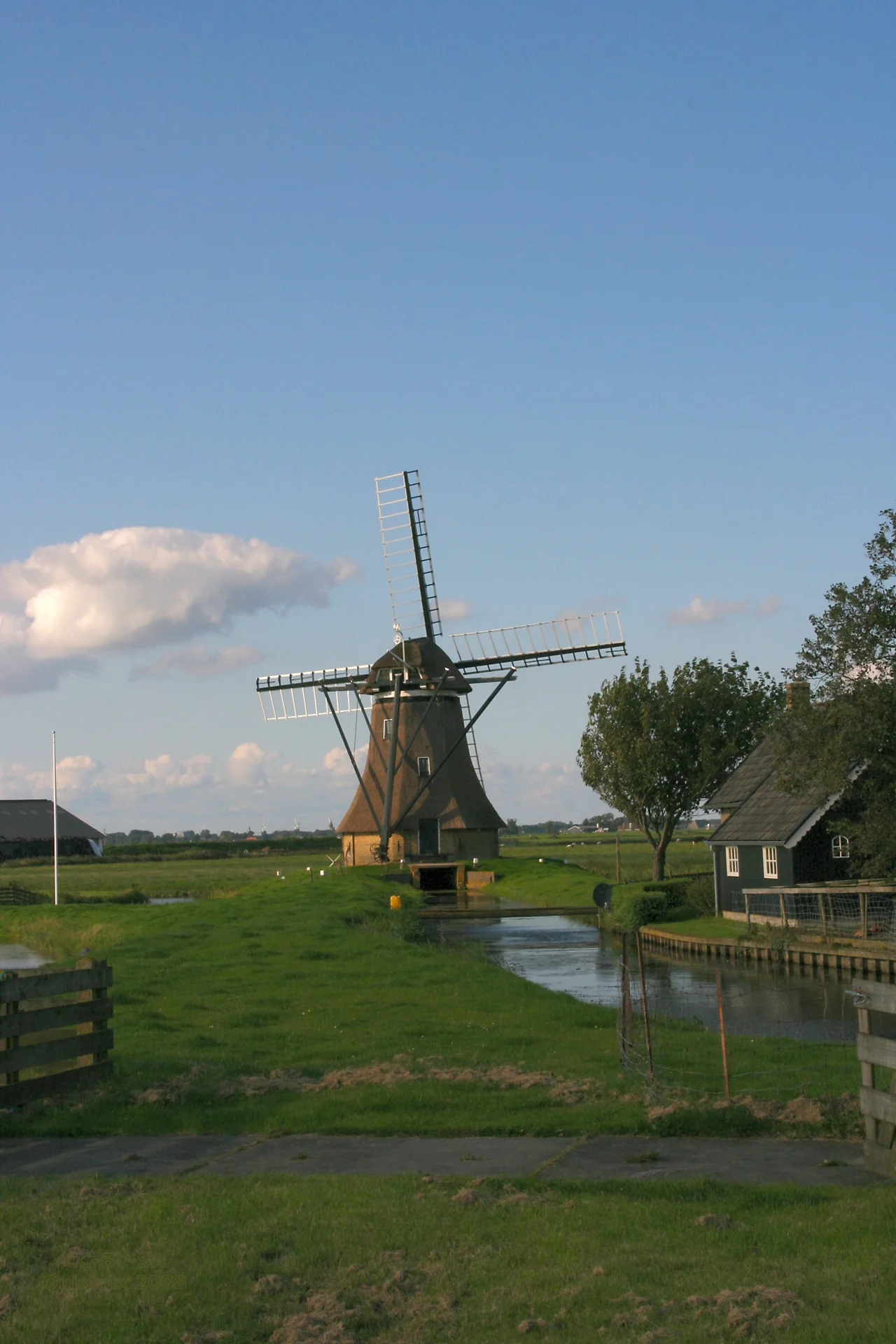

De Huinsermolen
In 1828, five windmills went to work on the Huinserpolder. They had twelve hundred pondemaat — roughly four hundred hectares of low Frisian ground — to keep dry, and the job needed all of them. A year later, a single new mill, taller and smarter than the cluster it replaced, took over the entire workload. De Huinsermolen has been doing that same job ever since: pulling water out of the polder, one Archimedes-screw revolution at a time, in a quiet village called Húns about fifteen kilometers southwest of Leeuwarden.
One Mill Instead of Five
The Huinserpolder — measured the old Frisian way at twelve hundred pondemaat — sits below sea level and exists, like much of the Netherlands, only because someone is always pumping. The five mills that opened the drainage work in 1828 were a stopgap. The following year the local water authority hired Lieuwe Johannes van der Meulen, a millwright from Leeuwarden, to build something more efficient. The mill he raised in 1829 was a three-storey octagonal smock mill on a single-storey base — what the Dutch call a grondzeiler, a ground-sail mill whose blades sweep almost down to the field. It replaced the original five and has been the polder's water-pump ever since. The Netherlands lists it as Rijksmonument number 8530.
Archimedes in a Thatched Tower
Inside the thatched smock, the machinery is a small lesson in pre-industrial engineering. The Patent sails span 21.80 meters and turn a cast-iron windshaft forged in 1877 by Prins van Oranje of The Hague — a famous nineteenth-century foundry whose castings still turn in mills all over the country. The windshaft carries a brake wheel with 55 cogs, which drives a 31-cog wallower at the top of the upright shaft. At the bottom, a 44-cog crown wheel meshes with a 40-cog gear on the axle of the Archimedes' screw. The screw itself is 1.60 meters in diameter and 5.04 meters long, set at a 22-degree incline. Each full turn lifts 1,343 liters of water from the polder into the higher drainage canal beyond. Multiply that by the slow steady rhythm of a working windmill, hour after hour, and a polder stays dry.
Diesel and Restoration
Wind is reliable in Friesland but it is not constant, and by the twentieth century the polder authorities wanted insurance. In 1958 a three-cylinder Lister diesel engine was installed inside the mill itself — a small British workhorse engine designed to run on agricultural sites — working in conjunction with the windmill so the polder could be drained even on still days. Two decades later, between 1978 and 1980, millwright Dijkstra of Gytsjerk carried out a full restoration: new thatch over the smock and cap, new Patent sails on the windshaft, the gearing inspected and made true. In 1995 the mill was held by Waterschap De Middelsékrite at Sneek, the regional water board still responsible for keeping the Huinserpolder dry. In 2001 a modern electric pumping station went up alongside the old mill.
Still on the Job
What makes De Huinsermolen worth standing in front of is not that it has been preserved as a monument. It is that it still works. The pumping station next door now handles the bulk of the water-management duty, but the mill is kept in working order and used regularly — sails set, brake released, wallower turning, the Archimedes' screw groaning quietly as it lifts another 1,343 liters with every revolution. In a country that has built tens of thousands of mills over the centuries and lost most of them, De Huinsermolen is part of a small surviving population doing what it was designed to do nearly two hundred years ago. Stand at the foot of the smock when the wind is from the southwest, watch the sails sweep down almost to the grass, and you can hear the polder draining.
From the Air
Located at 53.155°N, 5.657°E near the village of Húns, about 15 km southwest of Leeuwarden in the flat polder country of central Friesland. The mill is a thatched octagonal smock with sails reaching almost to the ground — a low, ground-skimming silhouette compared with stage mills like De Hoop at Stiens. A small modern pumping station sits beside it. Leeuwarden Air Base (EHLW) is the nearest field, about 15 km northeast; Groningen Airport Eelde (EHGG) lies about 65 km east. Best viewed at low altitude in clear conditions; the surrounding rectangular polder grid and drainage ditches help locate it.
Nearby Stories
- Buren, Friesland 1.1 km away
- Westerkwartier 3.8 km away
- Zuidwal Volcano 7.7 km away
- Lemmer 9.6 km away
- Zuiderzee Works 9.9 km away
- Hooghalen train crash 14 km away
- Zuiderduintjes 20 km away
- West Sole Gas Field 274 km away