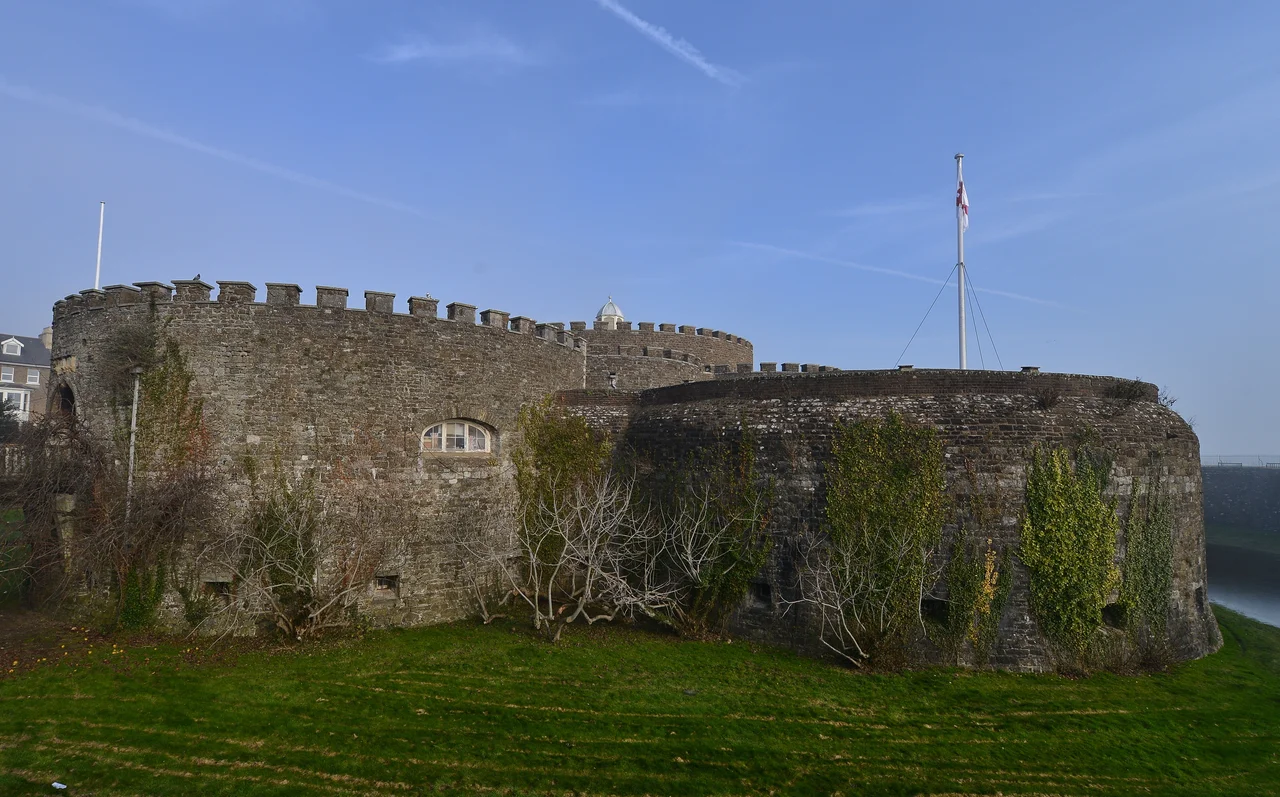

Deal Castle
From above, Deal Castle looks like a stone flower with six petals laid out on the shingle beach. The shape was not for beauty - it was for cannon. Henry VIII commissioned it in 1539 when he was sure that France and the Holy Roman Empire were about to invade England, and he wanted maximum firepower from minimum exposed wall. Sixty-six firing positions surround a central keep, with another fifty-three gunloops in the basement for handguns at close range. Anne of Cleves dined here in December 1540, when the mortar was barely dry. The invasion she had been brought from Cleves to symbolise an alliance against never came.
Henry's Devices
In 1533 Henry VIII broke with Pope Paul III to annul his marriage to Catherine of Aragon and marry Anne Boleyn. Catherine was the aunt of Charles V, Holy Roman Emperor, who took it as a personal insult. In 1538 France and the Empire declared an alliance against Henry, and the Pope encouraged them to attack. Traditionally the English Crown had left coastal defence to local lords. Henry now decided that was inadequate. He issued an order called a device - giving instructions for the defence of the realm in time of invasion - and ordered a chain of forts built along the English coast. The Downs anchorage off east Kent, protected from the open sea by the Goodwin Sands, was a particularly vulnerable spot: enemy ships could safely shelter there, and enemy soldiers could be landed straight onto Deal Beach. Henry knew this stretch of coast well. Three castles went up to defend it: Deal in the middle, with Sandown to the north and Walmer to the south, connected by a 2.5-mile earthwork ditch and bank.
Built in Eight Months
The pace was extraordinary. Work began at Deal in April 1539 and 1,400 men were on site by May. A strike for higher pay was broken up that summer by the project commissioner, Sir Edward Ryngeley. Lead, timber, and Caen stone recycled from the monasteries Henry had just dissolved made up much of the building material - the suppression of religious houses was, conveniently, generating both ideological pressure for an invasion and the building blocks to defend against it. By December 1540 the castle was substantially complete. Anne of Cleves dined inside that month. The three castles together cost the Crown 27,092 pounds, much of it paid for by dissolution proceeds. Deal was the largest of the three, with a tall central keep flanked by six inner bastions and six outer bastions, the western of which served as a gatehouse. Curved walls 15 feet thick. A dry moat 20 metres wide and 5 metres deep. Sixty-six artillery positions across four tiers, and 53 handgun ports for close defence.
The Royalist Stand
The castle saw little action in the First English Civil War, but it became important in the Second. By May 1648, when the Royalists rose again in Kent, the Parliamentarian navy was based in the Downs and protected by the Henrician castles. The naval commander William Batten had been forced to resign as Commander of the Fleet the previous year. He now turned his persuasion on his former colleagues, and elements of the navy switched sides to the King. Walmer, Sandown, and finally Deal declared for King Charles I. Parliament sent Colonel Nathaniel Rich to retake them. Walmer fell on 12 July. Deal, resupplied from the sea by a Royalist fleet that briefly landed 1,500 Flemish mercenaries before money problems forced their return, held out through July and into August. The garrison even mounted a surprise attack on their besiegers. But after news arrived of the Royalist defeat at Preston, Deal surrendered on 20 August. Sandown gave up shortly after.
A House Inside a Fortress
By the 18th century the captain's role had become honorary - a reward handed out by the Crown - and the captains began making the castle comfortable. In 1729 the captain Sir John Norris redeveloped the interior to improve his accommodation. In 1802 Lord Carrington carried out further improvements, reportedly as a friendly rival project to William Pitt the Younger's work next door at Walmer. According to Samuel Wilberforce, Carrington had hoped to charge his costs to the Treasury - but when he submitted the bill, his friend Pitt rejected it and Carrington had to pay himself. By 1898 the War Office accepted that the building was no longer really a military site, and in 1904 finally concluded the castle had no defensive value. Then, in November 1940, German bombers destroyed much of the captain's quarters, forcing the resident captain, William Birdwood, to relocate to Hampton Court Palace. Two 6-inch naval guns were mounted in front of the castle from 1940 to 1944, manned by 337 Battery of 563 Coast Regiment. The castle was suddenly, briefly, a fortress again.
Walking the Petals Today
Deal Castle is now operated by English Heritage, who restored it in the 1950s for the public. The original iron-studded oak gatehouse doors still hang - historian Jonathan Coad considers them among the best preserved for their age in England - with five murder-holes overhead where defenders could have rained missiles or handgun fire down into the entrance passage. A passageway called the Rounds runs along the outside of the outer bastions at moat level, linking the handgun positions that covered the moat floor. The keep still holds its central staircase, its 17th-century bell, and 18th-century graffiti scratched into the lantern at the top. Walking it now you can feel the design's strange logic: every wall curves to deflect cannonballs, every embrasure splays outward to give a cannon room to swing. It was built by men who feared an invasion that never came - and was almost destroyed when the next invasion arrived four hundred years later, from the air.
From the Air
Deal Castle sits at 51.2185 degrees N, 1.4039 degrees E on the Deal seafront, the central one of three Henrician Downs castles. From altitude its six-petalled trefoil shape is unmistakable on the shingle beach. Walmer Castle (also intact, English Heritage) is 1 mile south; Sandown Castle (ruins) was 1 mile north. The Goodwin Sands lie offshore. Nearest airfield Manston (decommissioned) is about 10 nm north. Best viewed from 1,500-3,000 feet AGL approaching the Kent coast from over the Channel.
Nearby Stories
- Ringlestone Inn 3.4 km away
- Cliffs Pavilion 3.5 km away
- Citadel of Calais 6.5 km away
- 2021 English Channel Disaster 11 km away
- Stag Inn, Hastings 15 km away
- Dungeness Lighthouse 19 km away
- Clacton Pier 32 km away
- Four Days' Battle 54 km away