
Deal, Kent
Deal had no harbour. That was the strange secret of its prosperity. For four centuries a stretch of open shingle, with the Goodwin Sands offshore creating a sheltered anchorage called the Downs, made Deal a busier port than many cities with proper docks. Three hundred sailing ships at a time might lie at anchor a mile from the beach, waiting for the wind to change, and small fast lugger boats would launch directly from the shingle to carry mail, provisions, and replacement anchors out to them. The Deal boatmen became internationally famous for skill and bravery. James Cook set foot on English soil at Deal in 1771, returning from his first voyage to Australia. The boatmen rowed him in.
Where Sea and Sea Meet
Deal lies on the East Kent coast at the meeting of the English Channel and the North Sea, eight miles north-east of Dover. It first appears in the historical record as Addelam in the Domesday Book of 1086, and as Dela in 1158. The name is Old English dael, meaning valley - cognate with the modern English dale. It developed into a port by the end of the thirteenth century, becoming a limb of the Cinque Ports in 1278. Walmer, just south of Deal, is one of the possible landing places for Julius Caesar's first arrival in Britain in 55 BC. In 1495 Perkin Warbeck, who claimed to be the missing Prince Richard of York, tried to land at Deal as part of his bid for the English crown. Locals loyal to Henry VII drove his supporters back into the sea at the Battle of Deal, fought on the beach itself. Three years later Henry VII's grandson Henry VIII would have a stone castle built on the same shingle to make sure nothing similar happened again.
The Boatmen and the Anchors
The Downs - the patch of water between Deal and the Goodwin Sands - provided shelter for waiting ships, but the chalk seabed gave poor holding. Anchors dragged in strong winds. Cables parted. Lost anchors littered the seabed, where they fouled the gear of other ships and prevented them from getting away. This created two trades for the Deal boatmen. First, they swept the Downs for lost anchors. In one three-year period from 1866, the Board of Trade paid them to recover over 600 anchors. Second, they sold replacement anchors and chains to ships that had lost theirs. The boatmen kept a large stockpile of ground tackle on the beach, ready to be carried out in the lugger Albion or one of the other large open boats. In bad weather this counted legally as salvage and could pay enormous amounts. In one twelve-day stretch of November 1859, the Deal boatmen supplied 30 anchors and chains to ships in the Downs - 17 of them in a single day. The Albion alone earned 2,022 pounds 8 shillings 6 pence.
Launching from Shingle
The largest Deal luggers were 38 feet long, clinker-built, with a 12-foot beam and six tons of ballast. They were launched bow first down greased wooden skids laid on the shingle, gathering speed before the first wave hit. A haul-off rope to an offshore anchor could steady them as the sail went up. If they did not pick up enough speed they would broach parallel to the beach and be smashed by the surf. Beaching them again was harder still: it took 20 or 30 men at the capstan to haul a fully-laden lugger up the shingle. People got killed doing this. The trade peaked in the age of sail - by the 1880s, steam ships had reduced the wait for fair winds and the Downs anchorage went quiet. But for two centuries before that, Deal's shingle beach was a working maritime industrial site, and the men who worked it were the equal of any seamen in the world.
Smugglers and Marines
Deal had a smuggling problem. Or rather, Deal had a smuggling solution. Special fast galleys built for calm misty nights could outrun the Revenue cutters, and in 1737 the contraband trade reached a peak. In 1784 the government sent a punitive expedition to Deal - soldiers smashed or burned the smuggling boats, depriving the boatmen of their livelihood. The community remembered. But the Napoleonic Wars started shortly after, and the navy needed Deal's services again, and the resentment was set aside. The Royal Marines Depot was established at Deal in 1861. The Royal Marines School of Music moved there in 1930. On 22 September 1989 the Provisional IRA bombed the School of Music, killing eleven young bandsmen. The Depot was decommissioned in 1996. A memorial bandstand on Walmer Green now commemorates the men who, the inscription says, only ever wanted to play music.
The Timeball and the Pier
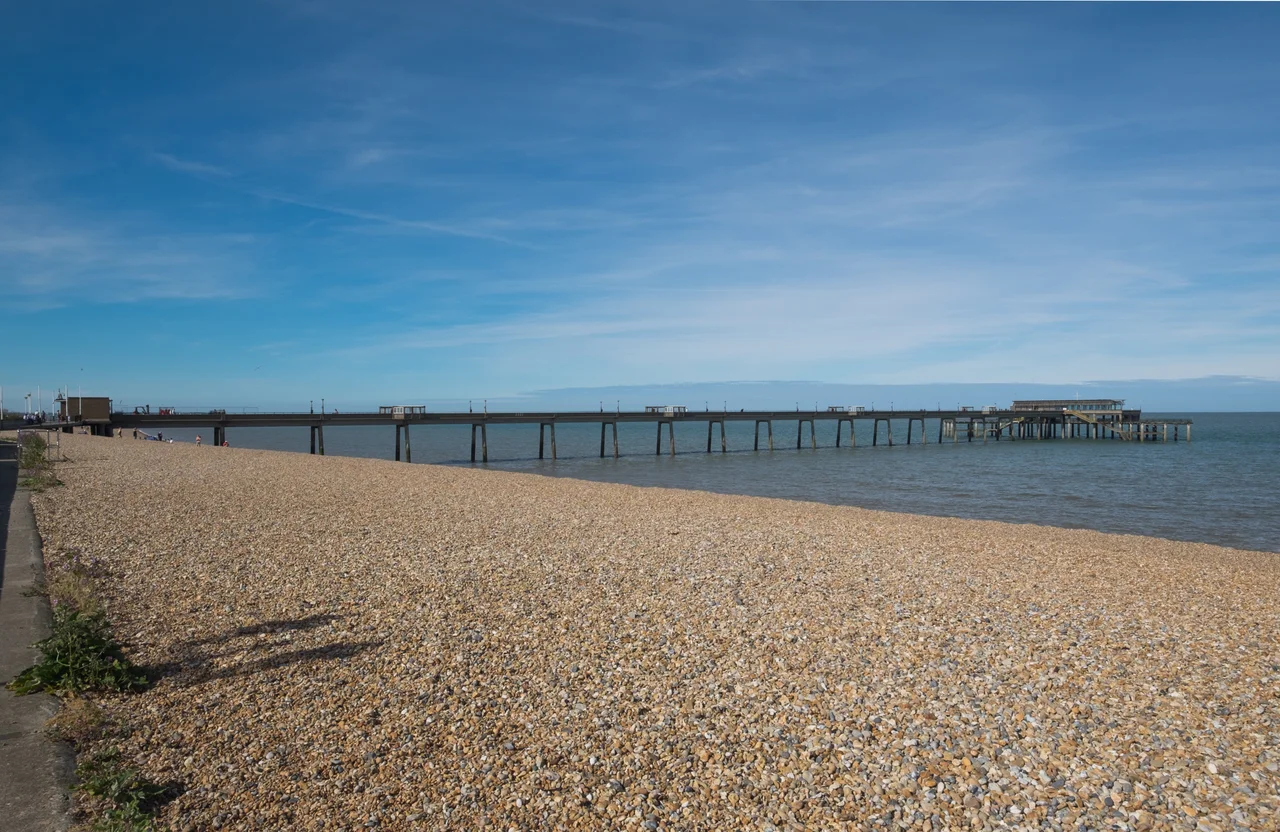
Just outside the gates of the former Naval Yard stands a tall thin building called the Timeball Tower. Originally planned in 1855 as a semaphore tower for signalling the Admiralty in London, it was converted instead to a timeball - a ball that dropped at exactly 1 pm Greenwich time so that ships in the Downs could set their chronometers. It is now a small museum. Deal's pier, opened in 1957 by Prince Philip, is the third pier the seafront has had. The first was built in 1838, destroyed by a gale in 1857. The second, an iron pier built in 1864, survived until January 1940, when it was struck and severely damaged by a mined Dutch ship, the Nora. The present pier is the last remaining fully intact pleasure pier in Kent. Below it the shingle still stretches north and south, the same beach the luggers launched from, the same chalky water still rolling in. Sailing ships are not waiting there anymore. But the bones of Deal's maritime past are still very much in place.
From the Air
Deal sits at 51.2226 degrees N, 1.4006 degrees E on the East Kent coast, where the English Channel meets the North Sea. The Goodwin Sands - a 10-mile-long shoal that wrecks ships at low tide and creates the sheltered Downs at high tide - lies 3-4 miles offshore. Deal Castle and Walmer Castle are visible as distinctive six-petalled and quatrefoil shapes on the shingle beach. Nearest airport: Manston (decommissioned) about 9 nm north. Best viewed at 2,000-3,000 feet AGL approaching the Kent coast from over the Channel. The French coast 25 miles east is visible on clear days.
Nearby Stories
- Ringlestone Inn 3.4 km away
- Cliffs Pavilion 3.5 km away
- Citadel of Calais 6.5 km away
- 2021 English Channel Disaster 11 km away
- Stag Inn, Hastings 15 km away
- Dungeness Lighthouse 19 km away
- Clacton Pier 32 km away
- Four Days' Battle 54 km away