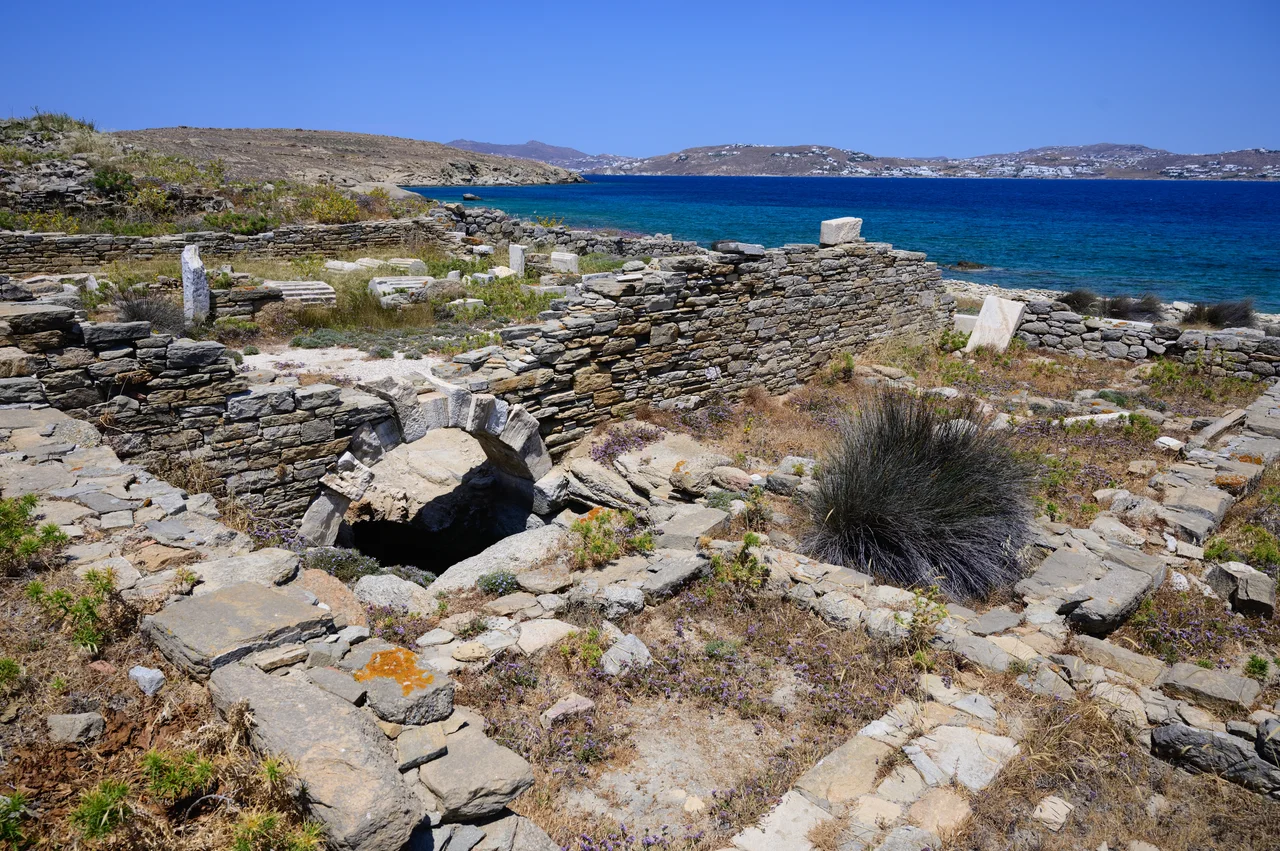

Delos Synagogue
Sometime in the second century BCE, a community on the island of Delos built a hall in the residential neighbourhood called the Stadium Quarter, away from the commercial and religious centre of one of the ancient Mediterranean's busiest trading hubs. They oriented it toward the east. They lined its interior walls with benches. They added secondary rooms to the south. Who they were, and what they did in that hall, has been debated by archaeologists and historians for more than a century. The building is known today as the Delos Synagogue. Whether it was actually a synagogue — or a Samaritan prayer house, or something else entirely — remains one of the genuinely open questions in the study of ancient Jewish and Samaritan communities in the diaspora.
A Community at the Edge of the City
Delos in the second century BCE was at the height of its importance — a sacred island, a free port, a crossroads where traders from across the Mediterranean gathered to buy and sell and worship. The centre of the city was dominated by Greek sanctuaries and the commercial agora. The Stadium Quarter, on the eastern edge, was different: quieter, more residential, less monumental. It was here, at a distance from the city's busy core, that the building now called the Delos Synagogue was constructed, probably between 150 and 128 BCE. The choice of location tells us something, though scholars disagree about what. Some see it as typical of diaspora communities, who built their assembly places at the margins of cities rather than at their centres. Others point out simply that the Stadium Quarter was a residential area, and the building may have begun as a private residence before being adapted.
The Question of Identification
The building was first identified as a Jewish synagogue in 1913 by the French archaeologist André Plassart, excavating for the École française d'Athènes. His identification rested in part on an inscription he believed was found nearby — an inscription that, scholars later determined, came from a different location entirely, a house in the adjacent residential area. The physical features of the building — the benches lining the interior walls, the eastern orientation, the secondary rooms — fit a synagogue in some respects. But they also appear in pagan temples and other structures on Delos. Monika Tümper, in a comprehensive 2004 study, argued that the building is indeed the oldest original synagogue structure surviving in the diaspora, identifying five phases of occupation. Lidia Matassa, in a 2007 paper, argued the opposite: that the physical, literary, and epigraphic evidence together do not support the identification. The scholarly consensus today is that the question is genuinely open.
Jews and Samaritans on Delos
Whatever the building was, there is solid evidence that Jews and possibly Samaritans lived on Delos during the Hellenistic and early Roman periods. Josephus, the first-century Jewish historian, preserved a letter addressed to the Roman praetor Julius Gaius and the council of Parium — a letter specifically concerning the Jews of Delos, dated to around 44 BCE. Some inscriptions found on the island mention people making dedications to 'the Most High God,' a formulation used by both Jewish and Samaritan communities. The Samaritan identification is taken seriously by some scholars; the Samaritans, who worshipped on Mount Gerizim rather than in Jerusalem, had their own diaspora communities in the Hellenistic world and may have maintained a place of assembly on Delos distinct from any Jewish congregation. The building in the Stadium Quarter may represent one community, or the other, or may have served both at different times — or may have been something else altogether.
What the Building Holds
The hall is a rectangular structure oriented toward the east — the direction of prayer for Jewish communities — with a large main room and a series of smaller rooms at the southern end. The benches are built into the interior walls, running around the perimeter: a feature that has been central to the synagogue argument, since it resembles seating arrangements known from later synagogues. But the same arrangement appears in two pagan cult buildings on Delos, and in other structures whose function is clearly not religious. The building lacks what archaeologists most associate with synagogues of the period: Torah shrines, menorahs, or any explicitly Jewish iconography. Its silence on these points neither proves nor disproves anything, since many ancient synagogues lacked such features. The building holds its secrets carefully.
Why It Matters
The Delos building matters because of what it might represent: the physical trace of a Jewish or Samaritan community living, working, and gathering for worship in one of the ancient world's great cosmopolitan centres, more than two thousand years ago. The community whose hall this may have been has left almost no other direct evidence of its existence. They came to Delos as merchants, probably, drawn by the same commercial opportunities that brought Italians, Egyptians, Syrians, and Phoenicians to the island. They lived in the residential quarter, built or adapted a hall, and oriented it toward home. Josephus's letter tells us they were still there — still asserting their right to practice their religion — well into the first century CE. Whether or not the building in the Stadium Quarter was their synagogue, the community itself was real. They deserve to be remembered as people, not as an archaeological puzzle.
From the Air
The Delos Synagogue site lies at approximately 37.40°N, 25.27°E on the eastern side of the island of Delos, roughly 2 kilometres west of Mykonos. The Stadium Quarter, where the building stands, is in the northeastern part of the Delos archaeological site, at some distance from the central sanctuary and harbour area. The nearest airport is LGMK (Mykonos National Airport), approximately 6 kilometres to the northeast. Delos is reached by regular ferry from Mykonos; there is no airstrip on the island, which is an uninhabited UNESCO World Heritage Site. From the air at around 1,000 feet, the archaeological excavations are clearly visible against the pale rock — the Stadium Quarter is distinguishable as a denser residential area on the eastern fringe of the site, north of the ancient gymnasium.
Nearby Stories
- Panagia Ekatontapiliani 1.5 km away
- Panagia Kanala 15 km away
- Andros 30 km away
- HMHS Britannic 30 km away
- Kimolos 33 km away
- Amorgos 34 km away
- Ikaria 51 km away
- Emporio, Chios 71 km away