
Dendra
The innkeeper walked three hours to get there. He had heard that Swedish archaeologists were digging up something extraordinary outside the village of Dendra — tombs of Mycenaean warriors that had waited, sealed underground, for more than three thousand years. When he arrived, the excavators handed him a gold cup shaped like an octopus and invited him to drink wine from it. That cup, the Dendra Octopus Cup, had been buried with a king. The innkeeper had walked from Mykines, near the citadel of Mycenae, and he understood without explanation what it meant to hold something that old in his hands.
A Cemetery for Kings
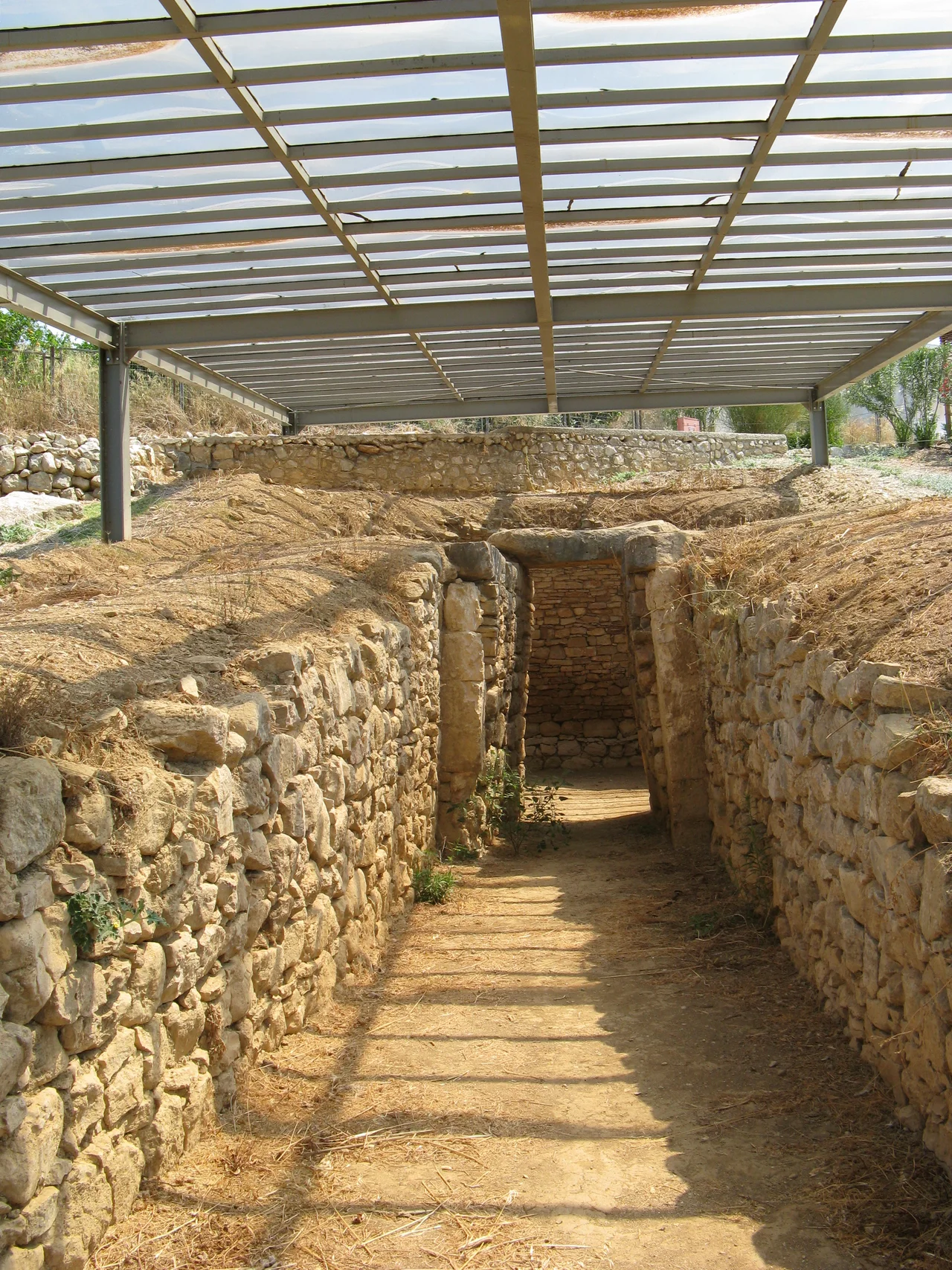
About six kilometers from Argos, on a gentle rise in the Argolid plain, Dendra holds one of the richest Mycenaean cemeteries ever discovered. Three tumuli and sixteen chamber tombs were cut into the hillside, their entrances sealed, their contents — bronze weapons, gold vessels, ceramic figurines, glass paste jewelry once gilded with gold leaf — left untouched for millennia. Swedish archaeologist Axel W. Persson, who began excavating in 1926, concluded that the cemetery belonged to the ruling elite of nearby Midea, a fortified citadel overlooking the plain. Most modern archaeologists share that view. The tholos tomb — the largest, which Persson named the Royal Tomb — was built during the Late Helladic IIIA period. Inside, burials had been made not in sarcophagi but in pits cut into the floor, a choice that, unbeknown to the Mycenaeans, would protect the contents from later looters who arrived and found the chamber itself apparently empty.
The King, the Queen, and the Little Princess
Persson gave names to the dead. Three skeletons in the Royal Tomb became, in his telling, a king, a queen, and a little princess. The king lay with the gold Octopus Cup — decorated with raised tentacles sprawling across its surface — placed beside him. At least three more individuals shared the tomb, their bones mingled by successive interments over generations. A later burial near the tomb's entrance, the stomion, dates to the Protogeometric period, centuries after the tomb's main use — suggesting that people long after the Mycenaean era recognized the site as sacred ground. Several chamber tombs at Dendra also contained donkey bones, which scholar Peter Mitchell interprets as possibly evoking the horses that were sacrificed and buried with high-status Mycenaean warriors at this and other sites.
The Oldest Armor in Europe
Chamber Tomb 12 changed what archaeologists thought they knew about Bronze Age warfare. Excavated in 1960, it contained a complete articulated set of bronze body armor — the Dendra panoply — along with a helmet fashioned from the tusks of boars. The panoply consists of a cuirass, shoulder guards, arm guards, and lower body protection, all hammered from bronze plates and fitted together so a warrior could move in it. It dates to around the 15th century BCE, making it the oldest known complete bronze armor from Europe. No other Bronze Age suit from anywhere on the continent approaches its completeness. The panoply is now displayed at the Archaeological Museum in Nafplio, the nearby city that also served as the first capital of modern Greece. Standing before it, visitors can read the proportions of the man who wore it — broad shoulders, perhaps 170 centimeters tall — and imagine what it meant to field a warrior armored head to foot in an age when most fighters wore leather.
The Dendra Mystery
Not everything at Dendra turned out to be real. In 1937, rumors spread through the local village about a large golden vessel that had supposedly been found and then vanished. Persson returned to investigate what had become known as the Dendra Mystery. He excavated another chamber tomb, hoping to find evidence of the vessel's existence. He never did. The golden vessel, he concluded, had never existed at all — a story that had grown from rumor into local legend. Persson described the previous theorist's explanation for an empty tomb as 'fanciful,' though the competing explanation — that it had simply been looted — was prosaic enough to be true. The real discoveries at Dendra needed no embellishment. They were extraordinary on their own terms.
An International Style
What the chamber tombs at Dendra reveal, alongside those at nearby Mycenae, is how interconnected the Bronze Age Mediterranean had become. The Dendra burials span the period from roughly the 16th to the 12th century BCE. Chamber Tomb 1 held five individuals alongside ceramic figurines of the phi type, including one of the nursing-mother kourotrophos form — a type with clear Minoan and Near Eastern parallels. One tomb contained a boar's tusk helmet, whose construction required dozens of tusks collected from hunted boars and stitched in rows onto a leather cap — a painstaking luxury object that appears in Homer's Iliad, described in detail as if the poet knew exactly what it looked like. Dendra's dead were buried at the crossroads of civilizations: Mycenaean warriors wearing armor no contemporary could lift, drinking from cups shaped like sea creatures, laid down in a hillside cemetery that their descendants would eventually forget — until a Swedish archaeologist arrived with shovels in 1926.
From the Air
Dendra lies at approximately 37.657°N, 22.825°E in the Argolid plain of the northeastern Peloponnese, about 6 km east of Argos and roughly 10 km southeast of Mycenae. From the air at 3,000–5,000 feet, the site sits in gently rolling olive-grove terrain between the modern village of Dendra and the acropolis of Midea visible on higher ground to the northeast. The nearest major airport is LGAV (Athens International Eleftherios Venizelos), approximately 110 km northeast. Regional access is via Nafplio, about 15 km to the south. Best light for aerial viewing is morning, when the Argolid plain is clear before afternoon haze builds.
Nearby Stories
- Villa of Herodes Atticus 3 km away
- Sicyon 3.5 km away
- Battle of Megalopolis 4.5 km away
- Hermione: The City at the Edge of the World 7.5 km away
- Agia Lavra 7.7 km away
- Megara 13 km away
- Agistri 13 km away
- Teuthis 15 km away