.jpg)
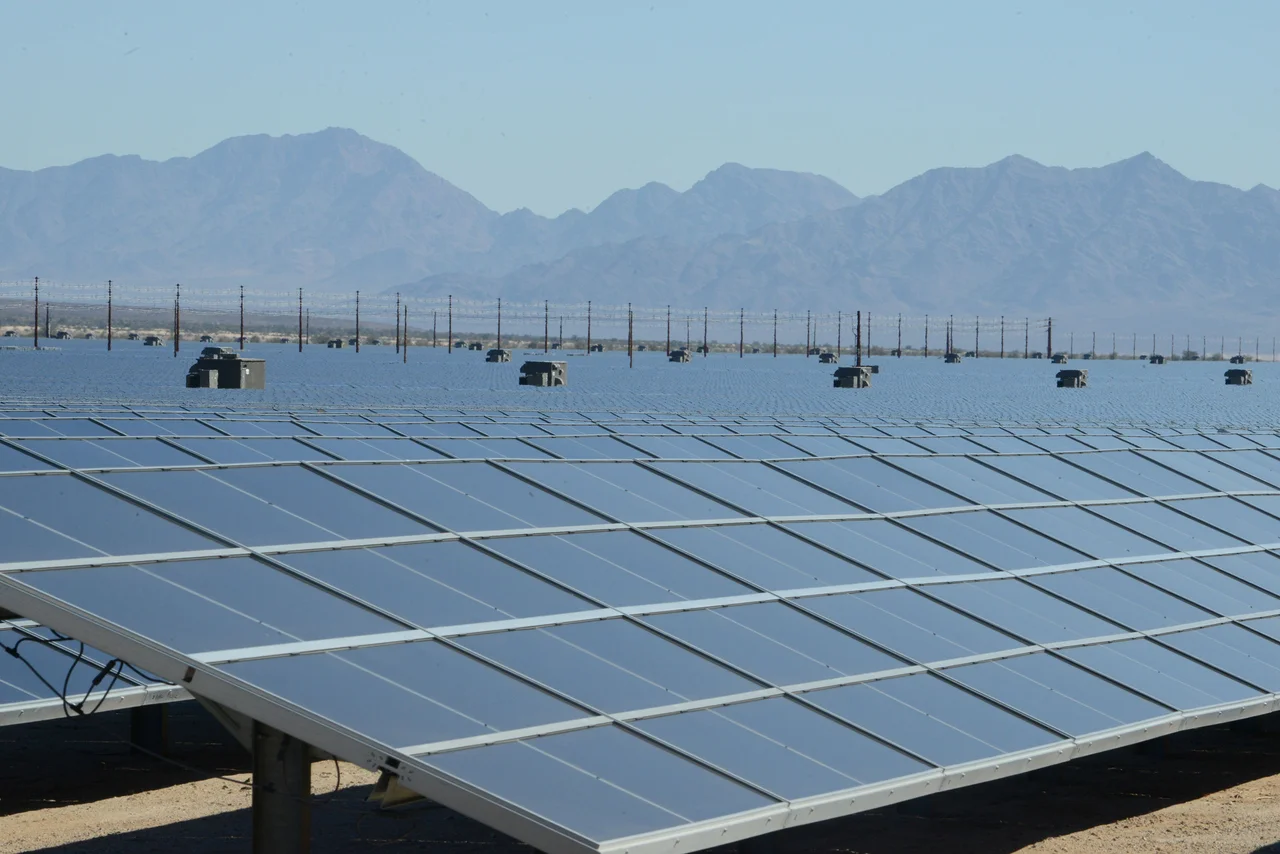
Desert Sunlight Solar Farm
Six square miles of photovoltaic panels spread across the floor of the Colorado Desert, east of Joshua Tree and south of Interstate 10, where the Mojave's elevation has finally given way to the lower, hotter terrain near Desert Center. The Desert Sunlight Solar Farm generates 550 megawatts. On a clear desert day — and there are many of them — the array is visible from altitude as a dark, grid-patterned rectangle against the pale alluvial plain.
First Solar Builds in the Desert
First Solar, the American thin-film solar manufacturer, built the Desert Sunlight facility using its cadmium telluride panel technology. Construction proceeded across the flat terrain near Desert Center, a small community along Interstate 10 between Palm Springs and the Arizona border. The farm reached completion in January 2015, making it one of the largest photovoltaic installations in the world at the time of its completion.
The project covers approximately six square miles — a scale that is easier to appreciate from altitude than from ground level, where the panels extend to the horizon in every direction and the nearest mountains recede into haze. The 550-megawatt capacity generates enough electricity to power a substantial number of California homes, delivered to the grid through transmission infrastructure built as part of the project.
Battery Storage Arrives
Solar generation has a timing problem: panels produce power when the sun shines, which does not always align with when electricity is most needed. The solution — battery storage — came to Desert Sunlight in stages. In 2022, a 530-megawatt, 2,120-megawatt-hour battery storage system was added to the facility, fundamentally changing its character. The farm could now store electricity generated during peak sun hours and release it during evening demand periods, when solar panels produce nothing.
A second expansion followed in 2024. The addition of storage transformed Desert Sunlight from a generation facility into something more like a utility-scale energy management system — an array that captures daylight and delivers it at night.
Ownership and the Desert Floor
The facility is owned by a consortium that includes NextEra Energy, Clearway Energy, and the California Public Employees' Retirement System — CalPERS, the pension fund for California state workers. The presence of a public pension fund among the owners reflects how thoroughly large-scale renewable energy has moved from the edge of the investment world toward institutional portfolios.
The landscape surrounding Desert Sunlight is flat, sparsely vegetated, and extremely hot. Desert Center sits nearby — a small roadside community with a gas station and a history as a waypoint for travelers crossing the desert. The solar farm occupies terrain that was previously used for agriculture and ranching, land that the Colorado Desert's climate and the depletion of groundwater had made difficult to farm. The panels now cover that ground, converting the same sun that made farming difficult into electricity.
From the Air
Located at approximately 33.82°N, 115.45°W near Desert Center, California, south of Interstate 10. The array is one of the most visible landmarks in the Colorado Desert from altitude — a dark 6-square-mile rectangle against pale desert floor. Joshua Tree National Park lies to the northwest; the Salton Sea is visible to the southwest on clear days. Nearest airports: Thermal/Jacqueline Cochran Regional (TRM) ~25 miles west, Desert Resorts Regional (PSP) ~45 miles west.
Nearby Stories
- Eastern Coachella Valley 3 km away
- Twenty-Nine Palms Band of Mission Indians of California 3.6 km away
- Cadiz Dunes Wilderness 7.8 km away
- Chocolate Mountains 15 km away
- Lost Horse Mine 16 km away
- Poston War Relocation Center 54 km away
- London Bridge (Lake Havasu City) 70 km away
- Laguna Diversion Dam 91 km away