
Lost Horse Mine
The mine's name carries the origin story: Johnny Lang went looking for stolen horses in 1890, followed their tracks into a valley in what is now Joshua Tree National Park, and found something more valuable than horses. He met a prospector called Dutch Frank who was already working a claim there, and he purchased that claim for approximately a thousand dollars. The horses were presumably recovered eventually. The mine that followed produced 10,000 ounces of gold and 16,000 ounces of silver before it closed in 1931.
Lang's Discovery and the McHaney Threat
Johnny Lang acquired the Lost Horse Mine in 1890 and immediately encountered the problem that plagued mining operations throughout this part of the Mojave: Jim McHaney's gang. McHaney ran a criminal operation in the desert that included cattle theft, claim jumping, and threats against independent miners. He targeted the Lost Horse Mine, and Lang spent his early years at the claim navigating the threat that McHaney represented. Lang managed to hold the property — unlike some of his neighbors who lost their claims through violence or intimidation — and began developing the mine. Steam-powered ore processing equipment was eventually brought to the site, and the steam engines required fuel.
The Trees That Are Gone
The mountains surrounding Lost Horse Valley were forested with pinyon pine and juniper when Lang began mining there. The steam engines that powered the mine's operation consumed wood as fuel, and over the years of the mine's operation, the surrounding slopes were stripped. The trees have not come back. Walking through Lost Horse Valley today, the absence of the forest that once grew there is still visible — the slopes are more barren than adjacent areas of the national park that were not subjected to the same fuel demands. This pattern repeated throughout the desert mining era: water sources were exhausted, fuel supplies consumed, and landscapes permanently altered by operations whose economic returns often failed to justify the ecological cost.
From Lang to Ryan to Keys
Lang held the mine through its most productive years, then sold it to J.D. Ryan, a Montana rancher, and the property changed hands again over the following decades. By the time William F. Keys arrived in the Joshua Tree area and began his long tenure as the defining figure of desert settlement, the Lost Horse Mine's history was already substantial. Much of what is known about the mine's early years comes from Keys's accounts — he knew the territory and the people who had worked it, and his testimony preserved details that might otherwise have been lost. The mine operated intermittently from 1894 to 1931, returning to production during periods of higher gold prices and sitting idle when extraction costs exceeded the value of what could be found.
Ruins in the Valley
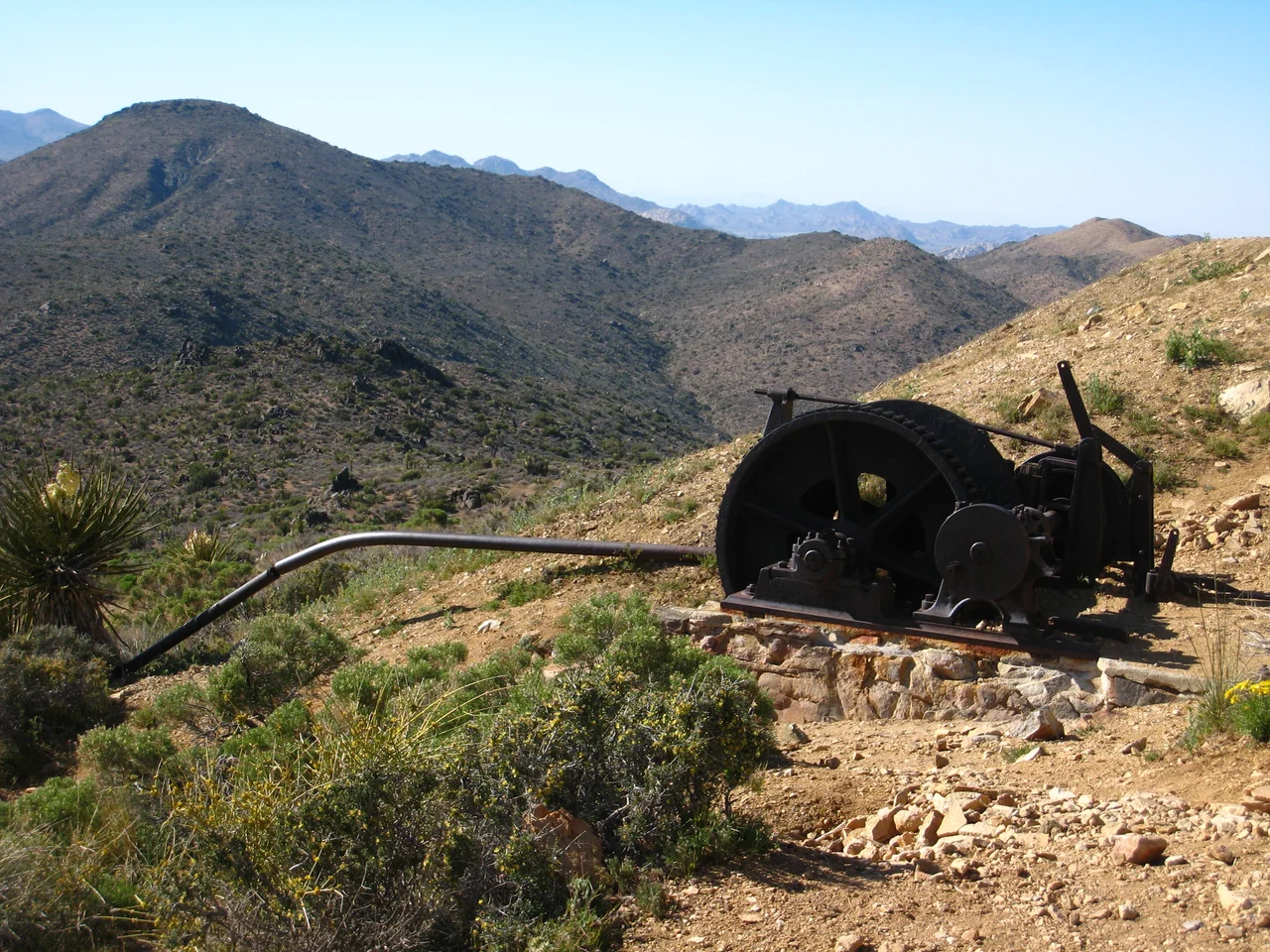
The remains of the Lost Horse Mine are preserved within Joshua Tree National Park and accessible by trail from the park road. The ruins include the ten-stamp mill that processed ore during the mine's productive years — one of the more complete mill ruins in the park — along with scattered equipment, stone foundations, and the shafts that descend into the granite at various angles. The 4-mile round-trip trail to the mine passes through Lost Horse Valley and offers views of the surrounding mountains and the Coachella Valley below. The mine is listed on the National Register of Historic Places. What visitors see there is the physical record of four decades of extraction: the shafts, the tailings, the mill, and the stripped slopes that document what the operation required and what it consumed.
From the Air
Located at 33.941°N, 116.137°W in the southern portion of Joshua Tree National Park, Lost Horse Mine is in the Lost Horse Valley area near the park's southern boundary. The valley is visible from altitude as a relatively open basin surrounded by rocky ridgelines. The Coachella Valley is visible to the south beyond the Little San Bernardino Mountains. Nearest airports: KPSP (Palm Springs International, approximately 28 miles south-southwest), KTNP (Twentynine Palms, approximately 22 miles northeast). The park's Joshua tree woodland is visible as a distinctive textured landscape at lower altitudes.
Nearby Stories
- Coachella Valley 3.4 km away
- Mountain Fire (2013) 5 km away
- Cabazon Dinosaurs 12 km away
- Coxcomb Mountains 14 km away
- The Integratron 19 km away
- Sidney Garfield 25 km away
- Cadiz, California 30 km away
- Calico: The Ghost Town Walter Knott Saved 76 km away