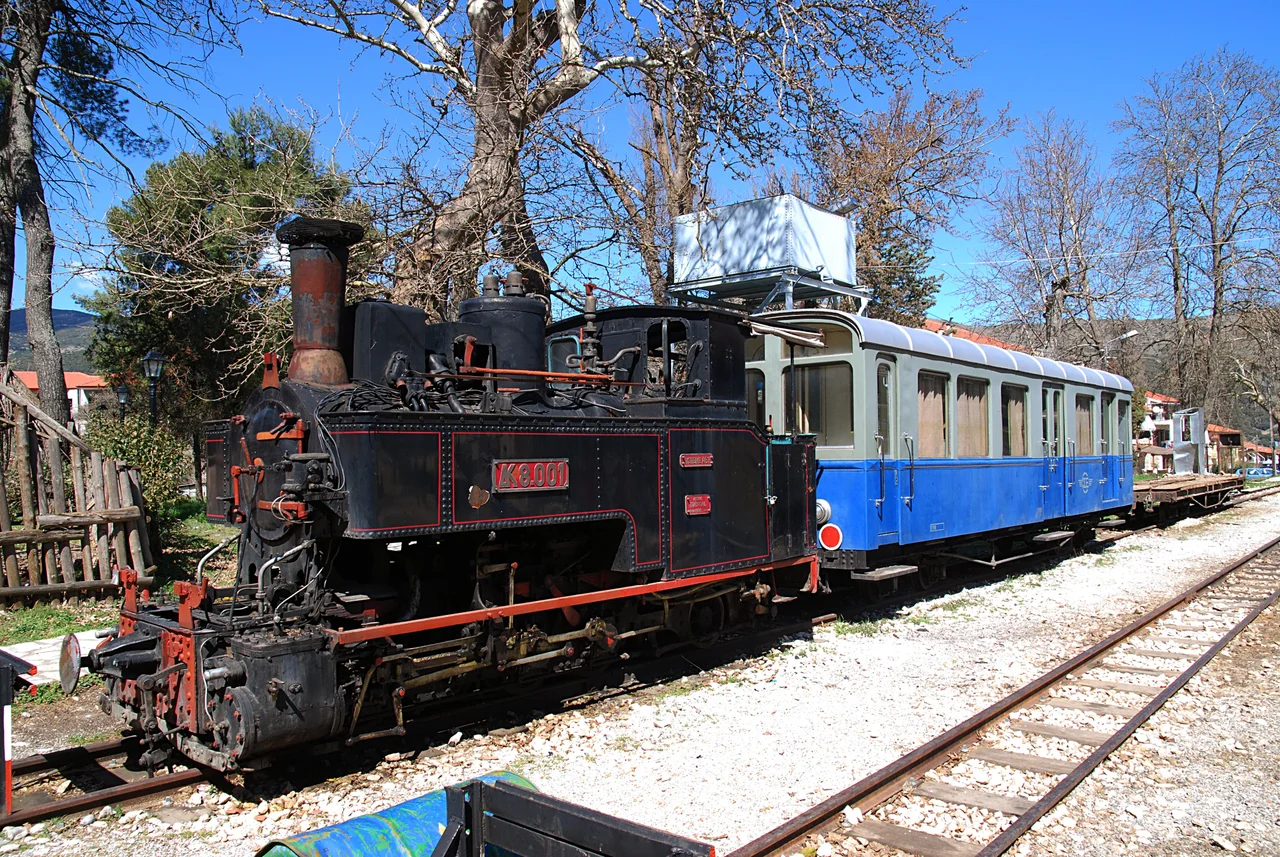

Diakopto–Kalavryta Railway
The Vouraikos Gorge cuts through the mountains of Achaea like a wound that never fully healed. Limestone walls rise hundreds of metres on both sides, the river crashes along the bottom, and for most of its length there is no obvious path for anything larger than a mule. The engineers who surveyed this terrain in the 1880s decided to run a railway through it anyway. What they built — a 750-millimetre narrow-gauge rack railway climbing 720 metres in 22 kilometres — has been carrying passengers up those walls for more than 130 years, and remains one of the most vertiginous train journeys in Europe.
Engineering a Gorge
The line was authorised by the government of Prime Minister Charilaos Trikoupis as part of his ambition to connect all of Greece by rail, and opened in 1895 under the government of Theodoros Diligiannis. The construction was carried out by the French company ATON with the help of Italian craftsmen who had gained experience building similar lines in the Alps — experience the gorge would demand. From the coastal town of Diakopto, where the railway connects with the main Peloponnese line, the track enters the gorge almost immediately, and from that point the engineering challenges are constant. Multiple bridges span the Vouraikos River. Numerous tunnels pierce the limestone. The gradient reaches a maximum of 17.5% — far too steep for a conventional adhesion railway — which is why three sections of the route use an Abt rack system, a toothed rack rail meshed with a cog beneath the train. On rack sections the train slows to 12 kilometres per hour, which is also when passengers are most likely to look at what surrounds them.
A Journey in Stages
The line runs 22.3 kilometres from Diakopto at sea level to Kalavryta at 720 metres. Along the way it stops at Niamata, Triklia, and the village of Kato Zachlorou, where visitors can disembark and walk to the Monastery of the Great Cave — Mega Spilaio — one of the oldest and most important monasteries in Greece. The stop at Zachlorou occupies a narrow widening of the gorge, a few houses beside the river, surrounded by walls of rock. It is not easy to explain to someone who hasn't been here what the scale of the gorge feels like from inside it: the sky is a strip of blue or grey overhead, the train clings to the rock face, and the river is audible below even over the engine noise. The full journey today takes approximately an hour, with three weekday trips and five on weekends.
War, Ruin, and Return
The line survived the twentieth century with difficulty. During the Second World War it was damaged by both German forces and Greek resistance groups — a characteristic double scarring of infrastructure caught between occupiers and those fighting them. Normal service levels were not restored until around 1948, after the Greek Civil War. In 1954, the operating company SPAP was nationalised; subsequent mergers and reorganisations eventually placed the line under OSE, the Greek state railway organisation. Between 2007 and 2009 OSE undertook a comprehensive overhaul: rails, rack sections, bridges, and tunnels were all renewed, and four new three-car diesel-electric trainsets from Stadler Rail replaced the aging Billard and Decauville stock. A landslide closed the line again in 2019. On 29 April 2024 it reopened, with three daily roundtrips on weekdays and five on weekends. The line has a way of returning from its setbacks.
Rolling Stock and a Famous Fan
The earliest locomotives on the line were steam engines built on a design by the French firm Cail in 1891 — six were constructed specifically for these gradients. One of them, ΔΚ 8003, is still preserved at Kalavryta station. The first modern diesel-electric trainsets, built by Billard in 1958, were the product of an odd circumstance: the line had originally planned to electrify, ordered electric multiple units from Billard, and then cancelled the electrification before the cars arrived. As a makeshift solution that proved remarkably durable, a trailer carrying a diesel generator was placed between the two passenger cars, and this workaround ran successfully for decades. The Diakopto steam engine acquired the nickname Madame Hortense and featured prominently in Gerald Durrell's 1974 children's book The Talking Parcel and its film adaptation — a measure of how much personality these small machines had accumulated over their years in the gorge.
What the Gorge Gives
The railway serves practical purposes — connecting the mountain town of Kalavryta to the main rail network and from there to Athens — but it is also, in the best possible sense, a tourist phenomenon. The Vouraikos Gorge is not accessible by road for most of its length; the railway is the only way in. What that means in practice is that the 22-kilometre ride offers landscapes that most people in Greece and Europe never see: the deep limestone canyons, the river flashing below, the ancient monastery clinging to a cliff face, and the gradual opening of the terrain as the train climbs toward the high plateau around Kalavryta. It is the kind of journey that reminds you why railways were once considered miraculous.
From the Air
The Diakopto–Kalavryta railway runs from Diakopto (38.190°N, 22.190°E) on the Gulf of Corinth coast up through the Vouraikos Gorge to Kalavryta (38.025°N, 22.113°E) at 720 metres elevation. The midpoint coordinates of the route are approximately 38.094°N, 22.165°E. From the air at 6,000–8,000 feet, the gorge is dramatically visible — a deep slash cutting south from the coast into the mountains, with the river at its base. The railway itself is invisible from most altitudes, hidden within the gorge walls, but the gorge opening at Diakopto and the plateau around Kalavryta are easily identified. Mount Chelmos (2,355 m), home to the Aristarchos Telescope, rises to the east of Kalavryta and is the dominant terrain feature at this latitude. The nearest major airport is LGRX (Araxos), approximately 70 km to the west-northwest near Patras. Mountain weather can close in rapidly — the plateau around Kalavryta receives significant snowfall in winter and cloud cover is frequent in the gorge itself.
Nearby Stories
- Rio–Antirrio Bridge 2.1 km away
- Heraion of Perachora 3.2 km away
- Battle of Chalandritsa 6.2 km away
- Orchomenus (Arcadia) 7.6 km away
- Galaxidi 8.1 km away
- Battle of Coronea (447 BC) 11 km away
- Battle of Lalas 11 km away
- Arkadiko Bridge 23 km away