
Dimini
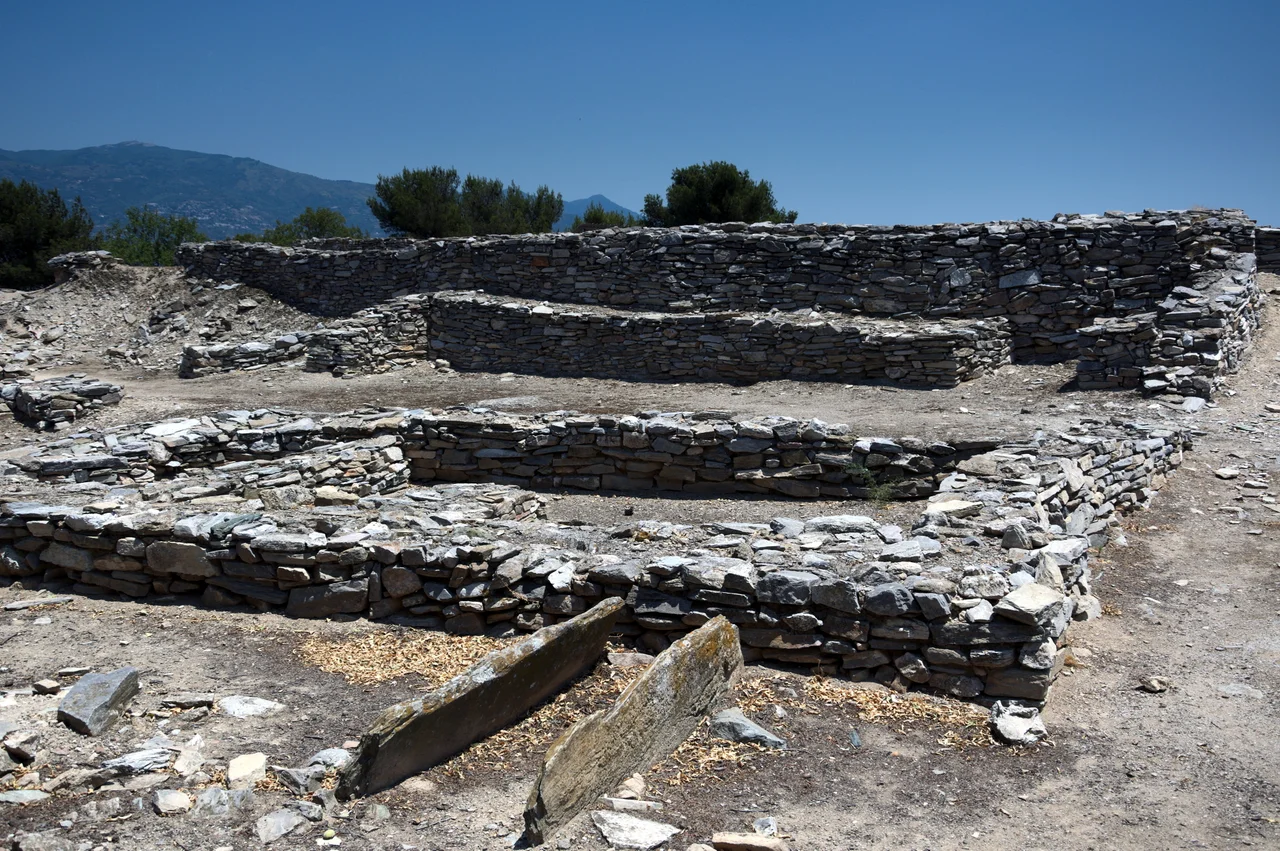
Stand at the heart of the Dimini acropolis and you are surrounded by rings. Six concentric stone walls, low and close-set, wrap the hilltop like the growth rings of a tree. People raised them nearly seven thousand years ago, between roughly 4800 and 4500 BC, when the wheel was new and writing did not yet exist anywhere in Europe. At the center sits a megaron, a large rectangular hall, and around it the foundations of mud-brick houses, a drainage system, and a kiln big enough to fire the painted pots that made this place famous. Most villages this old left almost nothing. Dimini left a town plan.
The Rings of the World
The walls are what stop you first. Archaeologists count six, in places seven, concentric enclosures, each two to three meters tall and in spots barely a meter apart. For more than a century scholars argued over what they were for. Defense against raiders? Pens for animals? Markers of rank, with the most important households living closest to the center? The honest answer is that we are still deciphering a society that left no words behind, only stone and clay. What is clear is intention. Someone planned these rings, organized the labor to build them, and decided who lived where. The architecture itself argues for an early social hierarchy, a community already sorting itself into insiders and outsiders, near and far.
Painted in Spirals
Then there is the pottery. Dimini ware is the signature of Thessaly's Late Neolithic, vessels covered in abstract painted designs, spirals, meanders, and lattices in red and brown on pale clay. These were not crude pots. They were carefully composed surfaces, traded and copied well beyond the village. Fragments turn up across the region and as far away as Cakran in modern Albania, evidence of contact and exchange across distances that, on foot, meant weeks of travel. The finest examples now sit in glass cases in Athens. Picture the potter who first dragged a brush in that tight spiral, working by firelight, with no idea that the gesture would outlast every empire that came after.
Was This Iolcos?
Dig down through the Neolithic layers and a second city emerges, thousands of years younger. In 2001, after two decades of excavation led by Vasiliki Adrimi-Sismani, archaeologists uncovered a Mycenaean palace complex from the Late Bronze Age, with two grand halls, two beehive-shaped tholos tombs, and a sherd inscribed in Linear B, the earliest Greek script. Many believe this was Iolcos, the city Homer named as the home of Jason and the launching point of the Argonauts. The identification is debated, and proof remains elusive. But the idea is irresistible: that the myth of the golden fleece set sail from this very hill, where the Aegean wind still carries the smell of salt up from the gulf.
Neighbors, Not Conquerors
An older theory held that the Dimini people were invaders who violently overran the nearby Sesklo culture around 5000 BC, two peoples locked in conquest. Newer dating tells a gentler story. When researchers Ioannis Lyritzis and Richard Galloway tested ceramics from both sites using thermoluminescence, they found that Dimini's inhabitants appeared around 4800 BC, four centuries before Sesklo declined near 4400 BC. The two communities overlapped. They were neighbors who shared a landscape for generations, not armies who replaced one another in a single bloody season. It is a useful reminder that prehistory, like the present, was mostly made of ordinary people living side by side.
From the Air
Dimini sits at 39.355°N, 22.889°E, on low hills just west of Volos at the head of the Pagasetic Gulf. The nearest airport is Nea Anchialos National (LGBL), roughly 15 km southwest. From a viewing altitude of 2,000 to 3,000 feet, look for the green ridge separating the city from farmland; the excavated acropolis is a small terraced rise. The broad, sheltered gulf and the long ridge of Mount Pelion to the east are the clearest navigation landmarks. Clear Thessalian summer skies offer the best visibility.
Nearby Stories
- Farsala 10 km away
- Oreus 10 km away
- Glossa 13 km away
- Archaeological Museum of Lamia 14 km away
- Tempi Train Crash 55 km away
- Mount Olympus 61 km away
- Siege of Euripos 62 km away
- Byzantine Empire under the Palaiologos Dynasty 112 km away