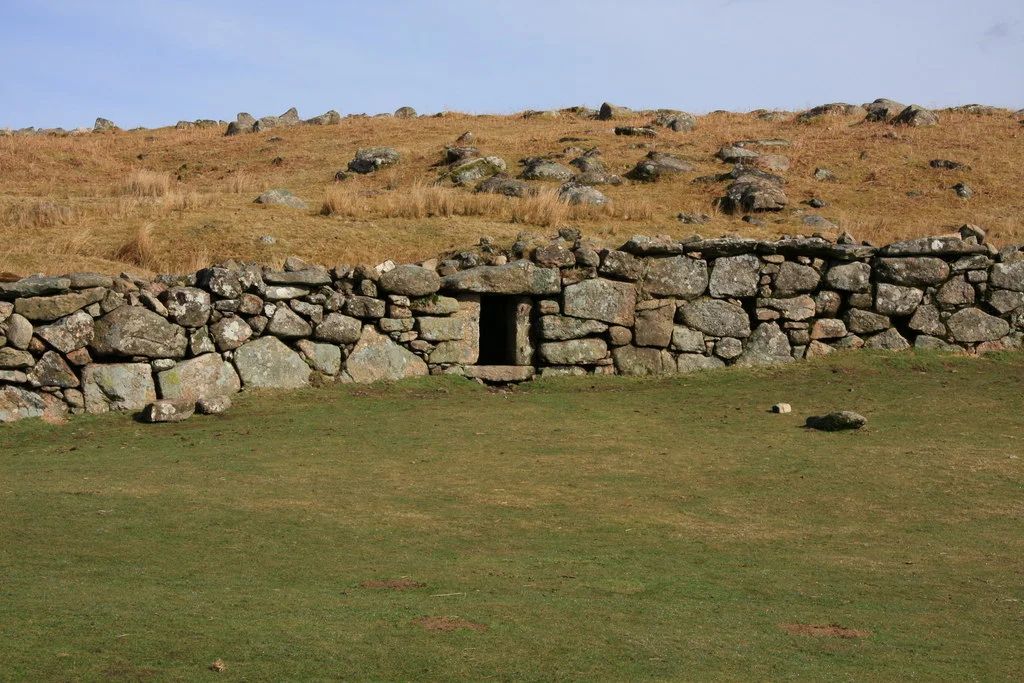

Ditsworthy Warren House
Rick Carter, the production designer for War Horse, spent months looking for the right place. When his location scouts finally led him onto the southwest edge of Dartmoor in 2010, he knew. "Finally in Dartmoor," he said later, "we found a derelict building in the middle of nowhere that we brought back to life. It had 360-degree views, which give it a sense of being part of something huge and imposing - the expanse of skies, the force of the elements - and that created a beauty beyond what we had hoped for." The building was Ditsworthy Warren House, a Grade II listed granite cottage above the upper Plym valley near Sheepstor, and it had been waiting in the middle of nowhere for several hundred years already.
A House for the Warrener
Ditsworthy is a warren house - a building constructed for the keeper of an artificial rabbit warren, in an age when rabbit meat and fur were valuable enough to justify hiring someone to live out on the moor and tend the colony. The warren itself comprises 53 pillow mounds, each averaging 16 meters long and 7.2 meters wide, built up by the warreners to give the rabbits comfortable dens and easier capture. Just east of the house stands the Kennel Court, with six-foot walls to keep the warren dogs from escaping. The dating of the cottage itself is genuinely disputed. The 1978 listing entry puts the oldest part at the late 18th or early-to-mid 19th century. The Pastscape record argues for late 16th or early 17th-century work on still earlier foundations, noting that Ditsworthy is first mentioned in a 1474 document and was probably already old by then.
Granite Rubble and a Late Wing
The walls are built of granite rubble pulled from the surrounding moor, the kind of stone that simply lies on the surface in any sufficient quantity here. Patches of external render still cling to the stonework; most has weathered away. The original roofing would have been stone roof tiles, heavy and durable in a place where the wind never really stops. The house was once symmetrical: two storeys, central door, central porch. A late-19th-century extension on the right-hand end broke the symmetry, adding a single room on each floor. A shippon stands next door - the local Devon word for an outbuilding housing livestock. Together they form a small compact island of human habitation set in a vast empty expanse of bog, granite, and grazing sheep.
Leased to the Admiralty
Long after the warren itself fell out of use, the house found a new role. The British Armed Forces train across large stretches of Dartmoor - the moor's emptiness and unforgiving weather make it ideal for what soldiers need to learn - and Ditsworthy Warren House is leased by the Admiralty as part of that training estate. There is no vehicular right of way to the building. Walkers and horse riders can reach it on bridleways, but the land immediately around the house is not open to the public. The result is that one of the most photographed cottages on the moor sits in one of its quietest corners. The Plym flows somewhere below, Legis Tor watches from the north, and the wind that swept the warreners' faces still pours uninterrupted across the same fields.
Spielberg on the Moor
In August 2010 a film crew arrived. Steven Spielberg was adapting Michael Morpurgo's novel about Joey, the Devon farm horse sold to the army at the outbreak of the First World War, and he had chosen Ditsworthy to play the Narracott family farmhouse. The crew thatched the granite roof, hung window shutters, added a lean-to woodstore, and built a cruck-framed barn nearby. When filming ended, every alteration came off again. The site was restored to its previous state, exactly as the National Park required. Two local first-time filmmakers had been hoping to shoot at the same location in the same weeks and only discovered Spielberg's plans shortly before their own start date; they moved to Nun's Cross Farm near Princetown instead. A local blogger slipped past the on-set security in March 2011 and posted photographs of the interior dressing and of Spielberg himself.
After the Cameras
The thatch is long gone. The cruck barn has been dismantled. The cottage sits as it did before the trucks rolled in, weather-stained granite under a stone-tiled roof, surrounded by the pillow mounds of the old warren and the empty bowl of the Plym valley. People who walk out to it from Sheepstor or from Cadover Bridge find one of the most striking sites on southern Dartmoor - not because anything dramatic happens there now, but because nothing ever has, in any conventional sense. A warrener lived here. Generations of dogs and rabbits passed through. The Admiralty took a long lease. A film crew came and went. The rest is sky and wind and granite, in the proportions that have made this corner of England what it is.
From the Air
Ditsworthy Warren House sits at 50.479N, 3.997W on the southwestern edge of Dartmoor, above the upper Plym valley near Sheepstor. The cottage is small and may be hard to spot directly - the better visual cue is the broad open bowl of the upper Plym just south of Burrator Reservoir, with Legis Tor rising to the north. Recommended viewing altitude 1,500-2,500 feet AGL. Nearest airfield is Plymouth (EGHO) about 8nm south-southwest; Exeter (EGTE) lies about 30nm east-northeast. Note that Dartmoor live-fire training areas are northwest of here near Princetown - check NOTAMs. Visibility on the southern moor is generally better than further north, but low cloud is common.
Nearby Stories
- Bodmin Moor 4.1 km away
- South Devon Railway sea wall 4.8 km away
- Tiverton Castle 12 km away
- Hope Cove Lifeboat Station 14 km away
- Caerhays Castle 20 km away
- Holsworthy 22 km away
- HMS Formidable (1898) 32 km away
- HMS Montagu 41 km away