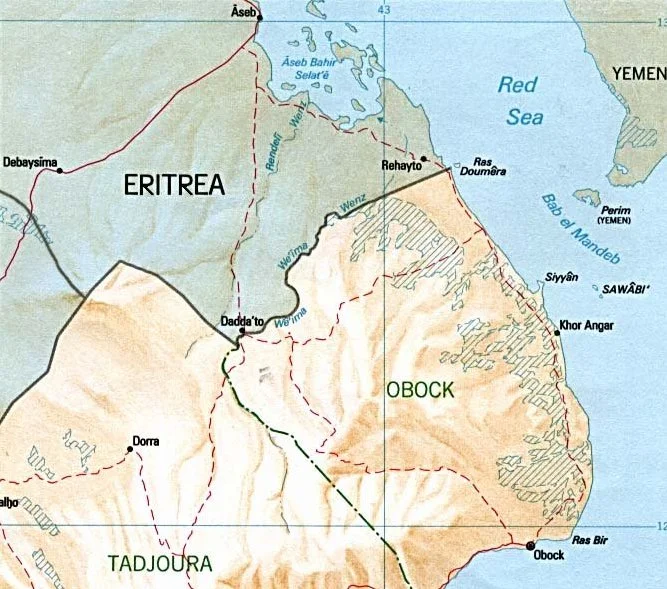

Djiboutian-Eritrean Border Conflict
The hill is called Ras Doumeira and it rises 240 meters above the Red Sea at the exact spot where Djibouti, Eritrea, and the open ocean meet. No one really wants it. There are no oil seeps, no fresh water, no tillable soil - just rock, wind, and heat that can break 45 degrees Celsius in the shade. Yet in June 2008, soldiers from two of the world's smallest armies fired at each other across its slopes for four days, and one of the most durable freezes in modern African diplomacy followed.
A Border Drawn with a Ruler
The line runs through Ras Doumeira because French and Italian diplomats drew it there in 1900. An agreement that year placed the international boundary at the cape and had it follow the peninsula's watershed for 1.5 kilometers. Doumeira Island, just offshore, was declared demilitarized and left unassigned. The arrangement worked as long as France held Djibouti and Italy held Eritrea - colonial neighbors managing their own imperial housekeeping. But the 1935 Franco-Italian Agreement, which transferred parts of French Somaliland to Italian Eritrea, was never fully ratified. When Eritrea finally won independence from Ethiopia in 1993, it inherited an unresolved claim. The hill remained a question no one wanted to answer.
Trenches in January
In January 2008, Eritrean soldiers asked to cross into Djiboutian territory to collect sand for a road project. Instead they occupied a hilltop and started digging. By April 16, Djibouti reported that Eritrean troops had fortified positions on both sides of the border and cut trenches into the rocky ground. Djibouti's president Ismail Omar Guelleh complained. Eritrea's President Isaias Afwerki denied that any troops had crossed anywhere. Ethiopian Prime Minister Meles Zenawi, watching from Addis Ababa, called the situation 'a threat to the peace and security of the whole Horn of Africa' and quietly noted that Ethiopia depended on the Djibouti-to-Red-Sea trade corridor for everything it imported. The pieces were set.
Four Days of Rifles
On June 10, 2008, several Eritrean soldiers deserted their positions and ran into Djibouti seeking asylum. Eritrean forces opened fire, demanding the deserters be returned. Djiboutian soldiers fired back. For four days, the two armies traded shots across the hill. Djibouti - its army estimated at 18,000 against Eritrea's 200,000 - took the heaviest losses, and French military advisors, operating under a mutual defense treaty, provided logistical, medical, and intelligence support from Djibouti City. France did not join the actual fighting; President Guelleh preferred that his own soldiers defend their homeland. On June 13, Djibouti announced the fighting had subsided. Both sides buried their dead. Eritrea kept four Djiboutian soldiers as prisoners of war.
The Long Thaw
International pressure arrived in waves. The Arab League demanded Eritrean withdrawal. The United States condemned Eritrea's 'military aggression.' In January 2009, UN Security Council Resolution 1862 welcomed Djibouti's pullback and demanded Eritrea do the same within five weeks. Eritrea refused. In December 2009, Resolution 1907 imposed an arms embargo on Eritrea, travel bans on its leaders, and froze assets. Qatar brokered mediation in 2010 and deployed peacekeepers to the hill. The four Djiboutian prisoners came home in March 2016, eight years after their capture. Then in 2017, when Saudi Arabia and the UAE led a blockade of Qatar, Doha pulled its peacekeepers out of Ras Doumeira. Within days, Djibouti accused Eritrea of reoccupying the hill and Doumeira Island. Nothing had been resolved; everything had simply paused.
Normalizing, Slowly
In September 2018, Djibouti and Eritrea announced they would normalize relations. The timing was not coincidental. Earlier that year, Ethiopian Prime Minister Abiy Ahmed had made peace with Eritrea, ending a twenty-year freeze that had warped the entire Horn of Africa. Suddenly Eritrea had friends. Ports on the Eritrean coast, dormant for decades, began to reopen. But the hill itself - Ras Doumeira, with its trenches, its wind, its commanding view over shipping lanes where 30 percent of world commerce passes - has never been clearly demilitarized since Qatar left. Border disputes in the Horn rarely end. They just get quieter, and the soldiers hold their positions, waiting to see who builds more trenches next.
From the Air
The disputed hill and island lie at 12.71°N, 43.13°E, roughly 120 kilometers north of Djibouti City on the Red Sea coast. From cruising altitude, Ras Doumeira appears as a dark basalt cape jutting into the turquoise Bab-el-Mandeb. The nearest civilian airport is Djibouti-Ambouli International (ICAO: HDAM, IATA: JIB). The area is heavily restricted; do not overfly below 10,000 feet without Djiboutian or Eritrean clearance. Clear weather prevails most of the year; expect hazy visibility from Saharan dust April through July.
Nearby Stories
- Mokha 40 km away
- French Submarine Vengeur 71 km away
- Djibouti 77 km away
- Ashrafiya Mosque 77 km away
- Southern Red Sea region 139 km away
- USS Cole Bombing 153 km away
- Berbera 275 km away