
Mokha
The coffee never grew in Mokha. It grew in Ethiopia and the highlands of Yemen and came down to the port on camelback, and Mokha took it from the camels and loaded it onto ships that would carry Coffea arabica to Cairo and Istanbul and, eventually, to Amsterdam and London and the coffee houses that transformed European sociability. For three hundred years Mokha was the bottleneck through which the world's coffee flowed. Mocha beans from Sana'a - the Yemeni coffee the traders called Sanani - were prized for their distinctive flavor, and they still are. The Ottoman law that required ships entering the Red Sea to stop at Mokha and pay duty made fortunes. Then the world found other sources. Mokha is now a small fishing port, but the name echoes in coffeehouses everywhere.
Before the Ottomans
Based on the ancient Periplus of the Erythrean Sea, a Greek-Egyptian navigational manual written in the first century, scholars believe the important ancient emporium of Muza was near present-day Mokha. The exact site has been debated - either Mokha itself, the coastal village of Maushij, or the inland settlement Mauza' - but what is clear is that ships traded along this coast in Roman times. Then history goes quiet. For more than a thousand years the site was a small fishing village, unremarkable, turning its face toward the modest Red Sea trade that continued after Rome. Everything changed in 1538 when the Ottomans arrived in Yemen and recognized what the geography offered: Mokha was the first decent port north of the Bab-el-Mandeb strait, the narrow southern entrance to the Red Sea. Every ship coming up the trade routes from the Indian Ocean had to pass through that chokepoint, and Mokha was where they could be required to stop.
The Coffee Monopoly
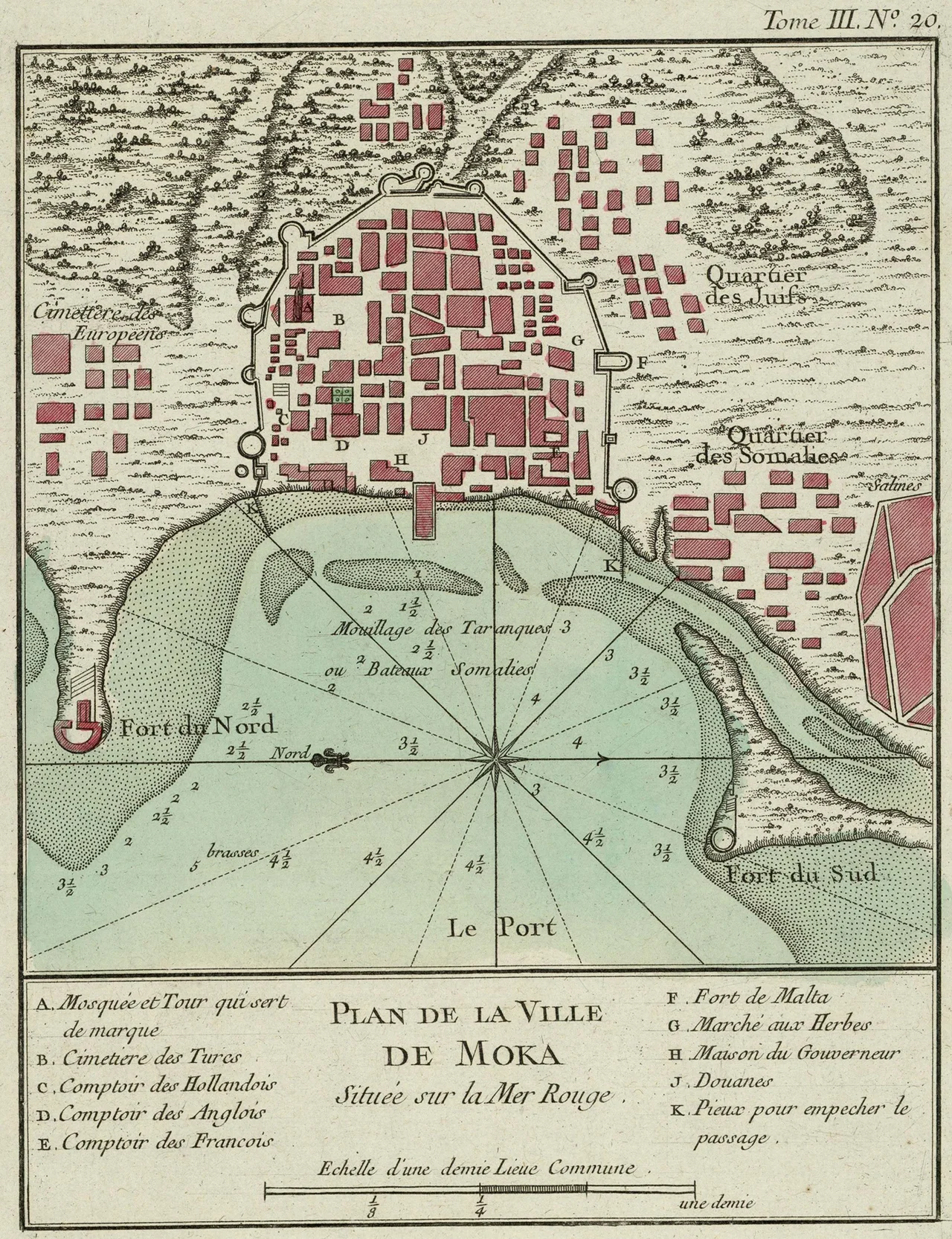
Mokha became a market for everything that moved through the southern Red Sea - frankincense and myrrh, Dragon's blood and Socotrine aloe, cumin and the Balm of Gilead - but coffee was the commodity that made it famous. From the sixteenth century through the nineteenth, Mokha was the principal coffee-exporting port on Earth. English, Dutch, and French trading companies maintained factories in the town. The city had a stone wall around a citadel, and outside the wall spread a labyrinth of thatched huts, some four hundred of them housing Jewish traders who worked chiefly in coffee. The Somalis of Berbera brought the produce of the Horn of Africa across to Mokha in their own dhows - coffee, gum arabic, myrrh - operating under what the traveler Henry Salt called a kind of navigation act that excluded Arab vessels from Somali ports. Foreign observers at Mokha were quick to correct the prejudices of earlier travelers like James Bruce, who had called the Somalis savage. The traders they saw were peaceable, industrious, and running a sophisticated cross-continental commerce.
Plague and Decline
The eighteenth century brought a plague that killed half of Mokha's population, and the city never fully recovered. The coffee trade continued but other centers - Java in the Dutch East Indies, the French Caribbean, the Spanish colonies - began growing coffee of their own, often at a fraction of Yemen's prices. Ethiopian coffee, always the ultimate origin of the plant, became the principal source for North African markets, selling for a third of the price of the same coffee imported through Arabia. In 1817, a British lieutenant was reportedly mistreated in Mokha, and when the imam's governor refused British demands for redress, the British responded in December 1820 by sending HMS Topaze and East India Company troops to attack and destroy the city's North and South Forts. A decade and a half later Ibrahim Pasha of Egypt attacked again, destroying the seaward wall and the citadel. By the time diplomat Edmund Roberts visited in the 1830s, a fragmented Turkish rebel faction under Turkie ben al Mas held the town. When Jacob Saphir visited in 1859, he saw many houses vacant of dwellers.
Naming the World's Coffee
Even after the trade moved elsewhere, Mokha's name stuck to coffee. The mocha latte - espresso with chocolate and milk - takes its name from the port. So does the Moka pot, the stovetop espresso maker the Italians designed in the 1930s. The Yemeni wild Mocha coffee bean is still considered a distinctive varietal, prized for its complex flavor. The Port of Mokha in its modern form was established in 1955. The patron saint of the town is Ali bin Omar al-Shadhili, a Sufi holy figure whose name local lore sometimes links to the introduction of coffee drinking to Yemen itself. Mokha gave the world a word, a drink, and a brewing method, and then mostly stepped out of the frame that its own name still occupies.
War and What Remains
The modern Yemen war has battered Mokha badly. The Houthis took the city in late 2014 during their southern offensive. An Arab coalition bombed it in July 2015. Pro-Hadi forces recaptured it in February 2017. In 2021, an alleged Houthi attack using ballistic missiles and drones caused major damage to the port, destroying warehouses being used by aid organizations, the Associated Press reported. What remains is a small fishing town. Local coffee farms cannot compete on price with plantations in former colonies in Java, Brazil, and elsewhere, and Mokha's economy is now largely based on fishing the Red Sea. The minaret of the old mosque still rises against a sky that has seen five centuries of dhow traffic and now sees almost none. The camels no longer carry coffee down to the port. But in every café where someone orders a mocha, the city's name still travels.
From the Air
Mokha is at 13.32°N, 43.25°E on the Red Sea coast of Yemen in Taiz Governorate, just north of the Bab-el-Mandeb strait. Sana'a Airport (OYSN / SAH) is about 260 km northeast; coastal access has been heavily disrupted by the ongoing Yemen war. Climate is hot desert (BWh) - very low rainfall, high temperatures. From altitude the small port and the mosque minaret are distinguishing features, set between desert and sea. Note: Yemeni airspace has significant security restrictions and active conflict - verify access and consult NOTAMs carefully.
Nearby Stories
- Ashrafiya Mosque 7.8 km away
- Assab 16 km away
- Italian Empire 20 km away
- Zafar, Yemen 116 km away
- USS Cole Bombing 117 km away
- Battle of Al Hudaydah 150 km away
- Southern Red Sea region 152 km away
- Tadjoura 166 km away