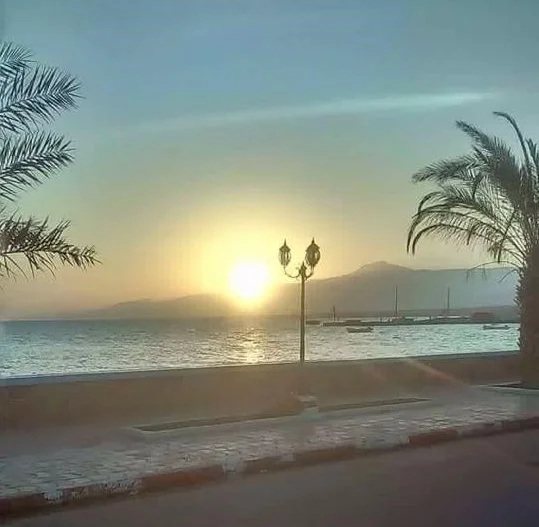

Tadjoura
The Afar name for Tadjoura is Tagorri. It derives from tagor, a goatskin flask for drawing water. The fuller form, tagor-li, means something like "that which has goatskin flasks to draw water" - in effect, "abundant with water." In a country where water is the scarcest resource and the most precious commodity, a town named for having water is making a claim. Tadjoura has kept the claim for at least four centuries. Its population today is around 19,000, the third-largest city in Djibouti after the capital and Ali Sabieh. Its whitewashed buildings shine against the Gulf of Tadjoura blue. A list of its sultans stretches back to Burhan bin Muhammad in 1620 and ends, or pauses, in 2019 with the death of Abd'ul Kadir bin Hummad bin Muhammad bin Arbahim, whose four-part name preserves three and a half centuries of patrilineal memory.
Rise of the White House
Tadjoura's emergence as a significant port began around 1810, when the Adoimara - the "white house" moiety of the Afar people - defeated their rivals, the Asa-yamara or "red house." The Adoimara were allied to the rulers of Shewa in the Ethiopian highlands, and their victory opened a reliable trade corridor between the Ethiopian interior and the Gulf of Tadjoura. The town became the seat of an Afar sultan known as the Dardar, who claimed authority over the northern Adoimara as far as the borders of Shewa - though even his staunchest supporters admitted his actual writ did not reach beyond Lake Assal, a short distance inland. Tadjoura differed from rival ports in that it handled almost entirely the trade of Shewa and the Sultanate of Aussa, rather than the trade of Harar or the Ogaden. This specialization made it prosperous.
The Annual Bazaar
Each September, according to the British explorer William Cornwallis Harris, Tadjoura's beach piled up with merchandise, and its suburbs filled with camels, mules, and donkeys. The bazaar ran for two months. Everything that Ethiopia and the Afar lowlands produced that could be sold to Arab, Indian, or European merchants flowed through here: ivory, gold, ostrich feathers, wheat, durra, honey, senna, madder, civetone. The trade was handled entirely by women, the traveler C.T. Beke noted, who loaded camels and managed the transactions while the men stayed away - "to avoid bloodshed, this country being the scene of constant feuds among the different tribes." Total trade in 1880-81 was estimated at 29,656 rupees in exports and 18,513 rupees in imports, modest by European colonial standards but substantial for a regional port. By the mid-19th century, as other Afar port towns declined into small decaying villages, Tadjoura was thriving.
The Slave Market
Much of Tadjoura's prosperity rested on a painful foundation. The town was one of the most important slave markets on the Red Sea coast. Historian Richard Pankhurst estimated that roughly 6,000 people a year left Ethiopia through the combined ports of Tadjoura and Zeila during the 19th century. These were human beings - captured in raids, sold into debt bondage, or seized in wars - forced onto dhows bound for Arabia, Egypt, and beyond. Their lives and names are mostly lost to the historical record. The slave trade was formally abolished in French Somaliland by decree on October 26, 1889. Noel-Buxton reported that Tadjoura continued as a slave-trade center after the decree, but limited to smaller, more frequent shipments. Formal prohibition ended the market eventually, though the economic damage to Tadjoura - whose wealth had depended partly on this traffic - was offset for a while by arms trade, as the town became a distribution point for rifles and ammunition bound for Shewa and Ethiopia. The French poet Arthur Rimbaud, after abandoning poetry for commerce, lived in Tadjoura during this period.
French Arrival, Railway Decline
Between 1883 and 1887, France signed a series of treaties with Somali and Afar sultans that allowed it to expand its protectorate to include the Gulf of Tadjoura. Leonce Lagarde became the protectorate's first governor. In 1894 he established permanent French administration in the then-new city of Djibouti and named the region Cote francaise des Somalis - French Somaliland. Tadjoura's fortunes turned once the Ethio-Djibouti Railway began running in 1901 and reached Dire Dawa 17 months later, then Addis Ababa on December 3, 1929. The railway carried Ethiopian trade directly to the newer, deeper port of Djibouti. Tadjoura, without a rail connection, lost its main role. For most of the 20th century it was a small whitewashed coastal town served only by ferry from the capital - two and a half hours across the Gulf - living on fishing, a bit of tourism, and the memories of an earlier prosperity.
The New Port
The 21st century has brought Tadjoura a new chance. In 2000, the old port was modernized at a cost of USD 1.64 million. Then the government invested roughly USD 90 million in a much larger deep-water port, designed primarily to handle potash from Ethiopia's Afar Region - where massive deposits have been the subject of mining interest for years. The new port also serves livestock, sesame, frankincense, fertilizers, and grain. A new road, RN-11, runs from Tadjoura to Balho, dramatically shortening the driving time for Ethiopian cargo bound for the Afar and Tigray regions compared with the traditional route via Galafi. Whether the potash mining ever fully develops, the port is positioned for Djibouti's longer-term strategy of serving as Ethiopia's maritime gateway not just through the capital but through multiple coastal facilities.
Whitewash and Blue Water
From the air, Tadjoura sits on a curve of coast where the land comes down to meet blue water. The whitewashed buildings reflect sunlight so strongly that in midday they can be hard to look at. Tadjoura Airport operates a single runway on the edge of town. The Gulf of Tadjoura stretches east, with Djibouti City visible on clear days on the southern shore. To the north, the Afar interior climbs toward the rift and the active volcanism of the Danakil. The beaches at sunset are where the old town comes out to walk - a continuity of daily ritual that has probably gone on longer than the oldest building still standing. Four hundred years of sultans, counted by their fathers' names, back to Burhan bin Muhammad in 1620, and before him into memory that fades into myth.
From the Air
Located at 11.78°N, 42.88°E on the northern shore of the Gulf of Tadjoura. Tadjoura Airport (HDTJ) provides single-runway aviation services. Recommended viewing altitude FL150-250. The Gulf of Tadjoura is visible as a distinct bay between Tadjoura and Djibouti City (approximately 60 kilometers south by water, 130 kilometers by road). Expect hot temperatures year-round and possible thermal activity during midday. Lake Assal - 153 meters below sea level, the lowest point in Africa - lies a short distance south of Tadjoura and is a dramatic geographic feature.
Nearby Stories
- Afar triple junction 33 km away
- Zeila 37 km away
- Bab-el-Mandeb 52 km away
- Lake Abbe 65 km away
- Djiboutian-Eritrean Border Conflict 79 km away
- Sultanate of Aussa 89 km away
- Perim 91 km away
- Southern Red Sea region 195 km away