_Al-Ashrafiya.jpg)
Ashrafiya Mosque
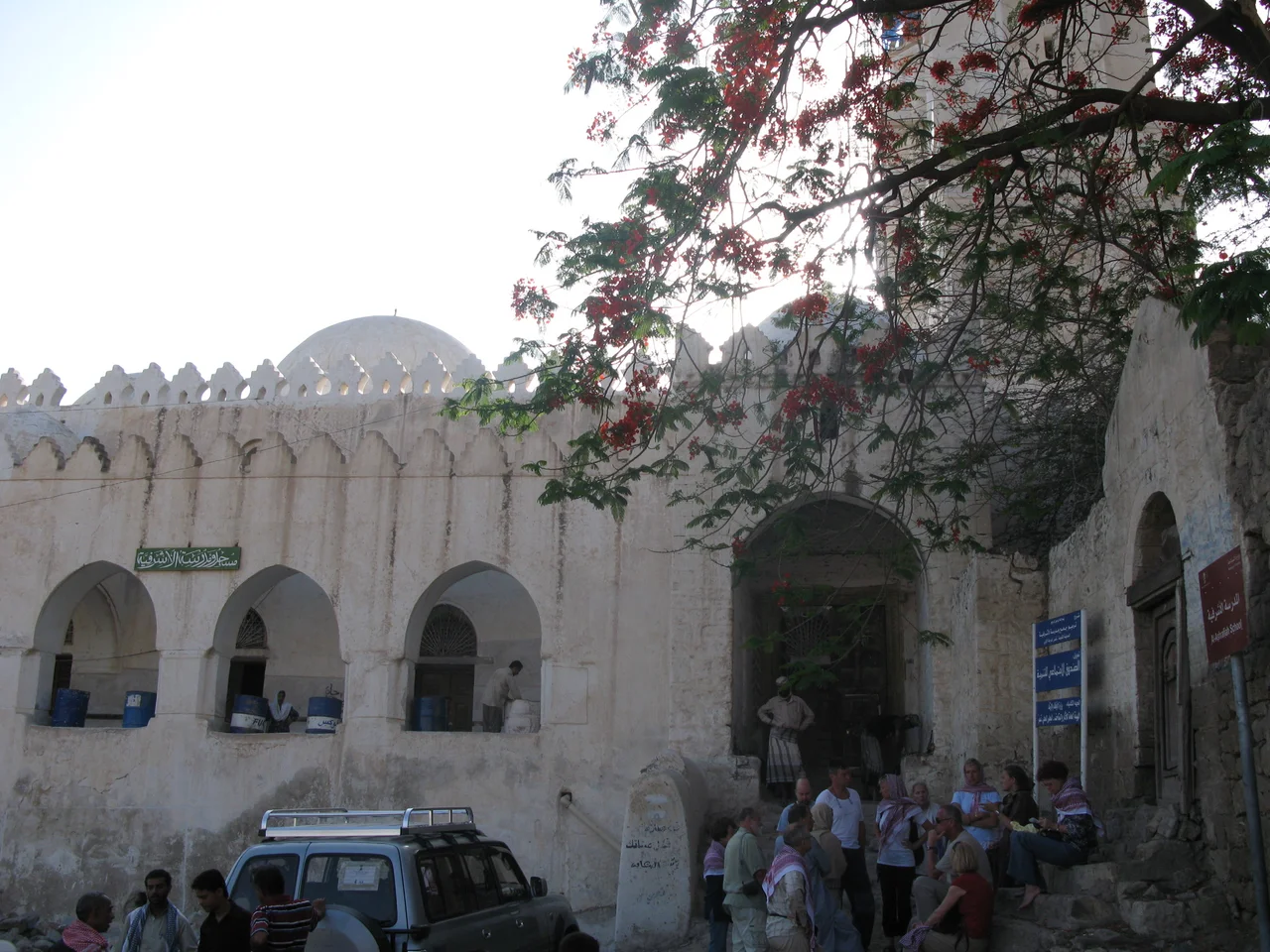
The two minarets rise at the foot of Mount Sabr in the old city of Taiz, and from a distance they look identical. Walk closer and they begin to disagree with each other. One is a little taller. The proportions shift. The Sultan Al-Ashraf Isma'il I, who finished the Ashrafiya Mosque in 1382 CE - 803 in the Islamic calendar - seems to have wanted a kind of deliberate near-symmetry, a building that would draw the eye and then reward it for lingering. Inside, the central dome opens above a prayer hall flanked by twin halls of four smaller domes each, the whole interior painted with floral motifs, geometric patterns, and Quranic calligraphy in stucco of such refinement that scholars have called it finer than anything comparable in medieval Yemen. The Ashrafiya is the most recognizable surviving monument of the Rasulid dynasty that ruled this country for two and a half centuries.
A Dynasty's Signature
The Rasulid dynasty governed Yemen from 1229 to 1454, and at their peak in the late thirteenth and fourteenth centuries, they made Taiz their capital and patronized a remarkable flowering of architecture, scholarship, and science. The Ashrafiya Mosque was built in two campaigns by sultans of that dynasty: the first around 1295-96 under Al-Ashraf Umar II, the second completed in 1382 by Al-Ashraf Isma'il I. Al-Ashraf Umar II was himself a scientist, an astronomer and genealogist whose treatises on horology and horticulture still survive in manuscript. The mosque that carried his name was therefore never only a place of prayer. It was also a madrasa, a library, and a tomb complex where Rasulid kings were buried beneath the domes they had commissioned. The Shafiʽi legal school taught here made Taiz one of the great centers of Islamic jurisprudence in its era.
The Architecture
The building sits on storm drains - a practical detail that explains the red brick used above the foundation. The exterior is finished in qadad, a lustrous traditional Yemeni plaster of slaked lime treated with oils, burnished by hand to a pale ivory sheen. The mosque originally consisted of a single prayer hall under one large central dome surrounded by eight smaller domes. Later additions added a square courtyard behind the prayer hall, wrapped with a royal tomb chamber and classrooms for the Quranic school, so that the whole complex forms a near-perfect square on the ground. The qibla wall - the wall that faces Mecca - is layered with arcades of adjacent arches, each a little smaller than the last, producing a receding perspective that pulls the eye toward the mihrab. Every surface that could be decorated has been.
A School of Law
The Ashrafiya functioned as one of the most influential centers of Shafiʽi Islamic scholarship anywhere in the medieval Muslim world. The library on site held manuscripts across the range of traditional Islamic sciences - Quranic exegesis, hadith, law, grammar, poetry, astronomy, medicine - and students came from across Arabia and beyond to study under its teachers. Above the main entrance to the madrasa, an inscription still greets arriving students, part of the mosque's decorative program of painted religious calligraphy. Unlike many madrasa-mosques where the teaching and prayer spaces are kept separate, the Ashrafiya integrated them: a student might move from a lesson into a prayer without leaving the building. In Yemen, this integration was distinctive. The Rasulids were making a statement about what they thought a sultanate should be.
The War Arrives
In 2015, the Yemeni Civil War reached Taiz. The Houthi movement, formally called Ansar Allah, and forces loyal to former president Ali Abdullah Saleh shelled the neighborhood of Al-Ashrafiya repeatedly. On 17 June 2015, at 4:30 in the afternoon, an artillery round struck the eastern minaret. Witnesses described the blast shattering windows in houses throughout the quarter. The shell left a clear crack running through the middle of the minaret. The deputy director of tourism for Taiz governorate, who was there, said local residents believed the Houthis had been aiming at a house nearby and missed - an accidental hit on a 633-year-old monument. There had been other shellings before that one. Yemeni residents, preservationists, and human rights groups have pleaded for the mosque to be treated as a protected cultural site. The fighting has not entirely stopped. For the artisans and guides who depended on the visitors who used to come to the old city, the war has been economic as well as structural.
Restoration, Continuing
A long-running restoration project, launched in 2007 and highlighted at the 2012 Third International Architectural Conservation Conference in Dubai, has been slowly bringing the Ashrafiya back. Thirteen Yemeni technicians trained locally in the documentation and restoration of gypsum motifs. The murals and stucco decoration were cleaned and stabilized to better than half their original condition. The central dome and prayer hall walls were consolidated to about sixty-five percent. Electrical wiring was run through the building for the first time. The southern and northern walls, the eastern domes, and the basement were replastered. By July 2014, one phase of the work was declared complete - and then the war of 2015 arrived and undid some of it. The people of Taiz have rebuilt their mosque before. The scaffolding has gone up again.
From the Air
The Ashrafiya Mosque stands at 13.569 N, 44.009 E in the old city of Taiz, Yemen, at the foot of Mount Sabr (3,006 m). Taiz International Airport (OYTZ) lies about 20 km south of the city center but has been largely inactive during the war. Sana'a International (OYSN) is 250 km north. Yemeni airspace is restricted due to ongoing conflict - advance coordination essential. The terrain is mountainous, with Mount Sabr immediately south of Taiz; mountain wave turbulence is common. Haze and dust often reduce visibility in summer.
Nearby Stories
- Yemen Eyalet 38 km away
- Zafar, Yemen 47 km away
- Mokha 50 km away
- 2020 Aden Airport Attack 73 km away
- 2013 Radda airstrike 77 km away
- Italian Empire 95 km away
- USS Cole Bombing 99 km away
- Battle of Al Hudaydah 123 km away