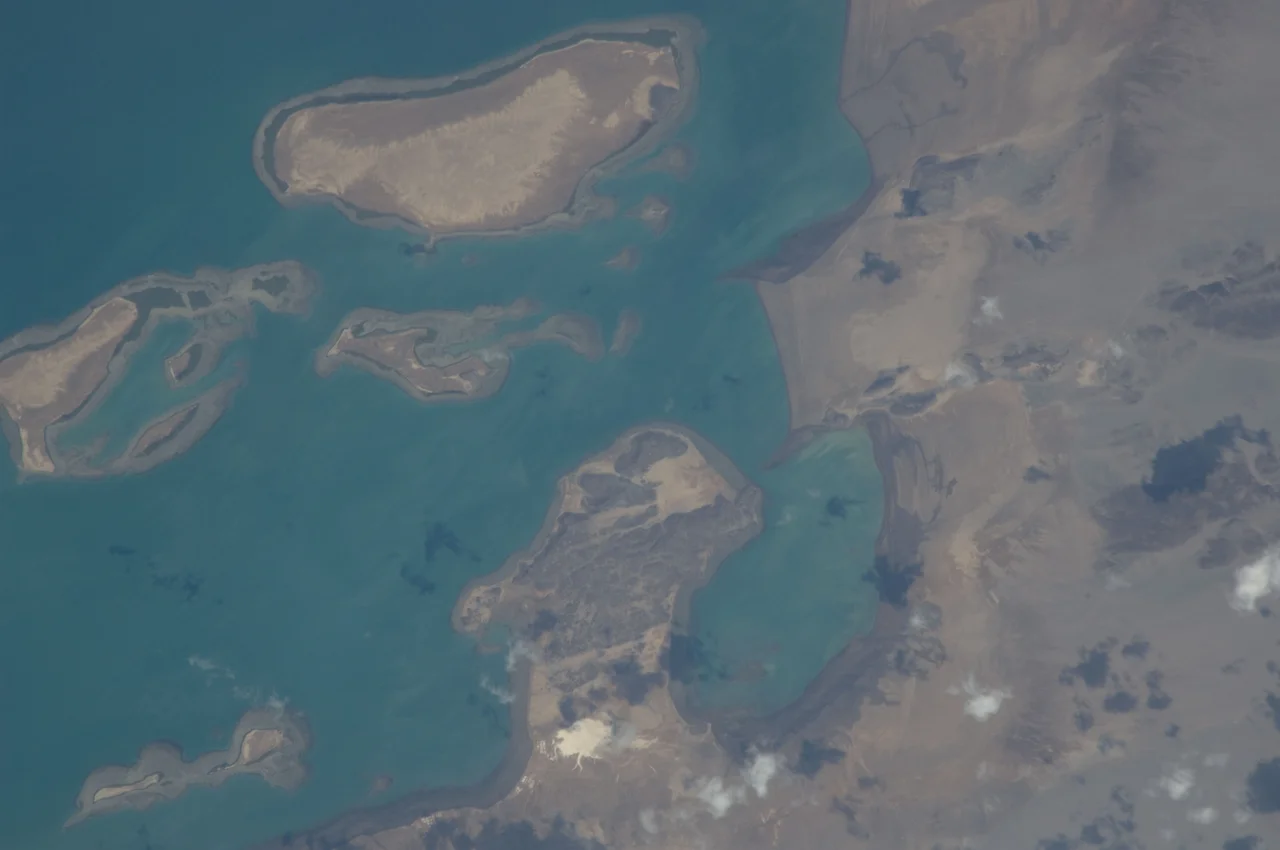

Assab
On 15 November 1869, an Italian missionary named Giuseppe Sapeto stepped ashore on the Bay of Assab and handed over 6,000 Maria Theresa thalers to two Afar sultans, the brothers Hasan ibn Ahmed and Ibrahim ibn Ahmed. They signed the bay over to him. Sapeto was working for the Rubattino Shipping Company, but his real client was Italy itself, which had no African colony yet and saw Assab - a fishing village of about 100 people living in twenty huts - as a foothold on the Red Sea close to the Bab-el-Mandeb chokepoint. The purchase was controversial. The Italian press and parliament opposed it. The Egyptians declared it illegal. None of that mattered. In 1882 the Italian government took control of the port, and the quiet Afar harbor at the edge of the Danakil Depression became the seed of Italian Eritrea, the colony that would eventually lead - more than a century later - to the independent nation of Eritrea.
Rifles for an Emperor
Italy wanted Assab as a gateway to Ethiopia. In the 1880s, Count Pietro Antonelli, Italian envoy to the Shewan king Menelik II, signed a contract to supply Menelik with 2,000 Remington rifles, shipped in through Assab. In 1883 Antonelli extended the deal: a treaty of commerce with the Afar sultan Muhammad Hanfari of Aussa, and a steady trade in guns. By the end of 1884, 50,000 rifles and 10 million cartridges had flowed through Assab in exchange for 600 camels loaded with gold, ivory, and civet. The Italian traveler G. B. Licata visited that year and counted 111 Afars, 140 Arabs, 43 Italians, 12 Abyssinians, and 10 Somalis. It was, he wrote, the beginning of great things to come. History had other plans.
Forgotten and Remembered
In 1885 Italy captured the much larger port of Massawa further up the coast, and Assab slid into the shadow of its northern rival. Menelik II broke off relations with the Italians after his crushing victory at the Battle of Adwa in 1896. Ethiopia thereafter preferred to trade through French Djibouti, and the completion of the Ethio-Djibouti Railway further dried up Assab's traffic. A 1922 British War Office report described Assab as less than a hundred round grass huts and a modest custom house. The British traveler Hermann Norden, visiting in the 1930s, noted that even the black children in the winding lanes gave the fascist salute - a small detail that says everything about how deep colonial administration had reached into a town that Europeans still thought of as unimportant.
The War and After
After the Second Italo-Ethiopian War of 1935-36, the fascist government in Rome rebuilt Assab's port and pushed a road inland to Dessie. Assab became one of the last Italian strongholds in East Africa to fall during the Second World War. On 11 June 1941, the 3/15th Punjab Regiment - Indian soldiers serving under British command - captured the town and its entire garrison, including the commander Pietro Piacentini. After Eritrea's federation with Ethiopia in 1952 and full incorporation ten years later, Soviet and Yugoslav engineers helped expand the port. An oil refinery opened in 1967. Workers came from Tigray and Wollo to the docks and the salt flats. By 1989 Assab's population had reached 39,600, and more than sixty percent of Ethiopia's international trade moved through its quays.
Closed Border, Empty Harbor
Then everything stopped. When the Eritrean-Ethiopian War broke out in 1998, the land border between the two countries slammed shut. Ethiopia, suddenly without a coastline of its own, redirected its trade through Djibouti. Assab's shipping traffic collapsed. The oil refinery had already been shut down for economic reasons in 1997. The 2005 census estimated the population at about 20,222, roughly half of what it had been at its peak. A 2008 border dispute with Djibouti, involving Qatari peacekeepers patrolling a buffer zone, reduced Assab's importance still further. For a decade, Assab was the classic dying port - too hot to be comfortable, too cut off to be useful, and too strategic for any of its several neighbors to leave entirely alone.
A New Geopolitics
In 2015, the United Arab Emirates arrived. The UAE built a deep-water port and expanded the airstrip at Assab International, and used the facility as a launching base for the Saudi-led intervention in the Yemeni civil war that had broken out next door across the Bab-el-Mandeb. Human rights organizations, including Human Rights Watch, have reported that the Emirati base was used for the transit and detention of prisoners from Yemen. During the Tigray War of 2020-2022, the Tigray People's Liberation Front accused Ethiopia of launching drones from the UAE base at Assab. The town sits at the intersection of three active or recent wars - Yemen, Tigray, the Eritrean-Ethiopian border - and its strategic value, which drew the Italian missionary Sapeto in 1869, is once again being bargained over by powers who arrive from elsewhere. Through all of it, the Afar fishermen have continued fishing.
From the Air
Assab sits at 13.008 N, 42.741 E on Eritrea's southern Red Sea coast, near the mouth of the Bab-el-Mandeb. Assab International Airport (HHSB) serves the town and has been expanded for military use since 2015. Hot desert climate with summer temperatures above 40 C - expect high density altitude and strong afternoon thermals. The region sees frequent sandstorms and haze, particularly in spring. Eritrean airspace is restricted; advance coordination essential. Yemeni airspace across the strait remains a conflict zone.
Nearby Stories
- Bab-el-Mandeb 13 km away
- Mokha 15 km away
- Perim 35 km away
- Yemen Eyalet 60 km away
- Southern Red Sea region 97 km away
- Tadjoura 99 km away
- Sultanate of Aussa 146 km away
- Lake Abbe 200 km away