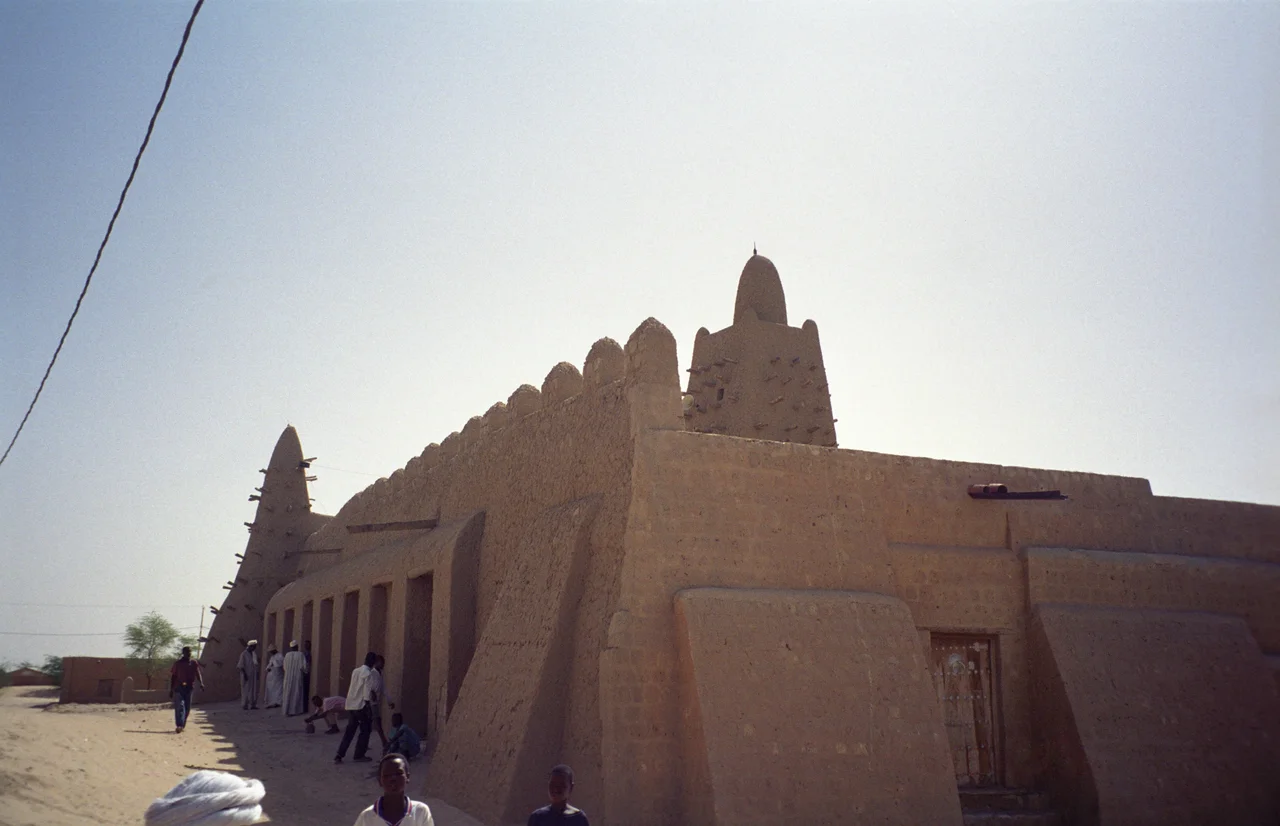

Djinguereber Mosque
It is made almost entirely of mud. Earth, packed and shaped by hand, bristling with the wooden stakes that masons climb each year to re-plaster its walls before the rains return. The Djinguereber Mosque has stood in the heart of Timbuktu since 1327, and after seven centuries it survives not in spite of its fragility but because of it. The faithful rebuild it constantly. To touch its walls is to touch a building that the people of Timbuktu have, in a sense, never finished making.
A King Returns From Mecca
The story begins with gold and a journey. Around 1324, Mansa Musa, ruler of the vast Mali Empire, set out on the hajj to Mecca with a caravan so laden with gold that, by legend, his spending unsettled markets across the regions he crossed. When he came home, he wanted Timbuktu to become a beacon of Islamic faith and learning. The Djinguereber Mosque was the result, its name drawn from the Koyra Chiini words for 'grand mosque.' Tradition long credited the design to Abu Ishaq al-Sahili, a scholar from Muslim Spain said to have been paid a fortune in gold dust. More recent scholarship treats that story as myth, arguing the building's true lineage is West African and Saharan, not Andalusian. The mosque was never an import. It rose from the desert that surrounds it.
Earth, Straw, and Wood
Step inside and the desert light gives way to a forest of pillars. Twenty-five rows of them run east to west, dividing three inner courtyards and a prayer hall that can hold two thousand worshippers. Almost everything is earth, bound with fibre, straw, and wood. Only part of the northern facade and the minaret are limestone, and even the minaret wears a skin of mud. The architecture has a name: Sudano-Sahelian, the style of the great earthen mosques of the Sahel, instantly recognizable by the bristling wooden beams that jut from the walls. They are not decoration. They are scaffolding, permanent ladders for the annual replastering that keeps the building alive against sun, sand, and the occasional brutal rain.
A Mosque That Survives by Being Remade
Survival has never been guaranteed. By 1990 the mosque sat on UNESCO's list of World Heritage in danger, threatened by encroaching sand as the desert advanced. The Aga Khan Trust for Culture launched a multi-year restoration in 2006, repaving, redraining, and replacing roof beams. But the trees whose timber once framed the roof have largely vanished with climate change, so beams now travel from Ghana at great cost. Too much rain is as dangerous as too little; heavy downpours in 1999, 2001, and 2003 collapsed earthen buildings across the city. The masons of Timbuktu, custodians of a craft passed down for generations, hold the building together with the same material it was born from.
When the Tombs Came Down
In 2012, the mosque stood at the edge of catastrophe. After the city fell to the armed group Ansar Dine, militants set about destroying the shrines and saints' mausoleums of Timbuktu, including tombs in the Djinguereber cemetery. Wielding hoes, pick-axes, and chisels, they reduced centuries-old monuments to rubble, declaring the veneration of saints forbidden. The world condemned it; UNESCO's director-general pleaded for restraint. Years later, the International Criminal Court convicted one of those responsible for the war crime of attacking cultural heritage. Local masons, meanwhile, did what they have always done. They rebuilt. The great mosque, scarred but standing, remains the living heart of a city that refuses to let its history be erased.
From the Air
The Djinguereber Mosque sits at 16.77°N, 3.01°W in central Timbuktu, Mali, near the southern edge of the Sahara. Its distinctive pyramidal minaret rises above the low ochre rooftops and is the most recognizable landmark in the old city. The nearest airport is Timbuktu (ICAO: GATB), roughly 7 km north. Approach from the Niger River side to the south for the classic view across the river floodplain toward the desert city. Best visibility is in the dry season; harmattan dust can sharply reduce horizontal visibility from late autumn into spring.
Nearby Stories
- Essakane 13 km away
- Liptako 18 km away
- Tondidarou 86 km away
- Hand of Fatima (rock formation) 159 km away
- Lake Débo 184 km away
- Hombori 187 km away
- Festival au Désert 332 km away
- Oualata 374 km away