
Dock Museum
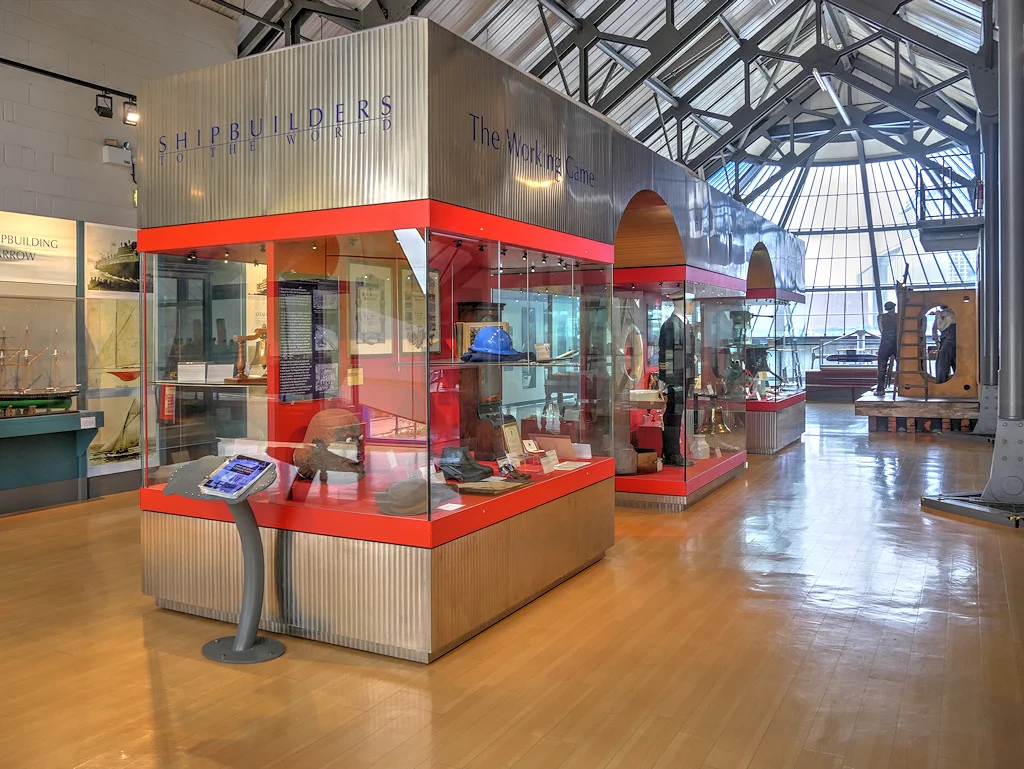
The museum takes its name from the hole in the ground that it sits inside. The graving dock opened in 1872 to repair ships, and when the Dock Museum opened in 1994, the architects built three floors of galleries down inside the old dock walls, suspended around the open space where ships used to be laid up. You walk into the museum at ground level. You walk through it by going down. By the time you reach the films at the bottom you are standing somewhere a hull would once have rested for cleaning and repainting.
The Shipyard Town's Story
Most of the exhibits concern the history of Barrow itself, focused on the things the town did at industrial scale and that few other towns did at all. The shipbuilding industry at VSEL, now BAE Systems. The steelworks, which at one point was the largest in the world. The Furness Railway, which brought the iron ore in and took the steel out. The bombings of the Second World War, known locally as the Barrow Blitz. There has been a museum of one kind or another in Barrow since 1907; the current building, on a site on the Walney Channel, has held the collection since 1994. Fifty thousand people visited in its first year. Visitor numbers peaked at one hundred and twenty thousand in 2001. Entry has always been free, and the museum is still under public ownership.
The Vickers Archive and the Hoard
The Vickers Photographic Archive is ten thousand glass plate negatives donated by the shipyard, recording the men, the cranes, the half-built hulls, the launches, the families on launch day, and the steady industrial rhythm of one of the world's largest naval shipbuilders. It was once available online. The Furness Hoard, a collection of Viking artefacts discovered in 2011 and purchased by the museum in 2012, has a permanent home here; it is one of the most significant Viking finds in the region in recent decades. The museum also has a strong prehistory collection, natural history artefacts, domestic furnishings, and toys. People sometimes assume it is solely a maritime museum. It is not. It is a museum about a town that the sea and the iron beneath it made.
Boats on Display
Four small boats are preserved at the Dock Museum. White Rose is a late-19th-century yacht. Banshee is a Whammel fishing boat from the Morecambe Bay tradition. Nance is a 1914 Morecambe Bay prawner. The museum's largest vessel - the RNLB Herbert Leigh, an old RNLI lifeboat, ON 900 - sits adjacent to North Road outside the building. Three floors of the interior hold models of the ships and submarines built in Barrow over a century and a half, from early steam-powered hulls to the silent modern submarines that still leave the Devonshire Dock Hall. Visitors can stand at the rail and look at a model of a vessel whose larger sister is currently being assembled half a mile away.
What the Museum Looks Like
The Dock Museum is distinctive from a distance: a long, low building with an angular roofline beside the Walney Channel, visible from the intersection of the A590 and Hindpool Road. The Bridge Coffee Shop is inside. A gift shop and a maritime-themed adventure playground are part of the visit. The Channelside Walk runs from the museum up onto the old slag banks behind, where the views open out across Barrow, Walney Island, the Lake District fells, and on clear days the Isle of Man. The lower floor and the studio space were leased to BAE Systems' HR department in 2015 under a twenty-five-year arrangement; some regular visitors objected at the time, but the workshops, events, and tours have continued in a revised capacity. The dock holds its town the way a graving dock once held a hull: open at the top, structured below, and built for repair.
From the Air
The Dock Museum sits at 54.112 N, 3.240 W on the Walney Channel in Barrow-in-Furness, on the north side of Hindpool. Barrow/Walney Island Airport (EGNL, BWF) is about 3 nm to the west across Walney Channel. Liverpool John Lennon (EGGP, LPL) is about 60 nm to the south. From altitude the museum's distinctive angular roof is visible alongside the channel; Devonshire Dock Hall, the dominant structure of the BAE shipyard, lies just to the south. The Channelside Walk extends north along old slag banks; Walney Island stretches long and thin to the west; the Lake District fells rise to the north, with Black Combe a distinctive cone-shape. The Furness Abbey ruins are about 2 nm to the northeast.
Nearby Stories
- Lancaster Priory 0.5 km away
- Kendal 4.5 km away
- Muncaster Castle 5 km away
- Ribble Steam Railway 5 km away
- St Annes Lifeboat Station 21 km away
- Ramsey Bay 28 km away
- Celtic Array 36 km away
- Laxey Bay 38 km away