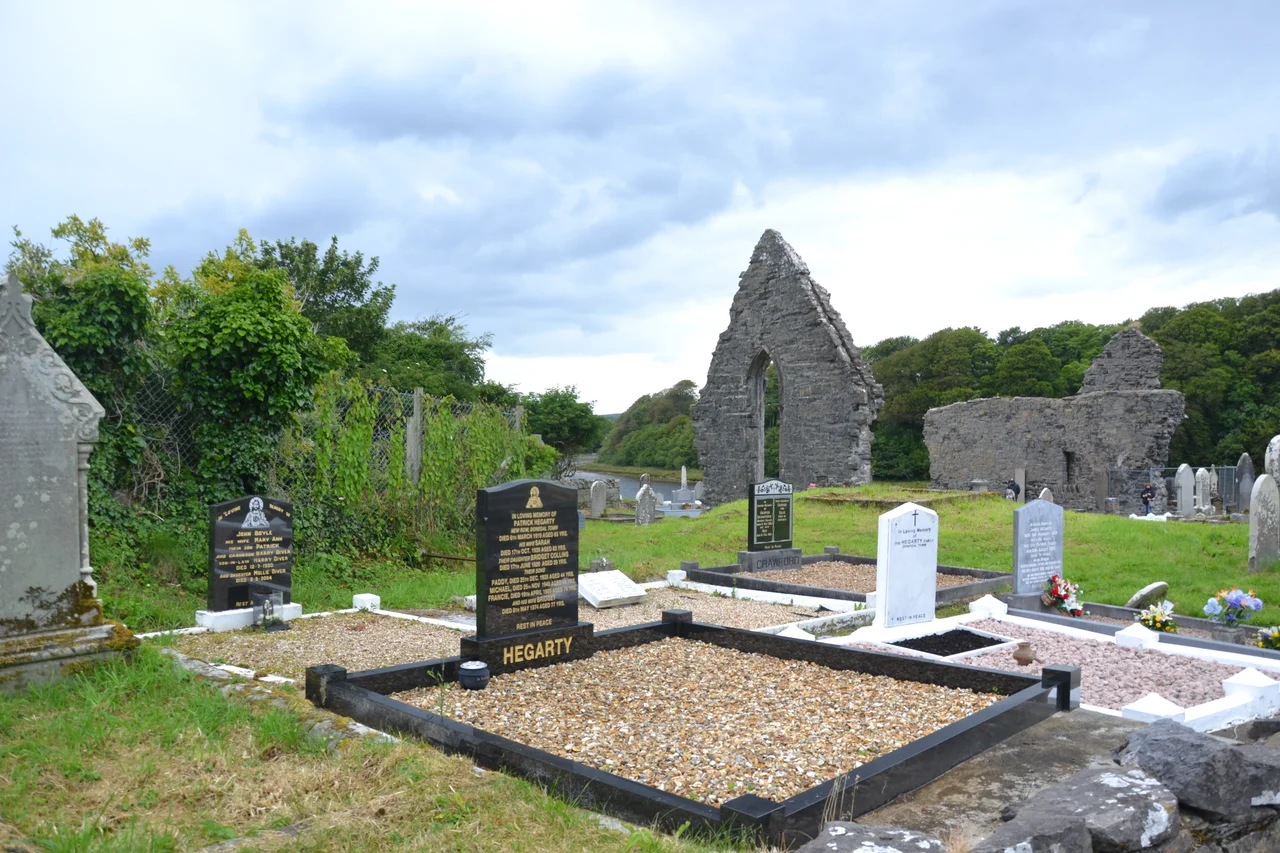

Donegal Abbey
On 10 August 1601, fire broke out in Donegal Abbey. The flames reached a store of gunpowder that the warrior chieftain Niall Garve O'Donnell had stockpiled there during his alliance with the English Crown. The explosion destroyed most of the building and killed hundreds of Niall Garve's soldiers, including his younger brother Conn Oge O'Donnell. The Abbey was never rebuilt. But the friars escaped, regrouped at Bundrowes near Bundoran, and between 1632 and 1636 sat down at long tables and assembled the most important historical document Ireland has ever produced: the Annals of the Four Masters, a compendium of more than two thousand years of Irish history pieced together from every manuscript and monastic chronicle the brothers could find.
A Woman's Hundred-Mile Walk
The story of Donegal Abbey begins with a woman walking. In 1474, Finola O'Donnell, also known as Nuala, was the wife of Hugh Roe O'Donnell, ruler of Tyrconnell. Finola came from a powerful family of princes in Leinster, but it was her husband's territory in west Ulster that needed a Franciscan house. The Franciscan provincial chapter was meeting at Ross Errilly Friary in County Galway, roughly a hundred miles south. Finola gathered a group of women and made the journey on foot. According to a seventeenth-century Latin account by one of the abbey's friars, she walked all that way to formally request that the Franciscans establish a monastery in Tyrconnell. The Order agreed. The abbey rose at the mouth of the River Eske where it empties into Donegal Bay, the gift of Finola and her husband, who would forever be known as the founders.
A Meeting with Spain
By the late sixteenth century, the abbey had become more than a religious institution. It was a strategic asset in the long struggle against English conquest. During the Nine Years' War, the abbey hosted a meeting between the Irish rebel leadership and envoys of King Philip II of Spain. The alliance the rebels sought never quite materialized in the form they needed, though Spanish troops eventually landed at Kinsale in 1601, an intervention that ended in disaster. The abbey itself became a fault line in the O'Donnell family's own civil war. Hugh Roe O'Donnell the Second, born around 1572 and strongly anti-English, fled to Spain seeking support. In his absence, his cousin Niall Garve O'Donnell made terms with the English government and set up his military base at Donegal Abbey. When Hugh Roe returned to attack his cousin in 1601, the abbey became a battlefield.
The Iníon Dubh and the Redshanks
An earlier chapter of the abbey's history involved one of the most formidable women in Gaelic Ireland. Iníon Dubh, meaning the Dark Lady, was the second wife of Sir Hugh O'Donnell and a Scottish noblewoman in her own right. When her son Hugh Roe O'Donnell's position appeared threatened by Sir Donal O'Donnell, Hugh's older half-brother and the favoured candidate of the English, Iníon Dubh acted decisively. She raised the clans of Donegal loyal to her husband and summoned large numbers of Redshanks, mercenary warriors from the Highlands and Islands of her native Scotland. At the Battle of Doire Leathan on 14 September 1590, Sir Donal was defeated and killed. The path was cleared for Hugh Roe, the prince Iníon Dubh had chosen for the succession. The abbey, in those years, was as much a centre of dynastic politics as it was of prayer.
The Four Masters and the Drowned River
After the gunpowder explosion of 1601, the Franciscan friars dispersed. The abbey was never rebuilt. But the order set up a new base at Bundrowes near Bundoran, on the River Drowes, just outside the town. There, between 1632 and 1636, four monks did something extraordinary. Mícheál Ó Cléirigh, Cú Choigríche Ó Duibhgeannáin, Fearfeasa Ó Maol Chonaire, and Cú Choigríche Ó Cléirigh acquired every antiquarian manuscript and monastic chronicle they could find. They synthesised these sources, layered them with their own memories of older oral traditions, and produced the Annals of the Kingdom of Ireland. The world knows the work as the Annals of the Four Masters. It covers Irish history from the legendary period of the Deluge through 1616, and remains the single most important primary source for medieval Ireland. Without that explosion at Donegal Abbey, the monks might never have moved. Without the move, the Annals might never have been compiled.
The Silver Chalice in Quebec
In 1870, the Catholic historian Charles Patrick Meehan recorded an odd footnote to the abbey's story. A silver chalice of fine workmanship had turned up in the possession of an Irish priest in Quebec. The inscription on it, in Irish, read: Mary, daughter of Maguire, wife of Brian Oge O'Ruairc, caused this chalice to be made for her soul, for the Friars of Donegal, the age of Christ, 1633. Inside the pedestal, in smaller letters: John O'Mullarkey, O'Donnell's silversmith, made me. The chalice had been made for the displaced friars of Donegal Abbey just before they began compiling the Annals. How it crossed the Atlantic to a priest in Quebec, nobody has worked out. It is the kind of object that quietly maps the diaspora the abbey's collapse helped create.
A Beatified Martyr
On 27 September 1992, Pope John Paul II beatified Concobhar Ó Duibheannaigh, a Franciscan priest from Donegal Abbey who had served as Bishop of Down and Conor. Ó Duibheannaigh was born around 1532 and lived through the worst of the Tudor conquest. In February 1612, at the age of eighty, he was hanged, drawn, and quartered outside the walls of Dublin. The execution was the standard punishment for treason, applied here for the crime of practising the Catholic faith. Pope John Paul II named him as one of the twenty-four officially recognized Irish Catholic Martyrs. His feast day is 20 June. The abbey where he had once served, by then nearly four centuries in ruins, continued to hold its place at the mouth of the River Eske, the stones telling stories that the living were no longer always sure how to read.
From the Air
Located at 54.65 degrees north, 8.12 degrees west, at the mouth of the River Eske where it empties into Donegal Bay, immediately southwest of Donegal Town. Recommended viewing altitude 1,500 to 2,500 feet above terrain. The ruins sit on a low promontory overlooking the bay, with Donegal Town to the east, the Blue Stack Mountains to the north, and the open water of Donegal Bay to the west and south. Nearest airports: Donegal (EIDL) just to the north, Sligo (EISG) to the south, City of Derry (EGAE) to the northeast. Atlantic weather brings frequent rain and strong westerly winds; Donegal Bay sometimes produces dramatic light, especially on clear winter mornings.
Nearby Stories
- Manorhamilton 5.7 km away
- Florence Court 6.2 km away
- Kesh Ambush 6.5 km away
- Battle of Glenmaquin 8.1 km away
- Easky 12 km away
- Gweebarra Bay 12 km away
- Killala 50 km away
- RMS Empress of Britain (1930) 82 km away