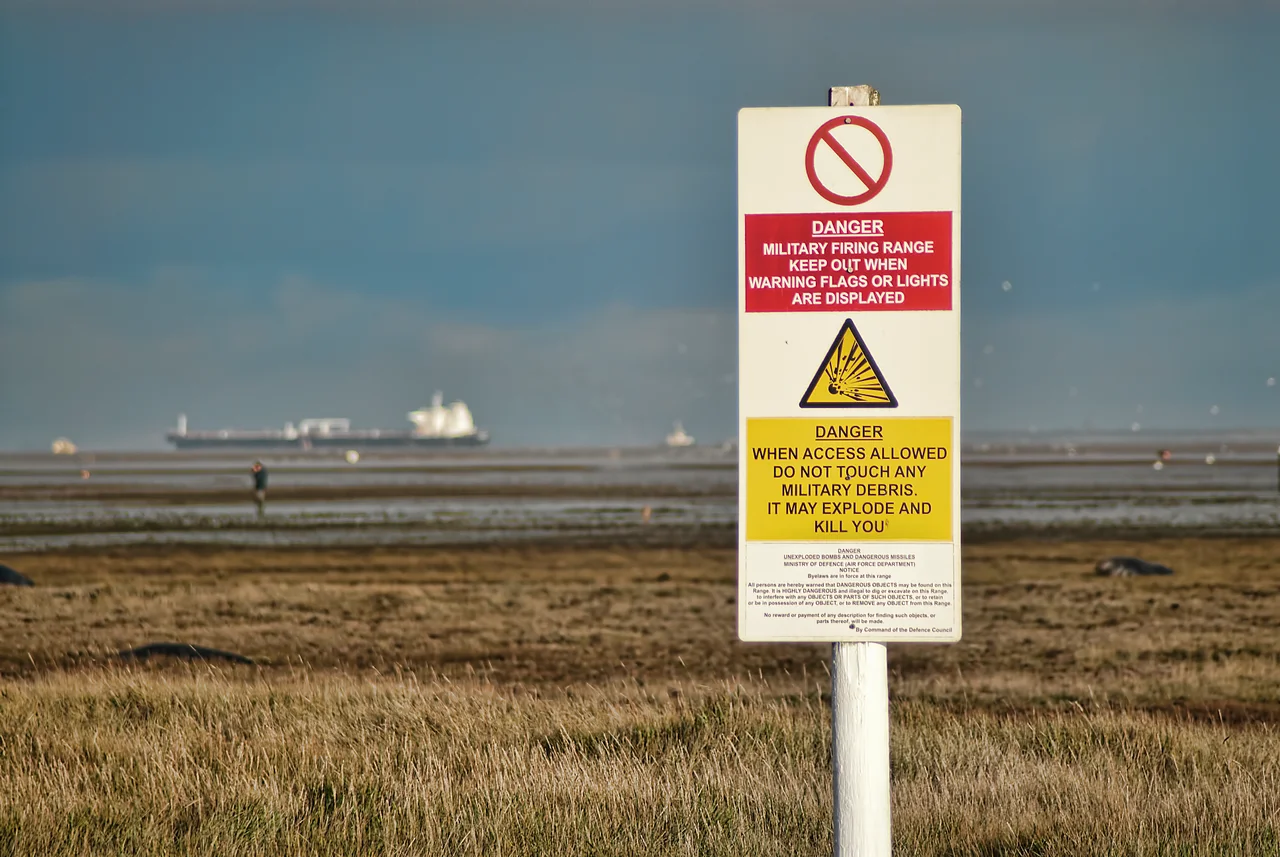

Donna Nook Air Weapons Range
Stand at the edge of the Donna Nook range on a quiet morning and you can hear two things at once: the distant boom of a practice bomb on the marsh targets and the unmistakable wet snort of grey seals breathing on the sand. The combination should not work. A live air-to-ground weapons range and a thriving nature reserve do not, in theory, belong in the same square mile. Yet for nearly a century the RAF has dropped ordnance here, the seals have raised their pups here, and both populations seem perfectly content with the arrangement. The Ministry of Defence calls Donna Nook the only national nature reserve in the UK on MOD land. The grey seals presumably call it home.
From Zeppelins to A-10s
Donna Nook has been a military site continuously since the First World War, when it was established as a defensive point against German Zeppelin airships trying to penetrate the Humber estuary - a strategically vital approach to Hull and the steel and shipping centres along the river. The bombing range opened in 1926 with three practice targets, one of them illuminated for night training. The range closed in 1946 and reopened in 1976 when nearby RAF Theddlethorpe was shut down after complaints from residents about noise. The site now covers 885 hectares of marshland and 3,200 hectares of sea, used by the RAF, US Air Force in Europe, and other NATO partners. It has been administered since 2008 by the Defence Infrastructure Organisation.
Arthur C. Clarke's War
Among the personnel posted to RAF Donna Nook during the Second World War was a young radar technician who would later become one of the most influential science-fiction writers in English. Arthur C. Clarke, author of 2001: A Space Odyssey and the man who first proposed geostationary communications satellites, was posted to Donna Nook in 1943 after an interview with Wing Commander Edward Jefferson. He worked on the Chain Home Extremely Low radar installation - a 10-cm wavelength set that tracked low-flying German aircraft and E-boats sneaking along the coast at night. The wartime experience with cutting-edge radar gave Clarke the technical grounding that informed his later science writing. The CHEL station and the airfield were separate sites in the same area; the wartime airfield itself served as a Relief Landing Ground for nearby RAF North Coates.
The 1981 Crash
On Friday 9 January 1981 at 1.35pm, Major Arthur Lloyd Moxon of the United States Air Force was practising strafing runs at Donna Nook in a Fairchild Republic A-10 Thunderbolt II - the heavy, slow-flying tank-killer designed for close air support. He was flying from RAF Woodbridge with the 510th Tactical Fighter Squadron. Something went wrong on the run. The A-10 crashed into the North Sea. Moxon, from Huron, South Dakota, was killed. His body was recovered three weeks later, on 28 January. The accident remains a sober reminder of what a live weapons range is: a place where serious aircraft do serious work, and where margins are sometimes thinner than they look from the public viewing area.
Grey Seals on the Bomb Range
The strangest fact about Donna Nook is also the most charming. Each November and December, around 2,000 to 3,000 grey seals haul out on the salt marshes within the bombing range to give birth and raise their pups. The pups are born with white fur, which they shed over three weeks before taking to the sea. By the end of December the beaches are dotted with hundreds of fluffy white seal pups while their mothers nurse them and bull seals patrol nearby. The wildlife, according to the Lincolnshire Wildlife Trust, has 'become accustomed to' the regular bombing - which is to say, the seals have decided the noise is none of their concern. A double wooden fence separates seal-watching visitors from the colony. Volunteer seal wardens patrol the fence-line during pupping season. The arrangement is improbable, it works, and it makes Donna Nook one of the most photographed sites in Lincolnshire each winter.
Nature Reserve, Bomb Range, Both
The nature reserve was formally established on 18 July 2002, opened by Air Commodore Nigel Williams. In 2023 it was incorporated into the new Lincolnshire Coronation Coast National Nature Reserve - the first new NNR declared as part of King Charles III's commemorative series - linking Donna Nook with the dunes at Saltfleetby-Theddlethorpe to the south. The Lincolnshire Wildlife Trust manages the conservation; the MOD continues to drop practice ordnance on the targets. The dual-use logic is straightforward: the bombing range protected the marsh from coastal development for decades, leaving habitat undisturbed at exactly the moment when most of the British coast was being concreted over. The seals benefited from the very thing that should have driven them away.
From the Air
Donna Nook Air Weapons Range covers the marshes and offshore waters around 53.475°N, 0.152°E on the Lincolnshire coast about 8 nm NE of Mablethorpe. ACTIVE WEAPONS RANGE - all civilian aircraft must observe published Danger Areas (EG D307/D308) during scheduled hours. Range is administered from RAF Cottesmore (EGUW) era and managed under the regional military airspace structure. RAF Coningsby (EGXC) and RAF Scampton (EGXP) lie within easy operational reach. Donna Nook should be viewed from a respectful distance and altitude. The seal colony is best appreciated at ground level in late November and December.
Nearby Stories
- Westermost Rough Wind Farm 2.5 km away
- Silver Pit 5.4 km away
- Beverley Minster 7.4 km away
- Lincoln Cathedral 13 km away
- 2004 Ingoldmells Bus Crash 14 km away
- Humber Bridge 21 km away
- Holkham National Nature Reserve 33 km away
- SMS Blucher 333 km away