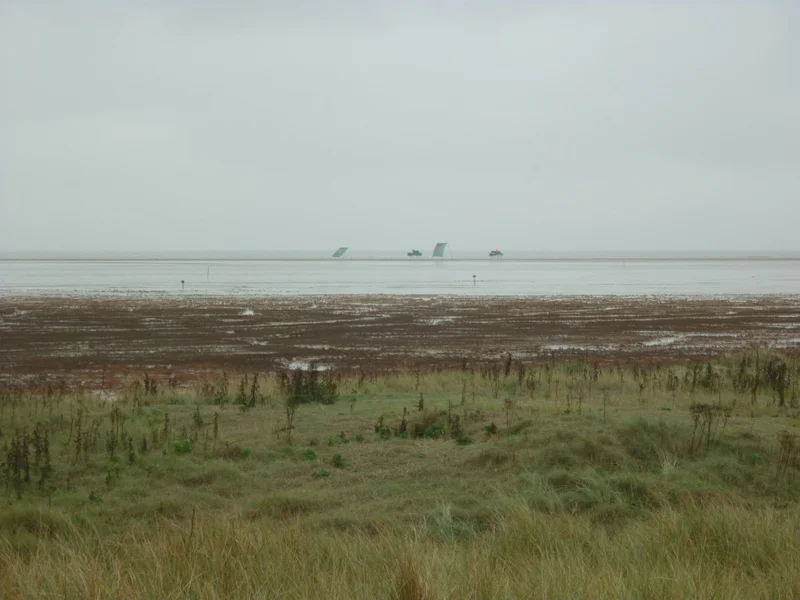

Donna Nook Lifeboat Station
On Christmas Eve 1921, the lifeboat Richard launched into a heavy sea off Donna Nook to reach the fishing boat Koivisto, adrift for nine days after engine failure and finally driven aground at Saltfleet haven. The lifeboat crew got the four men of the Koivisto aboard. Then, while standing by as a tug attempted salvage, the lifeboat itself capsized. Eleven crew and four rescued men were thrown into the December water. Somehow, every single one was recovered alive - first into the righted lifeboat, then onto the tug, then safely to Grimsby. The Royal National Lifeboat Institution awarded the entire crew the Thanks of the Institution inscribed on Vellum. It was the kind of rescue Donna Nook men did because the alternative was unthinkable.
A Century of Service
The Lincolnshire Coast Shipwreck Association opened a lifeboat station at Donna Nook in 1829 - one of the first organised rescue stations on the East Anglian coast. The Royal National Lifeboat Institution took over operations in 1864. For 102 years, Donna Nook crews launched into the North Sea to reach vessels in distress on the offshore sandbanks. The station closed in 1931, after the rationalisation of the RNLI coast network and improvements at neighbouring stations made Donna Nook redundant. Coverage of these waters passed to Cleethorpes and Mablethorpe. The lifeboat house is gone; the saltmarsh has reclaimed the launch site. Only the names on memorials and the records in the RNLI archive preserve what was done here.
Miss Dixon's Generosity
Two of the lifeboats that served at Donna Nook - both named Richard - were funded by a Miss Dixon, a benefactor who paid for replacement boats when the older vessels reached the end of their service life. The first boat at the station, built in 1805 by Henry Greathead for Bridlington and later used briefly at Saltfleet, proved unsuitable for Donna Nook's conditions. A purpose-built 28-foot lifeboat from Bell & Grange of Grimsby arrived in 1832. Over the next 32 years it launched nine times and saved 25 lives. The pattern at Donna Nook was the pattern at lifeboat stations all along the British coast: private generosity paid for the boats, volunteers crewed them, and the work paid for itself only in lives that did not become statistics.
Names on the Roll
The roll of honour at Donna Nook lists two incidents in which crew members died trying to launch the lifeboat. On 21 November 1884, attempting to reach the brig Economy of Grimsby, Coastguard Officer John Phillips drowned. He was thirty-three. On 13 March 1886, trying to launch to the brig Mermaid of Whitby, two more men were lost: Dan William Brooks, a crew member of twenty-two, and Alfred Richards, a volunteer of thirty-five. These were the deaths the RNLI's bronze and silver medals memorialise on the other side - the medals went to those who came back. Phillips, Brooks and Richards never did. Their names sit on the Donna Nook roll as quiet reminders that lifeboat service was, and remains, dangerous work undertaken by people who chose it.
Why Donna Nook
The lifeboat station was here for a reason that has not changed: the Lincolnshire coast offshore is treacherous. Shifting sandbanks - the Inner Knock, the Burcom, the Rosse Spit - have wrecked vessels since the records began. The Spanish Armada legend that gave Donna Nook its name comes from a ship called The Donna, supposedly sunk off this headland in 1588. Whether that origin story is true or a piece of nineteenth-century folk etymology is debatable. The hazard it describes is real. Even with modern navigation aids the area requires careful seamanship; in the age of sail it demanded courage from those onshore as much as from those at sea.
Closed but Not Forgotten
Today coverage of these waters comes from Cleethorpes RNLI Lifeboat Station to the north and other regional stations. The Donna Nook site has been absorbed into the Air Weapons Range and the National Nature Reserve - the bombing targets and the seal colony now occupying ground where the old launch carriage once stood. The station's history is preserved in RNLI archives and in the small memorials in churches up the Lincolnshire coast. It is the kind of history that fades from public view unless someone deliberately keeps it. The Lifeboat Enthusiasts Society does. So does the broader RNLI museum tradition. Donna Nook ran for a century; that century deserves to be remembered.
From the Air
The former Donna Nook Lifeboat Station was located at 53.475°N, 0.153°E on the Lincolnshire saltmarsh, now within the Donna Nook Air Weapons Range. ACTIVE WEAPONS RANGE - civilian aircraft must observe the Danger Areas. The Cleethorpes RNLI station to the north now covers these waters along with neighbouring stations. RAF Cottesmore (EGUW), RAF Coningsby (EGXC), and RAF Scampton (EGXP) are the nearest military airfields. From altitude the salt marsh and sandbanks are clearly visible, particularly at low tide when the channel patterns are sharp.
Nearby Stories
- Westermost Rough Wind Farm 2.5 km away
- Silver Pit 5.4 km away
- Beverley Minster 7.4 km away
- Lincoln Cathedral 13 km away
- 2004 Ingoldmells Bus Crash 14 km away
- Humber Bridge 21 km away
- Holkham National Nature Reserve 33 km away
- SMS Blucher 333 km away