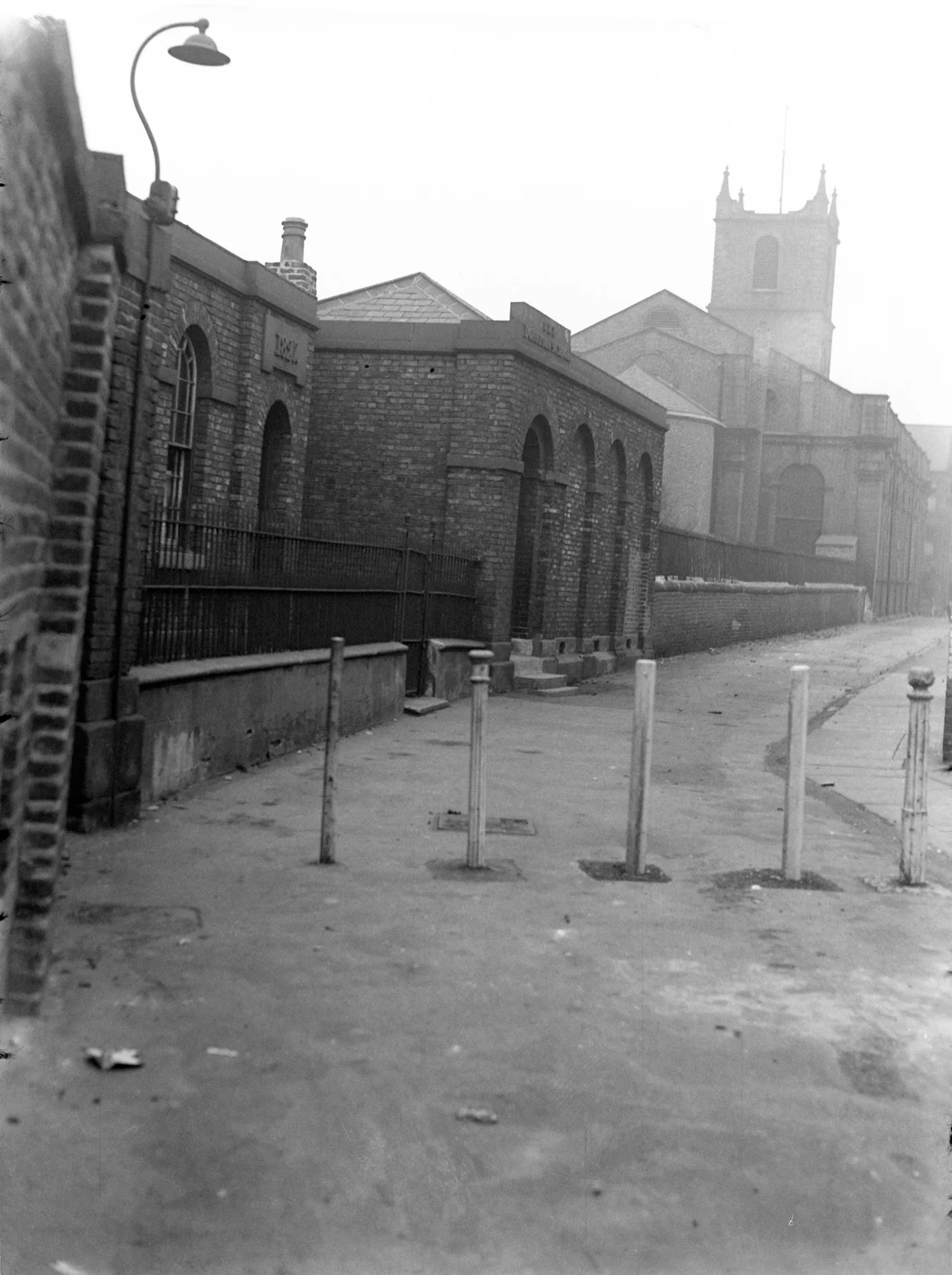

Donnison School
When Elizabeth Donnison died in 1764, she left fifteen hundred pounds in her will for a school - not for the daughters of the merchants, not for the boys of the town, but specifically for the girls of Sunderland's poorest families. It took her executors thirty-four years to make it happen. When the doors finally opened in 1798, 36 girls walked into a small building in the East End, next door to the Sunderland workhouse, and into a curriculum that would have been remarkable for them anywhere in Georgian England: reading, writing, needlework, spinning, sewing, knitting - and a set of clothes and shoes provided at the start of each term. The Donnison School was the first of its kind in Sunderland, and it stayed open in one form or another for two centuries.
The Bequest
Elizabeth Donnison left no detailed plan beyond the money and the purpose. What survives of her intent is the school she made possible: free education for female pupils from poor families, ages seven to sixteen. In an age when most girls of that station learned nothing formal at all, the curriculum was both practical and aspirational. The needlework and spinning would teach a trade. The reading and writing would teach independence. The clothes and shoes addressed the simple obstacle that most poor children in 18th-century Sunderland could not afford the basic clothing to attend school in the first place. Located next to the Sunderland workhouse - which had been constructed in 1740 - the Girls' Free School, as it was also called, opened directly into the city's poorest district.
A Schoolmistress' Cottage
In 1827, Elizabeth Woodcock funded the construction of a cottage on the site for the schoolmistress - a small, dignified addition that marked the institution's permanence. By that point the Donnison was thirty years old, the original 36-pupil intake had become hundreds across the years, and Sunderland was rapidly growing into the industrial port city that would dominate the Wear estuary. The school weathered the 19th and 20th centuries quietly. By the late 20th century it had ceased operating as a school but the buildings survived, sitting in what locals call Old Sunderland - the East End neighbourhood on the south bank of the Wear, near Holy Trinity Church, the Trafalgar Memorial, the Town Moor, and the Sunderland Docks.
The Heritage Centre
The school received a 287,000-pound grant from Sunderland City Council and the National Heritage Lottery Fund to repair and refurbish its building, and in 2007 it reopened as the Donnison School Heritage and Education Centre. The original 1798 classroom survives, along with Elizabeth Woodcock's 1827 schoolmistress' cottage. The centre tells the story of the school, of Elizabeth Donnison's bequest, and of the women and girls who passed through the doors - many of whose names are known and recorded. It is a small site by the standards of Sunderland's industrial heritage, but it preserves something rare: a place where the education of poor girls was treated, in 1798, as worth fifteen hundred pounds and a deliberate plan.
Above Old Sunderland
From the air the East End reads as the oldest fabric of the city - tighter streets, smaller blocks, the imprint of medieval and Georgian Sunderland still visible where 20th-century redevelopment did not quite reach. Church Walk, where the Donnison stands, runs near Holy Trinity Church - the parish church of old Sunderland, dating to 1719 with the Trafalgar Memorial in its yard. The Sunderland Docks lie just to the north on the river, and the Town Moor opens to the east. The Donnison building itself is small enough to miss from cruising altitude, but the Church Walk grid stands out as a preserved fragment of pre-industrial Sunderland. A pocket of the 18th century, kept around what one woman willed into being.
From the Air
Located at 54.908 N, 1.367 W, in the East End neighbourhood of Sunderland near the south bank of the River Wear. Recommended viewing altitude 1,500 to 3,000 feet. Nearest airports: Newcastle International (EGNT) approximately 11 nm north-west, Durham Tees Valley (EGNV) further south. Visual landmarks include the Sunderland Docks just to the north, Holy Trinity Church on Church Walk, the Town Moor opening to the east, and the North Sea coast beyond.
Nearby Stories
- Seaton Carew 2.7 km away
- HMS Unity (N66) 6 km away
- George Stephenson's Birthplace 6.1 km away
- Raby Castle 9 km away
- Cragside 15 km away
- Whitby Abbey 21 km away
- German submarine U-2367 46 km away
- Alexander L. Kielland (Platform) 277 km away