
Dorman Museum
George Lockwood Dorman died of enteric fever at Kroonstad in 1900, during the Second Boer War. He was the son of Sir Arthur Dorman, who with his partner Albert de Lande Long had built the Dorman Long ironworks into one of the great engineering firms of imperial Britain. Dorman Long would later construct the Sydney Harbour Bridge and Tyne Bridge. But in 1900, none of that mattered. Sir Arthur built a museum in his son's memory and opened it on 1 July 1904, in a corner of Albert Park in Middlesbrough's Linthorpe district. The collections George had gathered on his travels, including ethnographic items from his time stationed in South Africa, were among the founding objects. Grief became a building. The building became a place.
Dresser and the Linthorpe Pottery
Christopher Dresser was one of the central figures of the British Aesthetic Movement, an industrial designer whose work would later influence the Bauhaus and Scandinavian modernism. In the early 1880s he was deeply involved with the Linthorpe Art Pottery, a small Middlesbrough operation just down the road from where the Dorman Museum now stands. The pottery's life was short, barely a decade, but it produced more than 2,000 different mould shapes, won two bronze medals and a gold at international exhibitions, and earned a turquoise vase a place in Princess Alexandra's collection. The museum holds the largest collection of Dresser-influenced Linthorpe work in the world. A 2014 refurbishment, backed by the Heritage Lottery Fund, the Art Fund, and the V&A's Purchase Grant Fund, gave the collection its own dedicated gallery.
The Nelson Room
Thomas Hudson Nelson was a renowned local ornithologist who wrote The Birds of Yorkshire in 1907. He spent decades amassing a collection of mounted birds and birds' eggs, all preserved in the Edwardian style with painted backgrounds and glass cases. When Nelson died, his wife bequeathed the entire room to the museum in 1918, and it has been kept since then in its original setting, unchanged. The Nelson Room is now a rare object in itself, a Victorian-Edwardian natural history collection preserved with the casing and display methods that were standard a century ago and almost extinct today. Visitors do not just look at the specimens. They look at the way a previous century looked at specimens. The original 1904 collection also included a hundred-times-life-size model of a head louse, an ichthyosaur fossil, and a stuffed ribbonfish.
Elgee, Bronze Hoards, and a River Canoe
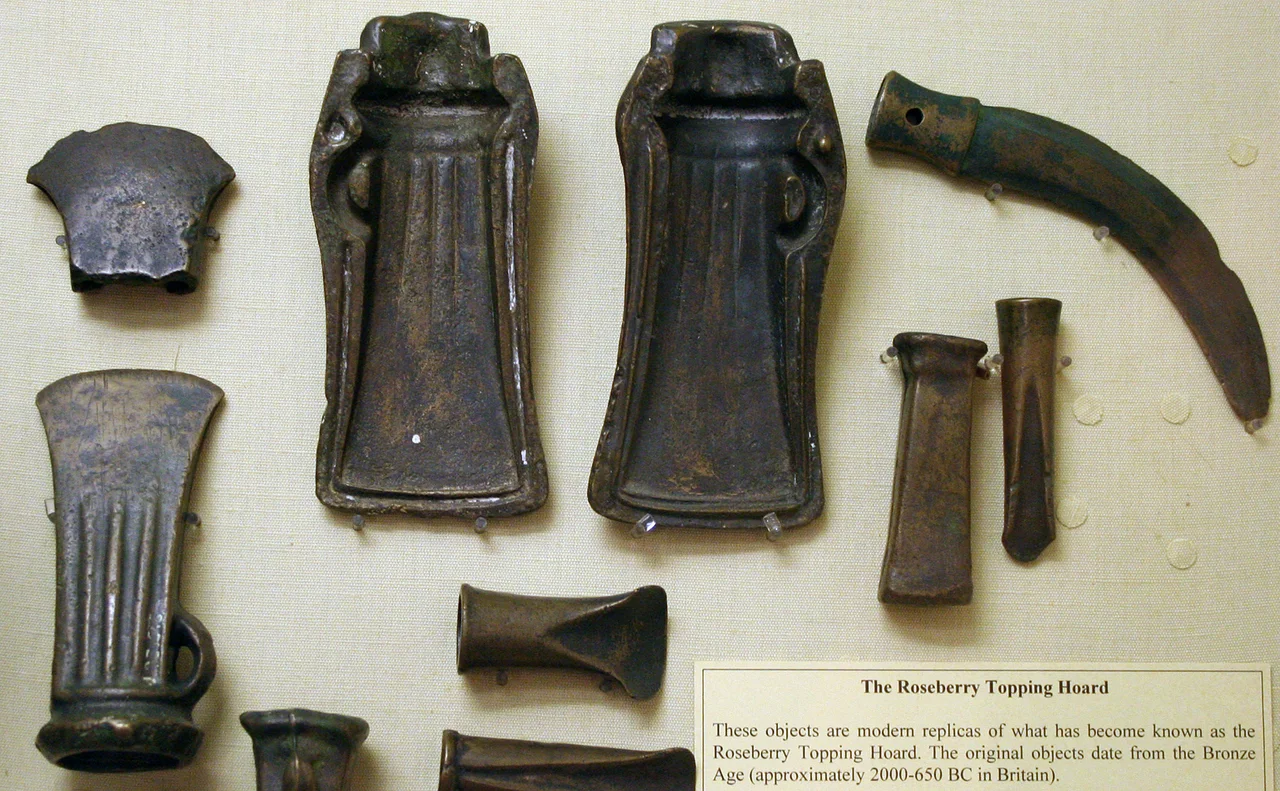
Frank Elgee was the museum's curator between 1923 and 1932, a self-taught archaeologist who excavated extensively across the moors. The museum holds his library of journals and photographs, including records of his digs at the Bronze Age hillfort at Eston Nab and the burial mounds at Loose Howe. In 1926 a dug-out canoe was recovered from the River Tees eight feet below the surface; it is on display. The museum holds replicas of the Roseberry Topping Bronze Age hoard, including the mould of a large axe head that could itself have been used to make more axes. The coins and medals collection includes the Yearby hoard of 16th and 17th century coins, the Thorpe Thewles hoard of Henry II and Henry III silver pennies, and the Middridge hoard of Edward I coins.
Town in Time
Middlesbrough was granted a charter in 1853, making it one of the youngest major industrial towns in England. Within forty years it had become the world's leading producer of iron and steel for railway and bridge building, and Dorman Long was at the heart of it. The Town in Time gallery covers all of this through artefacts, photographs, and stories. Hanging in the museum's double-height extension is the Lordship of Acklam Plan, a remarkable thirteen-foot-square painted sailcloth showing the boundaries and details of the medieval Acklam estates. The 20th Century Woman gallery examines how social and political changes shaped women's lives in Middlesbrough across a hundred years. As of 2024 the museum has been closed for renovation; the collections continue to be cared for behind the closed doors.
Flight Context
Dorman Museum is at 54.56 N, 1.24 W in Linthorpe, on the town centre side of Albert Park in southern Middlesbrough. From the air, Albert Park is visible as a clear green rectangle with the museum buildings on its northern edge. The River Tees runs roughly two miles north. The Transporter Bridge, an icon of Dorman Long's later engineering, crosses the Tees just east of Middlesbrough town centre. Teesside International Airport (EGNV) is about 10 miles south-west. Best viewing is from 1,500 to 2,500 feet AGL. The Cleveland Hills rise sharply to the south, and Roseberry Topping's cone is the obvious landmark south-east of the town.
From the Air
Dorman Museum is at 54.56 N, 1.24 W in Linthorpe, on Albert Park's town-centre edge in southern Middlesbrough. Best viewed from 1,500-2,500 feet AGL. Teesside International (EGNV) about 10 NM south-west. The Tees Transporter Bridge is visible east of the town centre. Cleveland Hills and Roseberry Topping rise to the south and south-east.
Nearby Stories
- Raby Castle 3.1 km away
- Crook Hall 3.4 km away
- Middleham Castle 4.8 km away
- Seaham Hall 7.4 km away
- Rievaulx Abbey 9.9 km away
- Whitby 12 km away
- Scampston Hall 17 km away
- German submarine U-2367 48 km away