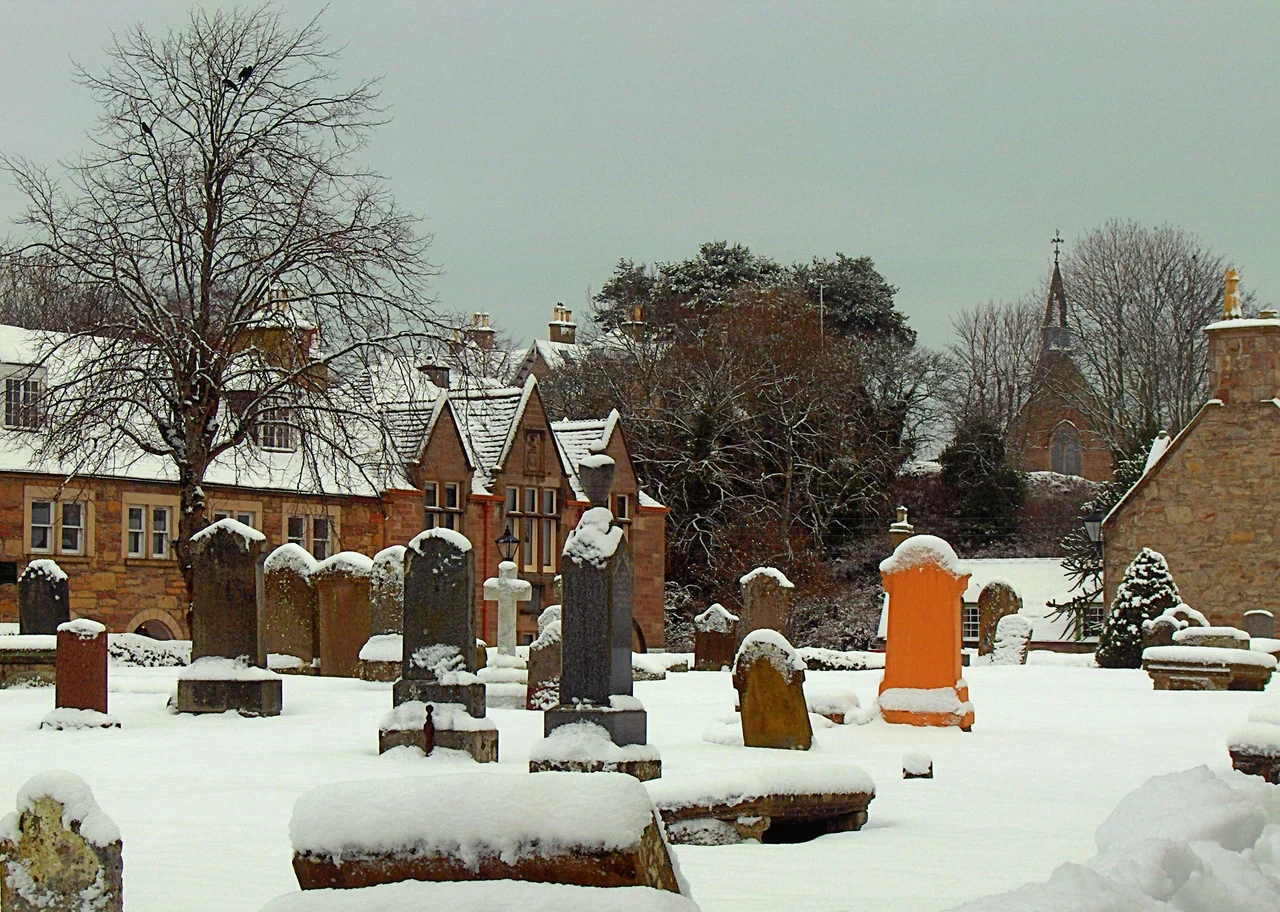

Dornoch Cathedral
On 21 December 2000, the pop star Madonna stood in Dornoch Cathedral and watched her son Rocco be christened. The next day, she married Guy Ritchie in nearby Skibo Castle. Eight hundred and twelve years earlier - to the year, very nearly - Saint Gilbert of Dornoch had laid the foundation stone of the same building. The press cars circling the Sutherland coast in December 2000 may have been the most attention Dornoch Cathedral had received since the Prince and Princess of Wales attended the morning service in 1866. But the building has been quietly attracting kings, dukes, dying saints, and exhausted pilgrims for the better part of a millennium.
Saint Gilbert's Cathedral
The cathedral was begun in 1224, in the reign of King Alexander II, by Gilbert de Moravia - later canonised as Saint Gilbert of Dornoch. Gilbert was Bishop of Caithness, a diocese that had been violently unstable for decades. His predecessor Bishop Adam was murdered in 1222 by a mob at Halkirk that resented his tithes; Gilbert moved the seat of the diocese south to Dornoch, away from that hostility, and began building the cathedral that would house his bishopric. He died in 1245 and was buried in the building he had founded. So was William de Moravia, 1st Earl of Sutherland, in 1248. Richard de Moravia, killed in the Battle of Embo against Norse invaders in 1245, was buried here too. The cathedral became a Sutherland family church almost from its first generation.
The Fire of 1570
In 1570, the Mackays of Strathnaver burned the cathedral. The fire was set during local clan feuding - the kind of small, vicious conflict that ran beneath the surface of Scottish religious politics throughout the 16th century. The roof and much of the nave were destroyed. For the next two and a half centuries, the cathedral stood as a ruin attached to a working church: parts of the medieval structure still in liturgical use, parts open to the sky. When the Reformation abolished the Scottish episcopate in the 17th century, Dornoch ceased to be the seat of any bishop at all. The name "cathedral" survived as a memory of what the building had been. The building itself waited.
A Duchess's Restoration
Full restoration came in 1835-37, paid for by Elizabeth Sutherland-Leveson-Gower, Countess of Sutherland in her own right and wife of the 1st Duke of Sutherland. She commissioned the architect William Burn at a cost of £15,000 - a substantial sum, drawn from the same Sutherland fortune that was at that moment evicting tens of thousands of Highlanders from their land during the Clearances. The restoration was a mixed thing. The largely intact medieval aisled nave was demolished and replaced with a narrower nave without pillars - a Victorian alteration that the modern eye finds harsh. The site of the medieval high altar was raised and converted into a burial area for the Sutherland family, who installed large marble memorials. The Duchess herself is buried here, alongside her husband, in the church their family had alternately patronised and reshaped for six centuries.
Carnegie's Organ, Madonna's Christening
In 1893, the cathedral got its first organ - a gift from Andrew Carnegie, who was busy converting nearby Skibo Castle into his Scottish retreat. Eustace Ingram built the instrument, and it was the first organ ever installed in the county of Sutherland. Carnegie paid £200 to enlarge it and add hydraulic power in 1909. Nearly a century later, in 1998, the Rev Susan Brown became minister; in 2018 she would become Moderator of the General Assembly of the Church of Scotland - the second in twenty-five years, following the Very Rev Dr James Simpson, who held the post in 1994. Brown was the minister on duty in December 2000, when the Madonna christening turned the small cathedral into international news for a week. The building absorbed the attention, the cameras left, and Dornoch Cathedral went back to being what it had been since 1224 - a parish church in a quiet town, with stones eight centuries old in its walls.
From the Air
Dornoch Cathedral sits at 57.88°N, 4.03°W in the centre of Dornoch, on the north shore of the Dornoch Firth. The cathedral's square tower and pinnacled roofline are the dominant vertical landmarks in the burgh. From cruise altitude north of Inverness (EGPE), 50 miles south, Dornoch lies just north of the Dornoch Firth Bridge that carries the A9 across the firth. The Royal Dornoch Golf Club's links course runs along the coast east of the cathedral - bright green strips along the dune system. The grass airstrip suitable for small aircraft sits just south of town. Best viewed at 1,500-2,500 ft AGL in clear weather; the cathedral catches morning light from the east.
Nearby Stories
- North Coast 500 5.8 km away
- Pluscarden Abbey 7.7 km away
- Fort George, Highland 8.2 km away
- Conon Hydro Scheme 12 km away
- Caithness and Sutherland Peatlands 19 km away
- Moray Firth 19 km away
- Hill o' Many Stanes 24 km away
- Kylesku Bridge 28 km away