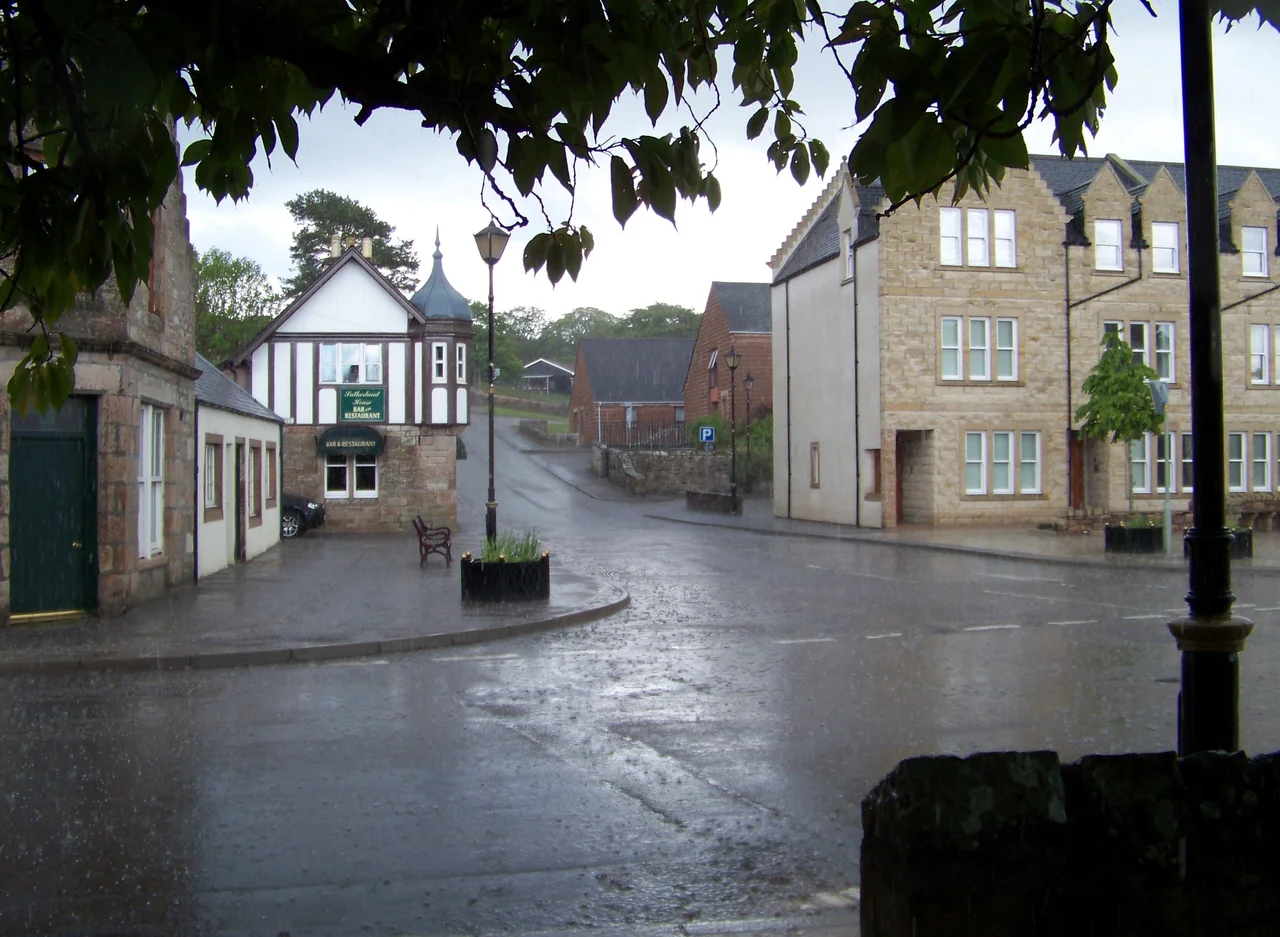
.jpg)
Dornoch
On a stretch of grass at the edge of Dornoch, the worn slab known as the Witch's Stone is misinscribed with the year 1722. The actual date was 1727, and the woman commemorated - or accused, depending on how you look at it - was named Janet Horne. She was elderly, perhaps suffering from dementia, and her daughter had a physical deformity that local rumour attributed to witchcraft. The court at Dornoch found Janet guilty, sentenced her to be burned in a tar barrel, and carried out the sentence. She was the last person legally executed for witchcraft in the British Isles. Nine years later, Parliament repealed the Scottish Witchcraft Act of 1563. Janet Horne's death was the last gasp of a long horror, and Dornoch has carried the memory ever since.
The Pebbly Place
*Dornoch* comes from the Gaelic for "pebbly place" - the local pebbles, the size of a fist, were once used as weapons; *dorn* is the Gaelic word for fist. The town is a former royal burgh on the north shore of the Dornoch Firth, where the firth opens into the Moray Firth, looking out over miles of sand and tidal water. Archaeological excavations during the development of a business park in 1997 turned up evidence of settlement from at least the 8th century: a building, ironworking debris, and - oddly - part of a whale. The first written reference comes from the early 12th century, when King David I sent an order to Rognvald, Earl of Orkney, instructing him to respect the monks at Dornoch. The town has been a centre of small but persistent importance ever since.
Janet Horne
The fuller account of Janet Horne's death belongs to the period when belief in witchcraft was finally collapsing among educated Scots but still held tightly in remote Highland parishes. By 1727, witchcraft prosecutions had become rare; most accusations were thrown out by judges. Janet Horne was unlucky. The Sheriff-Depute of Sutherland heard the case at Dornoch, accepted the evidence that Janet had ridden her own daughter as a horse - the daughter's lameness offered as proof - and condemned her. She was stripped, tarred, paraded through the town, and burned alive. The detail that has come down the centuries is that on the day of execution, having been allowed a moment by the fire, Janet warmed her hands at the flames meant to kill her. She was elderly and cold. She did not, apparently, understand what was happening. The Witch's Stone marks the rough spot of her death. It is impossible to walk past without something tightening in the chest.
Royal Dornoch
On a happier subject: golf has been played on the links at Dornoch since at least 1616 - making it among the oldest golf grounds in the world. The Royal Dornoch Golf Club was founded in 1877. The course was redesigned and extended by Old Tom Morris in 1886 and again refined by John Sutherland in the 1890s. The young Donald Ross began his career here as a greenkeeper before emigrating to America, where he would design Pinehurst No. 2, Seminole, and most of the great American championship courses of the early 20th century. Royal Dornoch has appeared on virtually every "world's best courses" list ever published; *Golf Digest* placed it No. 2 on its 2024 list of Top 100 International courses outside the United States. The links stretch along the firth beside an award-winning blue flag beach.
Madonna and the Cathedral
On 21 December 2000, the pop star Madonna had her son Rocco christened in Dornoch Cathedral, the day before her wedding to Guy Ritchie at nearby Skibo Castle. For a week, Dornoch was the most photographed small town in Scotland. The cathedral itself dates from 1224, founded by Saint Gilbert de Moravia, burned by the Mackays in 1570, and restored in 1835-37 by Elizabeth Countess of Sutherland. Dornoch Castle next door - the medieval palace of the Bishops of Caithness, now a hotel - has been quietly hosting visitors for centuries. The Old Town Jail and Sheriff Court still stand. The light railway that once ran from The Mound through Embo, Skelbo, and Cambusavie Halt closed in 1960, but the route is still walkable. Rosamunde Pilcher set her last novel *Winter Solstice* here, calling it Creagan. The town granted itself Fairtrade status in 2005. The University of the Highlands and Islands runs its Centre for History from the Burghfield House Campus.
From the Air
Dornoch lies at 57.88°N, 4.03°W on the north shore of the Dornoch Firth, near where it opens into the Moray Firth. The most distinctive feature is the long line of the Royal Dornoch links and beach stretching east-northeast along the coast - bright green fairways running between dunes and the white sand of the firth mouth. The cathedral's square tower is the most prominent vertical landmark in town. Dornoch has its own grass airstrip suitable for small aircraft and helicopters, just south of town. Inverness (EGPE) is 50 miles south. The Dornoch Firth Bridge carries the A9 across the firth just south of the town. Best viewed at 1,500-3,000 ft AGL; the tidal sand patterns at low water are extraordinary.
Nearby Stories
- North Coast 500 5.8 km away
- Pluscarden Abbey 7.7 km away
- Fort George, Highland 8.2 km away
- Conon Hydro Scheme 12 km away
- Caithness and Sutherland Peatlands 19 km away
- Moray Firth 19 km away
- Hill o' Many Stanes 24 km away
- Kylesku Bridge 28 km away