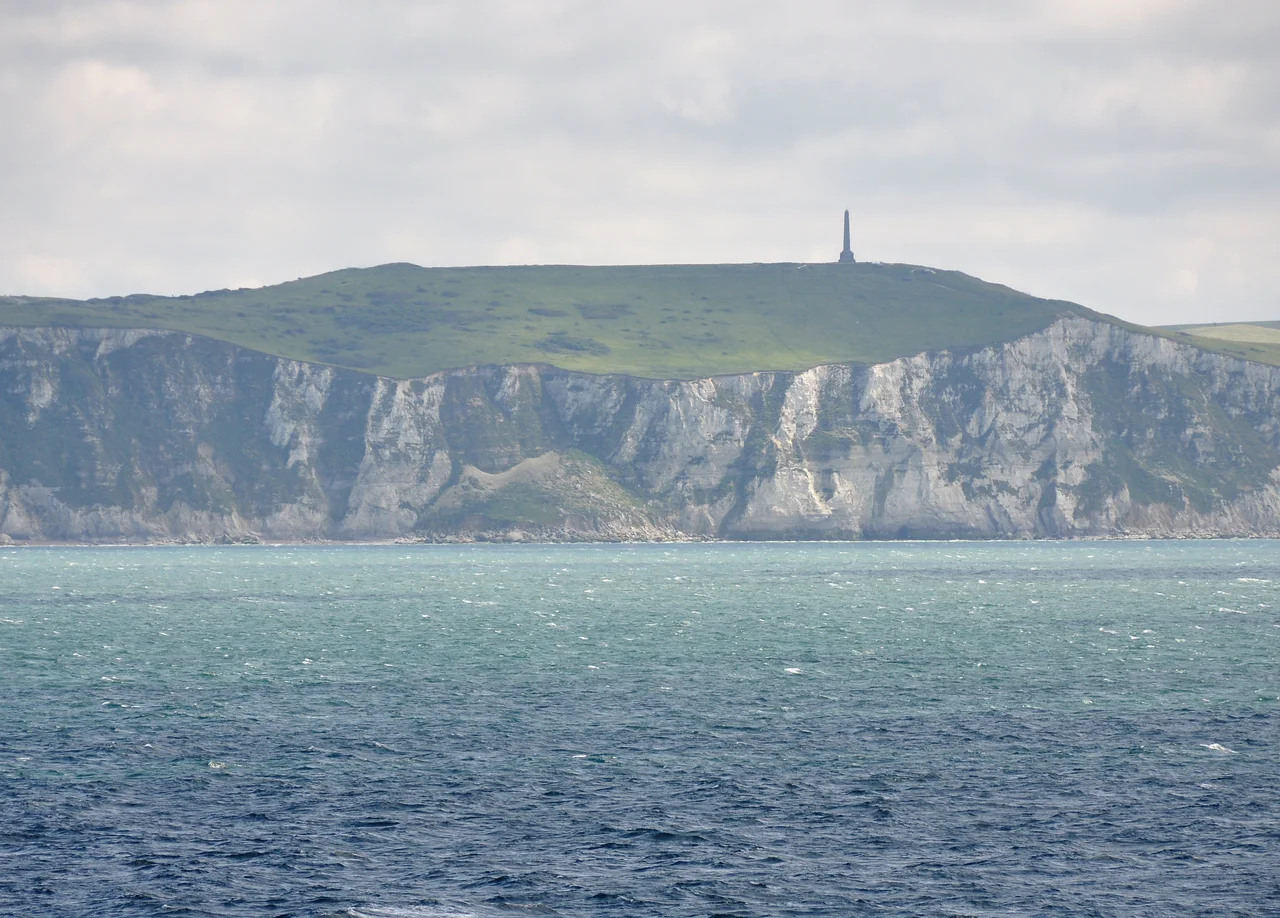

Dover Patrol Monument
Three identical obelisks of granite, 75 feet tall, stand on three coasts of two oceans. One sits on the cliffs above St Margaret's Bay near Dover. One stands above Cap Blanc-Nez near Calais, where you can sometimes see the Dover memorial across the water on a clear day. The third was raised in 1931 in John Paul Jones Park in Brooklyn, New York, near where the Verrazzano-Narrows Bridge now crosses the harbour entrance. The three together commemorate the Dover Patrol - the Royal Navy's vital and almost-forgotten First World War operation that kept the English Channel open and the German U-boats out, at a cost of about 2,000 lives.
The Patrol
The Dover Patrol was assembled in July 1914 around a core of twelve Tribal class destroyers and then grew enormously. Cruisers and destroyers, old and new, mixed with submarines, minesweepers, armed trawlers, drifters, armed yachts, motor launches and other coastal craft. French destroyers joined in periodically. The aerial component included flying boats, aeroplanes, and airships. The patrol's territory was the southern North Sea and the eastern English Channel, including the Straits of Dover - the narrowest crossing between Britain and the Continent, the place every merchant ship and troop transport had to thread. The work was unglamorous and constant: escorting merchant convoys, hospital ships, and troop transports; hunting U-boats; sweeping for German mines; laying British minefields and anti-submarine nets across the Straits; bombarding German positions on the Belgian and northern French coast. Admiral Reginald Bacon commanded from 1914 to late 1917. Vice-Admiral Roger Keyes took over after that.
Zeebrugge
On the night of 22-23 April 1918, the Dover Patrol mounted its most spectacular action: the Zeebrugge Raid, a daring attempt to block the entrance to the port of Bruges-Zeebrugge and trap the German destroyers and U-boats sheltering inside. The operation was partly a success and partly a costly failure - the Germans cleared the obstruction within days - but the courage involved was extraordinary. Six members of the patrol were awarded the Victoria Cross for their part in the action. Vice-Admiral Keyes had planned the raid. He became a national hero. The story of what those small ships had done crossing the Channel in the dark to ram concrete-filled blockships into a German-held port became the patrol's most famous moment. The forgotten daily grind of escort and minesweeping, the cumulative loss of around 2,000 men spread across four years of patrol duty, was much harder to celebrate.
Sir Aston Webb's Obelisk
A committee formed in November 1918 to raise public subscription for a monument. Over 45,000 pounds came in, including 1,000 pounds from King Albert and Queen Elizabeth of the Belgians, whose country the patrol had helped supply throughout the war. The architect chosen was Sir Aston Webb - the man who had designed Admiralty Arch, the Victoria Memorial on the Mall, and the eastern facade of Buckingham Palace. Webb gave the Dover Patrol an obelisk with an air of Egyptian architecture: a 75-foot square-section granite shaft topped by a pyramid, set on a tall plinth flaring out to a square base. Three sides of the base are framed in ashlar blocks around an inscription. It is austere and serious - the kind of monument that does not invite admiration so much as silence.
Three Coasts
The first obelisk's foundation stone was laid at Leathercote Point above St Margaret's Bay on 19 November 1919 by Prince Arthur of Connaught, on land donated by the 3rd Earl Granville. The completed monument was unveiled on 27 July 1921 by the Prince of Wales (later briefly Edward VIII). Both ceremonies were led by Harold Bilbrough, the Suffragan Bishop of Dover. The inscription on the south-eastern face reads: To the glory of God and in everlasting remembrance of the Dover Patrol 1914-1919. They died that we might live. May we be worthy of their sacrifice. A second inscription added later remembers the Royal Navy and Merchant Navy dead in the same waters 1939-1946. The French obelisk on Cap Blanc-Nez was unveiled on 20 July 1922 by the French Navy minister, Flaminius Raiberti, after its foundation stone was laid by Marechal Foch in January 1920. The Germans blew that one up during the occupation. It was rebuilt in 1962. The third obelisk, the Brooklyn one in John Paul Jones Park, went up in 1931 as a tribute to the American naval forces that had served alongside the British in European waters.
The Book of Remembrance
Inside the parish church at St Margaret's at Cliffe, a Book of Remembrance lists the names of nearly 2,000 men who died serving in the Dover Patrol. The names are not on the obelisk itself - there is no room - but on the carefully copied book pages held in the village church a short walk from the monument. The Coastguard Station that stood nearby is now closed. A radar station served here during the Second World War. The monument became a Grade II listed building in August 1966 and was promoted to Grade II* in August 2015. Visiting it now you stand on the chalk cliff above the Channel, with the obelisk overhead and the water below, and on a clear day the second obelisk just visible across 22 miles of strait. They died that we might live, the inscription says. The book of names sits a quarter-mile inland. Most of those men were buried at sea.
From the Air
The Dover Patrol Monument stands at 51.157 degrees N, 1.393 degrees E on Leathercote Point above St Margaret's Bay, between Dover and Deal on the South Foreland of Kent. The 75-foot obelisk is visible for miles from the air against the chalk cliffs. The twin Cap Blanc-Nez obelisk is across the Channel, also visible from altitude in clear weather. Nearest airfield: Manston (closed) about 12 nm north. Best viewed at 1,500-3,000 feet AGL approaching from over the Channel - the line between the two memorials is the line of the Dover Patrol's primary defensive belt.
Nearby Stories
- Ringlestone Inn 3.4 km away
- Cliffs Pavilion 3.5 km away
- Citadel of Calais 6.5 km away
- 2021 English Channel Disaster 11 km away
- Stag Inn, Hastings 15 km away
- Dungeness Lighthouse 19 km away
- Clacton Pier 32 km away
- Four Days' Battle 54 km away