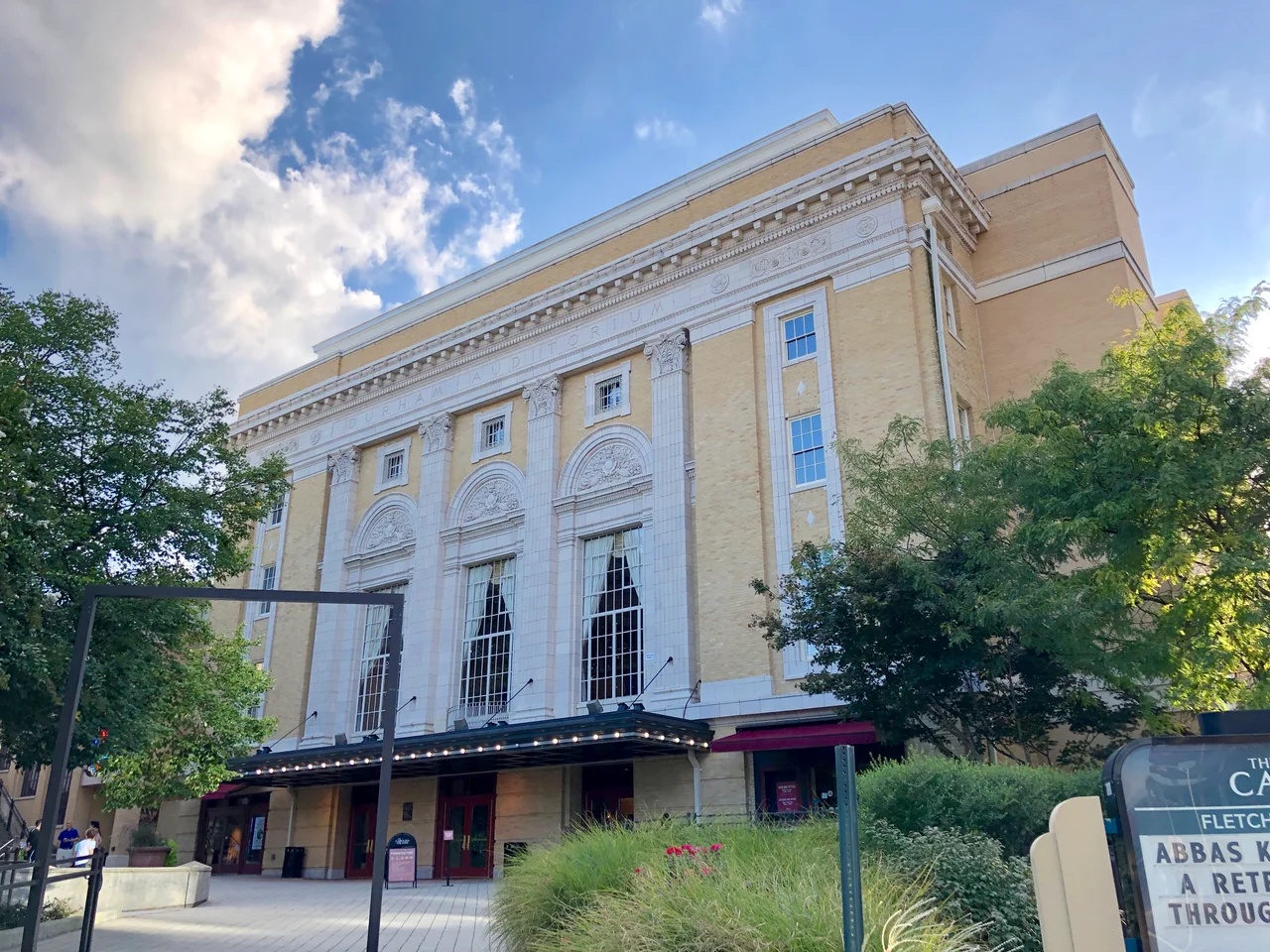

Downtown Durham Historic District
In 1957, three years before four students sat down at the Greensboro Woolworth and made the lunch counter a national symbol, seven young people walked into the Royal Ice Cream Parlor in downtown Durham and asked for service in the white section. They were arrested. The Durham sit-in did not make the history books in the way Greensboro did. It happened in this same downtown, inside the streets and buildings that the National Register listed as a historic district in 1977: 97 contributing structures across the central business district, mostly built in the first four decades of the 20th century, when tobacco money and Duke money turned a railroad stop into a city.
Built by Tobacco
Durham was a junction on the North Carolina Railroad until tobacco arrived. By the late 19th century, the bright-leaf tobacco grown on surrounding farms had made Durham one of the major industrial centers of the South, anchored by Washington Duke's American Tobacco Company and Julian Carr's Durham Hosiery Mills. The Duke family's investments in tobacco and hydroelectric power shaped the city's downtown. The grand classical First Baptist Church (1926-1927), the neoclassical Durham County Courthouse (1916), and the Art Deco Hill Building (1935) all rose during the decades when Durham's economy ran on cured leaf. The Snow Building (1930) and the Carolina Theatre of the 1920s pushed Art Deco into the streetscape. Architect George Watts Carr designed the Hill Building as an early version of a Southern skyscraper.
Black Wall Street
Parrish Street, a few blocks of red-brick storefronts in the heart of the district, was the spine of what Booker T. Washington dubbed Black Wall Street. The North Carolina Mutual Life Insurance Company, founded in 1898 and headquartered on Parrish, became the largest Black-owned insurance company in the United States. Mechanics and Farmers Bank, chartered in 1907 and opened in 1908, financed Black businesses across the South when most banks would not. Both institutions supported Black economic life in Durham during the Jim Crow decades, when federal and state law made segregation the legal default. Parrish Street's grandfathers had been enslaved; their grandchildren ran banks. The buildings still stand, though many now house different tenants. The story they tell is still being recovered by the city's own institutions.
Royal Ice Cream
On June 23, 1957, Rev. Douglas Moore led six young Black activists into the Royal Ice Cream Parlor at 600 Roxboro Street, just outside the historic district boundary but inside the same civic story. The owners had divided the parlor by race. The group sat in the white section, asked for service, were refused, and were arrested for trespassing. They were convicted in city court and again on appeal. The case made it to the North Carolina Supreme Court and was lost. Three years before Greensboro, Durham had staged a sit-in at a more vulnerable target, lost the legal fight, and continued. The Greensboro sit-ins that opened the South's lunch counters in 1960 built on what Durham had tried first. The Royal Ice Cream sit-in is now one of the events the city explicitly remembers.
Churches and Theaters
St. Philip's Episcopal Church (1907) anchors the district's Gothic Revival heritage. Trinity United Methodist Church, completed in 1880-1881, is one of Durham's oldest surviving churches. First Presbyterian (1916) carries early 20th-century ecclesiastical architecture in stone. The Durham Arts Council Building, built in 1906 as the city's first main library, now hosts cultural events. The Carolina Theatre, restored as a performing arts venue, still has its Art Deco bones intact. The Durham Armory of 1935 blends Gothic Revival with Art Deco, a stylistic conversation that runs through much of the district. The district's listing on the National Register in 1977 caught these buildings before urban renewal could do its usual work. Many have been adapted into offices, apartments, and restaurants.
August 14, 2017
In front of the 1916 Durham County Courthouse stood a 15-foot bronze Confederate soldier on a granite base, dedicated in 1924. On August 14, 2017, two days after the Unite the Right rally in Charlottesville ended with the murder of counter-protester Heather Heyer, a crowd gathered at the courthouse, threw a rope around the bronze figure, and pulled it down. Seven protesters were arrested. All charges were eventually dropped. The damaged statue went into storage. The granite base itself was removed in the middle of the night in August 2020. The corner is bare now. Adjacent to the historic district, the American Tobacco complex that gave Durham its first identity has been redeveloped into a mixed-use campus of offices, restaurants, and the Durham Bulls baseball park. The leaf is gone. The buildings remain.
From the Air
The Downtown Durham Historic District sits at roughly 35.99 N, 78.90 W, centered on the blocks around Main Street, Parrish Street, and the Durham County Courthouse. From altitude the district is identifiable by the Hill Building tower, the brick complex of the adjacent American Tobacco Historic District, and the Durham Bulls Athletic Park just south. Nearest airport: Raleigh-Durham International (KRDU) about 12 nautical miles southeast.
Nearby Stories
- Orange County Speedway 3.7 km away
- Tobacco Road 8.7 km away
- Haw River 15 km away
- Johnston County, North Carolina 18 km away
- Soul City, North Carolina 25 km away
- Chinqua Penn Plantation 29 km away
- North Carolina Aviation Museum 40 km away
- Cherry Hill Plantation 45 km away