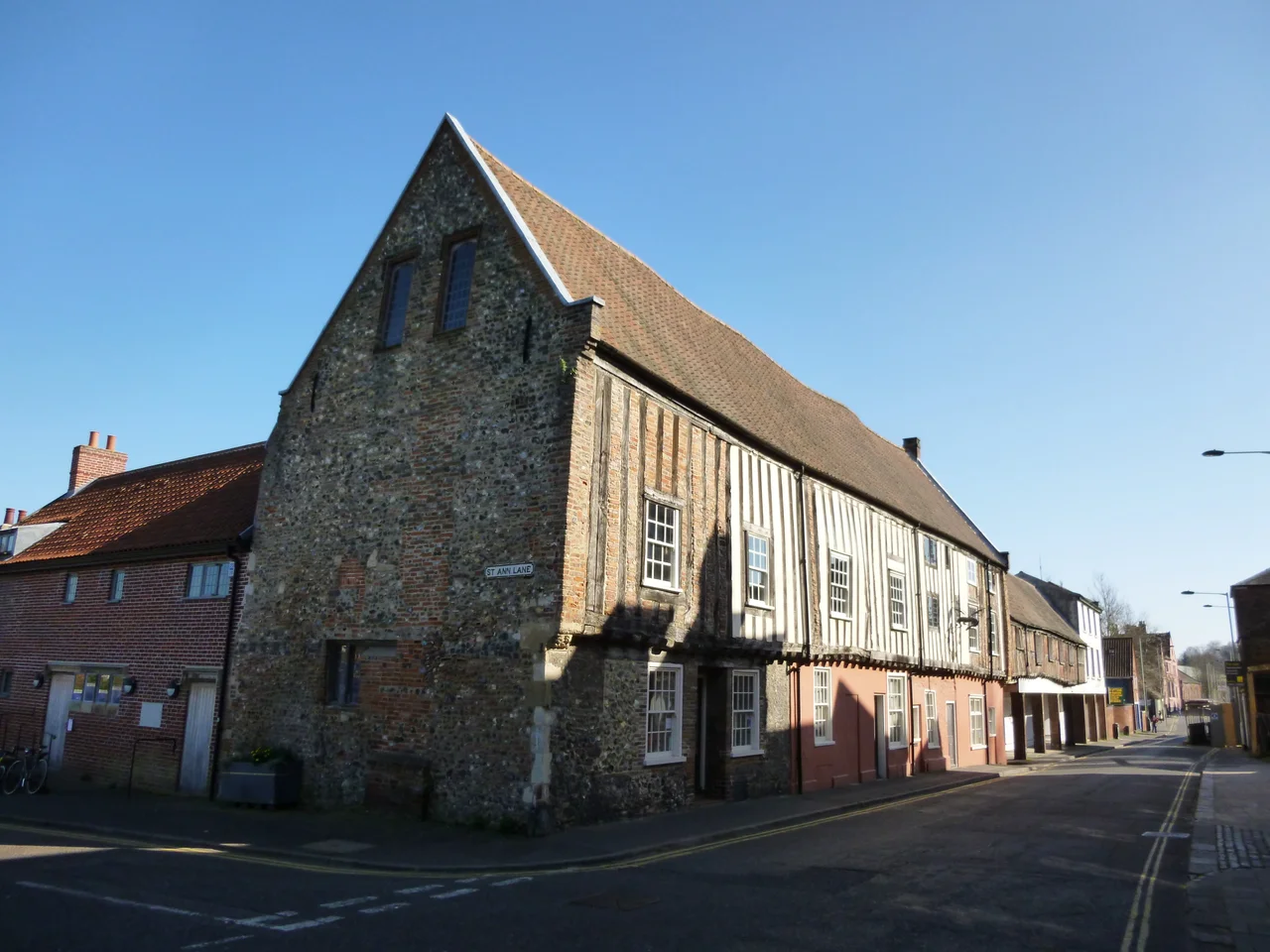

Dragon Hall, Norwich
Look up in the great timbered hall on King Street and you will see them: fourteen dragons, carved into the spandrels of the crown-post roof, their wings folded along the bay arches as if waiting to launch through the rafters. They were the personal flourish of Robert Toppes, a Norwich merchant who became mayor four times and who built this hall around 1427 as both showroom and statement. It is, as far as historians can tell, the only medieval merchant's trading hall in Northern Europe ever owned by a single man. Everywhere else - Lubeck, Bruges, Ypres - the great cloth halls belonged to guilds. Toppes built his alone.
The Layered Site
The ground under Dragon Hall has been busy for a thousand years. Beneath the floor archaeologists found an Anglo-Saxon hut from around 1000, the rough timber outline of a household here when Norwich was still finding its shape. In the late 13th century the abbey at Woburn ran a fish-processing operation on the northern end of the plot, with outbuildings and a track down to a staithe on the Wensum. A brick boundary arch opened the yard to King Street. Around 1330 a domestic 'hall house' went up on the southern part of the site - an L-shaped property owned by John Page, with an undercroft and an entrance from Old Barge Yard. By the time Toppes bought the land in the 1420s, he was acquiring not an empty lot but a layered palimpsest of buildings, walls, and waterfront access. He kept what he could use. The 14th-century entrance became the way his customers came in. The old brick arch stayed. He laid his new trading hall on top of everything else, threading a 15th-century commercial complex through what was already there.
Robert Toppes
Little is known about where Toppes came from. He arrived in the Norwich records as a young man already on the rise - an exporter of worsted, the fine wool cloth that made Norfolk rich, and an importer of finished textiles, iron, wine, and spices from across the North Sea. He was Treasurer of Norwich before he was thirty, then Sheriff, then mayor on four occasions, then the city's member of parliament four times over. He fell into a disputed election that briefly exiled him to Bristol. He was indicted in the aftermath of Gladman's Insurrection in 1443, a flash of civic violence that historians still argue about. His second wife, Joan Knyvett, knew the Paston family - the same Pastons whose letters now provide our richest portrait of 15th-century East Anglian life. Toppes paid for a stained-glass window at St Peter Mancroft, panels of which still survive. When he died in 1467, he provided for priests to pray for his soul, paying for it by selling the hall he himself called 'Splytt's.'
Seven Bays and a Thousand Trees
The trading hall itself was a piece of conspicuous engineering. Seven bays of timber framing, a crown-post roof, English oak from perhaps a thousand trees felled and squared and pegged into place. Customers came in through the old hall-house entrance, climbed a new staircase, and emerged into the upper room with its decorated spandrels and those fourteen carved dragons watching from above. Behind them, down a new stairway from the yard, were the warehouse undercrofts and the river quay - imports unloading from the Wensum, exports floating downstream to Great Yarmouth and on to the Low Countries. Norwich was already a city of merchants, but Dragon Hall worked at a different scale. One building combined showroom, warehouse, dock, and reception in a single integrated machine for the long-distance cloth trade. Toppes lived elsewhere; this was his commercial face, and the dragons were how he signed his name.
From Splytt's to Slum to Sanctuary
After 1467 the hall began a long descent. New owners subdivided it. Sash windows replaced bay windows. Attics were inserted, cellars dug, the great timber-frame interior cut up into smaller and smaller dwellings. A pub at the southern end gave the whole complex its new name: the Old Barge Building. By the 19th century around 150 people were crammed into the Old Barge and the tenements that had grown up behind it - a working-class slum on the river. A Slum Clearance program in 1936 took down most of the surrounding housing. By the 1950s the King Street facade had a butcher's shop at one end, a rectory in the middle, and the pub at the other. In 1954 the building was awarded Grade I listed status, and then in the 1970s the Norwich Survey, working out of the University of East Anglia, realized what was actually buried inside the masonry. In 1979 Norwich City Council bought the building. Partition walls came down. Floors lifted. Attics emptied. And in 1986 the carved dragons reappeared in the open air for the first time in centuries. Since 2018 the building has housed the National Centre for Writing - a fitting reuse for a hall built by a man who knew the value of telling a story about himself.
From the Air
Dragon Hall stands at 52.6254N, 1.3015E on King Street, on the west bank of the River Wensum about 600 m south of Norwich Cathedral. At 1,500-2,500 ft AGL the long roofline runs north-south along the riverside; the cathedral spire 600 m north is the easiest landmark. Norwich International (EGSH) lies about 4 nm north - airfield elevation 117 ft, circuit altitude 1,000 ft. Following the river south leads on to the Broads.
Nearby Stories
- Sheringham 2.7 km away
- Wingfield Castle 4.4 km away
- Castle Acre Castle and Town Walls 6.3 km away
- Brancaster 7.1 km away
- West Stow Anglo-Saxon Village 9.3 km away
- Four Days' Battle 80 km away
- Battle of Lowestoft 80 km away
- SM U-97 110 km away