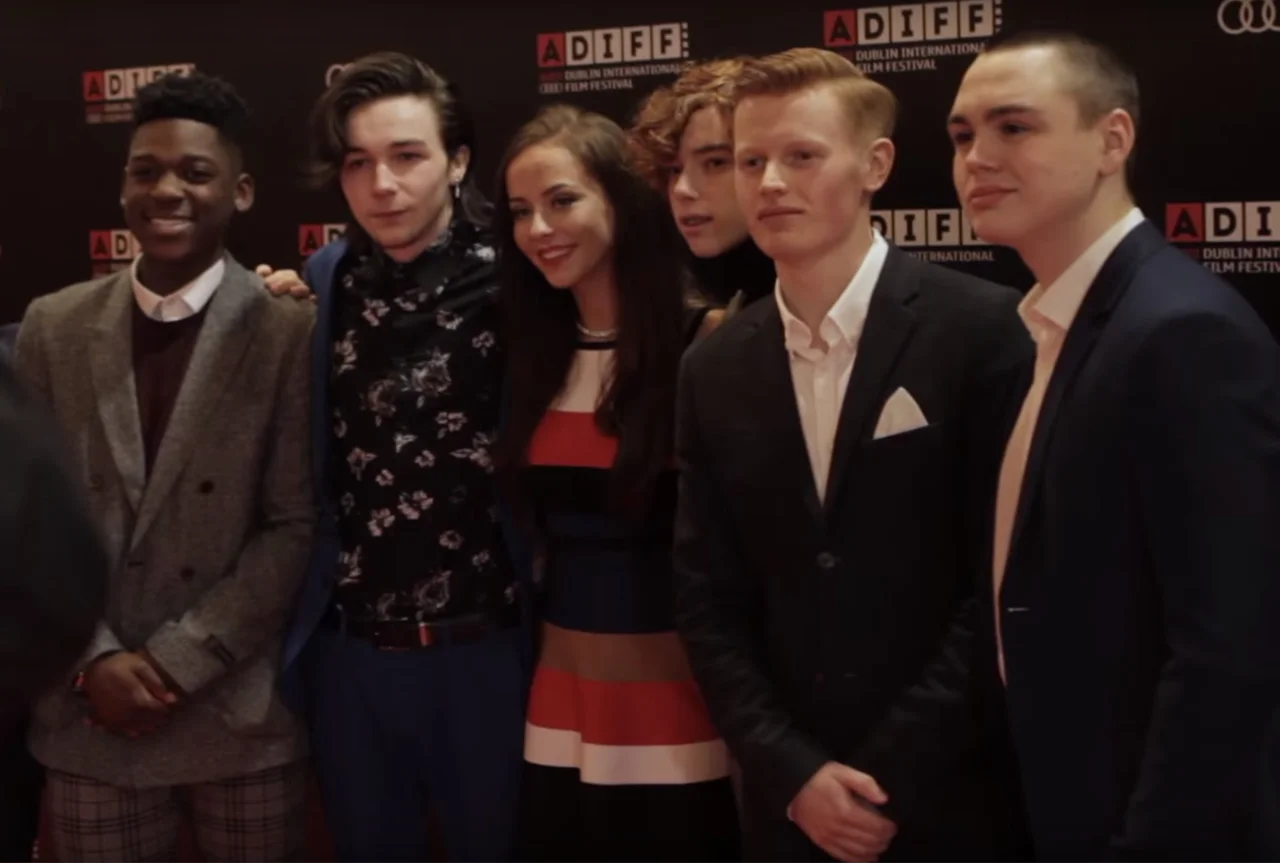

Dublin International Film Festival
Dubliners go to the cinema. They go a lot -- more per head than almost any other population in the European Union, a quirk noted by every distributor who studied the numbers. And yet, until 2003, the city had no international film festival of any standing. The original Dublin Film Festival, founded in 1985, had died after years of underfunding. The critic Michael Dwyer, who covered cinema for The Irish Times, found this state of affairs unbearable. 'It seems absurd,' he told an interviewer at the launch of the new venture, 'that the city didn't have an international film festival.' So he started one. His co-founder was David McLoughlin, then still an undergraduate at Trinity College.
The Volta
When DIFF created its career achievement award in 2007, it named the trophy after the Volta Picture Theatre, Dublin's first cinema, which opened on Mary Street on 20 December 1909. The Volta's founder was a 27-year-old Dubliner who had been recruited by his sisters' employers in Trieste because they thought a kinematograph theatre might do well in his home city. He was James Joyce. The cinema lasted about six months under Joyce's involvement before he sold his stake and returned to Italy to keep writing the novel that would become Ulysses. The fact that Ireland's most important literary figure had been, briefly, its first cinema operator is the kind of historical coincidence Dublin specialises in. The Volta Award has since been given to Daniel Day-Lewis, Stellan Skarsgård, Al Pacino, Danny DeVito, Costa-Gavras, Ennio Morricone, Julie Andrews, Angela Lansbury, Claudia Cardinale, Charlie Kaufman, Isabelle Huppert and Steve McQueen, among others -- a list that would have astonished Joyce, who quarrelled with the Volta's owners about everything.
Sponsors and Whiskey
Jameson Irish Whiskey was the festival's title sponsor for its first thirteen years, an arrangement so embedded that for most of its first decade DIFF was officially the Jameson Dublin International Film Festival -- JDIFF -- with whiskey-branded everything. In 2016 Audi took over. In 2019 Virgin Media Ireland took over. Since 2022 the festival has run without a name sponsor, which has not stopped it expanding. By 2008 it was selling 38,000 tickets a year. The Light House Cinema in Smithfield, a modern four-screen art-house venue with retro-styled lobby and famously good popcorn, has been the festival's primary home since 2009. Past venues included the Screen on Hawkins Street (long since closed), the Savoy on O'Connell Street with its grand single auditorium, and the Irish Film Institute on Eustace Street in Temple Bar. In 2008 DIFF launched a citywide installation called Dublin on Screen, projecting clips of films onto the exact locations where they had been shot. Eddie Redmayne in a doorway here, Cillian Murphy on a bridge there.
Once and Onward
DIFF's most consequential discovery came in its fifth year. In 2007, a low-budget Irish musical film called Once, made for around €130,000 and starring real-life buskers Glen Hansard and Marketa Irglova, won the festival's first Audience Award. It went on to win the Academy Award for Best Original Song the following year and became a Broadway musical. The Michael Dwyer Discovery Award, created after Dwyer's death in 2010, honours emerging Irish film talent. Its winners have included Ferdia Walsh-Peelo (the boyish lead of John Carney's Sing Street), Barry Keoghan (later of Banshees of Inisherin and Saltburn), Niamh Algar, and the cinematographer Piers McGrail. The Dublin Film Critics' Circle awards run alongside, voted by working journalists; their choices skew toward European arthouse, with directors like Yorgos Lanthimos, Pawel Pawlikowski, Ruben Ostlund, Cristian Mungiu and Kleber Mendonca Filho all collecting prizes before they became household names elsewhere.
The Beast from the East
The 2018 festival nearly broke. It had opened on 22 February to good reviews and full houses. A week later the Beast from the East, the worst snowstorm to hit Ireland in decades, buried Dublin under drifts that closed buses, schools, airports and most cinemas. Status Red weather warnings shut the city down. Rather than cancel the rest of the programme, festival director Grainne Humphreys -- who had succeeded Dwyer in 2008 -- extended the festival by two weeks. Films that had been scheduled for the closing weekend ran into mid-March. Audiences, finally able to walk again, came out in numbers. The 2018 weather extension is now festival folklore. Humphreys still runs DIFF; she has guided it from a small Dwyer-era passion project into one of the largest film festivals in the British Isles, with Irish premieres of titles that go on to compete at Cannes, Venice and Berlin.
Why It Matters
Ireland punches well above its weight in cinema. The country's combined Irish and Northern Irish population is around seven million -- less than greater Madrid -- yet has produced Neil Jordan, John Carney, Lenny Abrahamson, Pat Murphy, Yorgos Lanthimos's collaborator Nuri Bilge Ceylan, Cillian Murphy, Daniel Day-Lewis, Saoirse Ronan, Brendan Gleeson, Domhnall Gleeson, Barry Keoghan, Paul Mescal, Jessie Buckley and a wave of female directors who emerged in the 2010s. DIFF is the place where Irish audiences see Irish films first, and where Irish filmmakers test their work in front of their own city. It is also the place where Dubliners can spend ten days in February queueing in the rain outside the Light House for a Romanian arthouse drama with Hungarian subtitles and a 9pm screening of a Korean horror film -- and consider this a perfectly normal weekend evening. Joyce's old Volta is long gone, replaced by a Penneys store. The cinema he started is everywhere.
From the Air
The Light House Cinema in Smithfield, the festival's main venue, sits at 53.349N, 6.279W on the north bank of the Liffey in Dublin's regenerated Smithfield Square. The festival also uses venues across the city centre, including the Irish Film Institute in Temple Bar (53.345N, 6.265W) and historically the Savoy on O'Connell Street. From altitude, look for the chimney-shaped Smithfield observation tower beside the square. Nearest airport: Dublin (EIDW), 8 km north. The festival typically runs for ten days in late February or early March -- famously coinciding with whatever weather Ireland decides to throw at the Atlantic seaboard.
Nearby Stories
- Wicklow Mountains 12 km away
- Mornington 14 km away
- German submarine U-1051 16 km away
- Abbey of Kells 18 km away
- Irish Military Intelligence Service 20 km away
- HMS Manners (K568) 37 km away
- Templemore 42 km away
- Irish Sea Bridge 43 km away