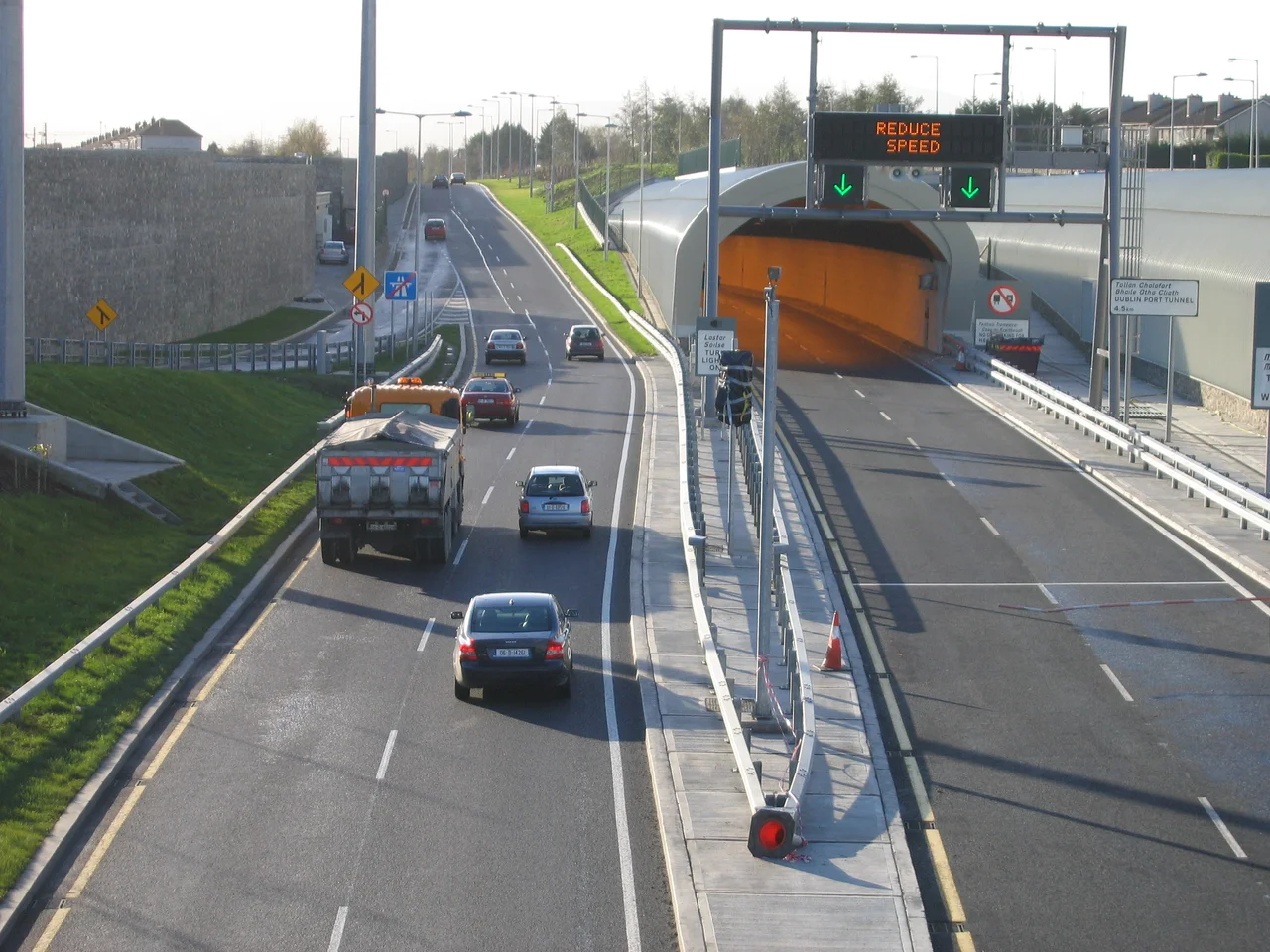

Dublin Port Tunnel
By the late 1990s the morning rush hour in Dublin had become a specific kind of misery. The city's port -- one of the busiest in Europe -- sat at the eastern end of the Liffey, hard against the city centre. Thousands of articulated lorries a day ground through narrow Georgian streets in low gear, belching diesel past schoolchildren and pensioners on their way to the quays. The fix, when it came, was ambitious: two parallel tunnels, 4.5 kilometres long, bored 30 metres below the rooftops of north Dublin. The engineers gave the boring machines girls' names, in the old tunnelling tradition. Meghan ate through 650 metres of soft clay. Grainne chewed through 2,600 metres of hard Dublin limestone. The result, opened on 20 December 2006, is still the fourth-longest urban motorway tunnel in Europe.
Meghan and Grainne
The two tunnel-boring machines were built by Herrenknecht of Germany and arrived at Dublin Port in 105 separate pieces aboard three ships. Reassembled, each was 156 metres long and 12 metres in diameter -- the size of a city block, on its side, with cutting teeth. The launch shaft was at Collins Avenue: 33 metres deep, 57 metres across, dug out by Mowlem in partnership with Intrafor of France. Grainne, named for an Irish mythological queen, headed south through limestone toward Marino, Fairview and the port. Meghan headed north through softer clay toward Whitehall. When Grainne finished her first bore, she was dismantled, turned around, and sent back the way she came to dig the parallel southbound tube. The breakthrough into the reception shaft happened on 18 August 2004 in the rock and 18 November 2003 in the clay. Between them, the machines removed 500,000 cubic metres of Dublin's underside -- enough rock to fill 200 Olympic swimming pools.
The Railway Above
The trickiest stretch was a sixty-metre section near Fairview where the new tunnel had to pass directly under the Dublin-Belfast railway. The railway sits on a Victorian-era embankment of soft fill resting on alluvial sand and silt, and trains run on it all day -- the InterCity service to Belfast, Drogheda commuters, the Dublin-area DART. There was no possibility of closing the line. So the Japanese contractor Nishimatsu built a temporary supporting structure 3.5 metres below the rails using pipe-jacking (a technique where steel pipes are hydraulically driven through the ground from concrete launching pits) and then constructed the tunnel inside the supported space. The 60-metre section took 24 months. One incident of subsidence closed the railway for three hours; the resulting penalty, written into the contract, was 28 euros per second -- 300,000 euros for one short interruption. Above ground, Alfie Byrne Road had to be raised 1.5 metres to accommodate the works. It has stayed that way.
Houses That Shook
Boring through hard limestone shakes the ground above it. In the Marino area -- a neighbourhood of small, careful semi-detached houses built in the 1920s -- residents felt their homes vibrate as Grainne ground past 23 metres below their kitchens. The contractor surveyed 241 properties before and after the tunnelling and set aside €1.5 million to compensate for the damage; cracked plaster, settled doorways, the small structural insults a 156-metre rock-eating machine leaves behind. Under Griffith Avenue and the Cloisters, boring was restricted to 16 hours a day to reduce noise. Under Annadale Crescent, residents got it down to 13. These compromises pushed the project from a planned 43-month build to 66 months -- nearly two extra years -- but they meant the tunnel arrived with a community that, mostly, was willing to live above it.
The Tolls and the Lorries
The Port Tunnel is tolled, but only for cars. Heavy goods vehicles (HGVs) pass for free, and from 7am to 7pm on weekdays a city-centre ban prevents any five-axle truck from entering the streets they used to dominate. The cumulative effect on Dublin's quays has been transformative: the air is cleaner, the cycle lanes safer, the pavements quieter, the Custom House visible without a backdrop of articulated trailers. Cars pay heavily at peak times -- €12 each way between 6 and 10am southbound and 4 and 7pm northbound, €3.50 the rest of the time -- to keep commuters from clogging a route designed for freight. The six-minute journey from M50 to port saves a haulier an hour of stop-start city driving. One curiosity: the Port Tunnel's 4.65-metre operating height is the highest official maximum of any of the 44 countries in the International Transport Forum. Even so, when it opened, lorry industry leaders grumbled that it should have been higher still. At the breakthrough ceremony, the haulage representative Jimmy Quinn delivered the line that has followed the project ever since: 'Maybe they should have done it when they were building it.'
Underground Run
Three times since opening, the tunnel has closed entirely for a curious purpose: people have run 10 kilometres through it. The Underground Run, held most recently on 26 March 2017, drew 2,400 runners and raised money for the homeless charity Focus Ireland. There is something cinematic about jogging through a road tunnel under the lights with no cars, the tile walls echoing your footsteps, the ventilation hum overhead. The tunnel itself is patrolled by 420 cameras, monitored from a control building beside the southern portal. FM radio piped inside lets RTE Radio 1, Newstalk, FM104 and four other stations follow you under Marino. In an emergency, broadcast messages override whatever song is playing. Below your wheels at the deepest point -- 30 metres under Marino, also the location of the drainage sump -- you are below the level of Dublin Bay. The tunnel famously shared an award with the World Trade Center recovery project for excellence in geotechnical engineering. The contrast was not lost on anyone.
From the Air
The Port Tunnel runs roughly north-south beneath the northside Dublin suburbs, connecting Dublin Port at 53.346N, 6.213W to the M50 motorway at Junction 2 near Dublin Airport, around 53.396N, 6.236W. The southern portal sits beside the docks; the northern portal is at Whitehall, just inside the M50. From altitude, the tunnel itself is invisible -- but the southern portal area is marked by the distinctive toll plaza next to Dublin Port and the bridge over the Tolka River. Look for the M1/M50 interchange to the north and the elevated section of the East Wall Road feeding into the south portal. Nearest airport: Dublin (EIDW), 2 km from the north portal.
Nearby Stories
- Wicklow Mountains 12 km away
- Mornington 14 km away
- German submarine U-1051 16 km away
- Abbey of Kells 18 km away
- Irish Military Intelligence Service 20 km away
- HMS Manners (K568) 37 km away
- Templemore 42 km away
- Irish Sea Bridge 43 km away