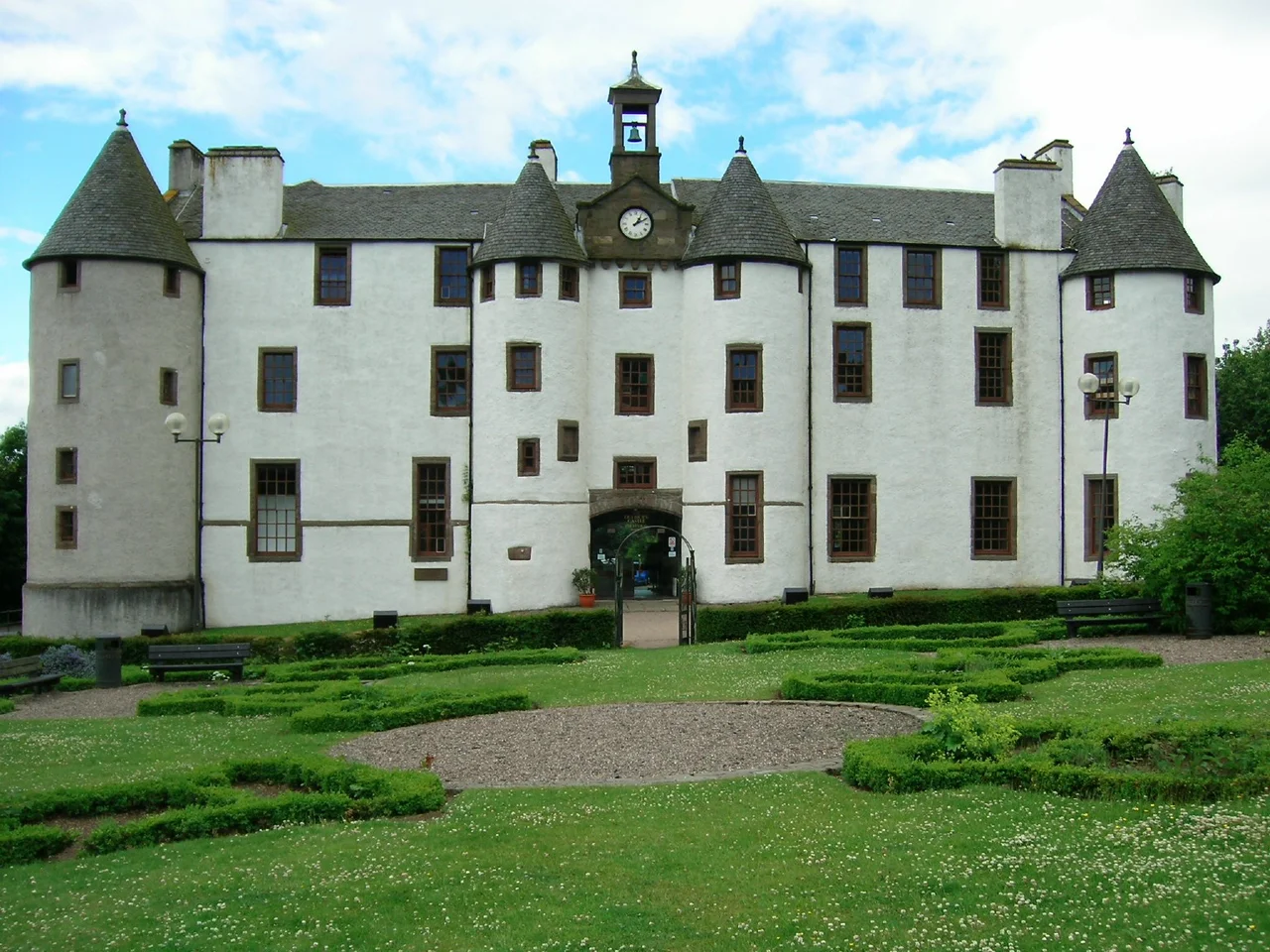

Dudhope Castle
In March 1298, William Wallace signed a charter giving the office of Constable of Dundee to the Scrymgeour family. Seven hundred years later, in March 1998, the Scrymgeour Clan Association held a commemorative dinner at Dudhope Castle, the seat of that hereditary constableship. The thread connecting those two dinners - one in the year of the Wars of Independence, one in the year of devolution - runs straight through this building on the south face of Dundee Law. Few castles in Scotland have been continuously useful for so long. Dudhope has been a fortress, a wool factory that never opened, a barracks for 400 soldiers, a public park, a business school, council offices, and now a third-sector hub. The walls keep adapting.
The Scrymgeour Seat
The Scrymgeour family - whose name eventually became Anglicised to Scrimgeour - built the original castle here in the late 13th century, on the southern face of Dundee Law overlooking the town and the Tay beyond. Their charter from William Wallace was confirmed by Robert the Bruce on 5 December of the same year, 1298 - extraordinary documentation for the period. The first castle was a smaller tower house, replaced around 1460. The structure was extended in 1580 for James Scrimgeour and Magdalen Livingstone into the L-plan form that survives today, with circular angle towers that were later demolished in the 18th century. Some surviving stone window pediments are dated 1600, bearing the initials "DML" for Dame Magdalen Livingstone. King James V visited in April 1540, and James VI and I came twice, in 1602 and 1617. The Scrymgeours were courtiers as well as constables.
Bonnie Dundee
On the death of John Scrymgeour, 1st Earl of Dundee, in 1668, King Charles II ignored the rightful heir John Scrymgeour of Kirkton and granted the castle and the office of Constable to Charles Maitland, brother of the Duke of Lauderdale. It was a politically convenient arrangement and an unjust one. Maitland later fell into financial trouble and in 1684 sold Dudhope to John Graham of Claverhouse - the soldier remembered in Scottish song as Bonnie Dundee. From this castle Graham rode out in 1689 to lead the first Jacobite rising. He won the Battle of Killiecrankie on 27 July, but was struck dead by a musket ball in the moment of victory. The castle reverted to the Crown, which granted it in 1694 to Archibald Douglas. The Douglas family were the last private occupants, holding it until about 1790.
Barracks for 400 Soldiers
After the Douglases left, Dudhope had a strange second life. In 1792 it was rented out for use as a woollen factory - a plan that came to nothing. In 1795 the Board of Ordnance took the lease, and from 1796 to 1879 the castle served as a barracks. New buildings went up around it: a hospital, officers' quarters, stables, guard rooms. The castle itself was converted to accommodate 400 soldiers. In 1854 Dundee Town Council took a sub-lease on the surrounding grounds for recreational use. When that lease expired in 1890 and the Earl of Home proposed building terraced housing on the site, the council instead bought the grounds outright for £31,700 - raising £20,000 itself and the rest through public subscription led by Lord Provost Mathewson. The grounds opened as a public park on 28 September 1895, opened by Sir James Low.
Saved, Restored, Reused
The castle building itself nearly didn't survive. The Dundee Corporation actually attempted to demolish it in 1958. Public sentiment, and arguably good fortune, prevented that. Between 1985 and 1988 the castle was redeveloped as offices and a conference centre, housing the University of Abertay's Dundee Business School. During restoration one main room was dedicated as the Scrymgeour Room, hung with Scrymgeour tartan and clan artefacts. In 1998, the Clan Association held that 700th-anniversary dinner there, marking Wallace's original charter. After the University of Abertay relocated, the building passed back to Dundee City Council. In 2022 it was transferred to The Circle Scotland, who use it to provide affordable office space for third-sector organisations. Dudhope Castle, after seven centuries, is still in active daily use - a survival rate few medieval buildings can match.
From the Air
Dudhope Castle sits at 56.4643 degrees north, 2.9841 degrees west, on the southern face of Dundee Law - the volcanic plug that dominates the centre of Dundee. EGPN (Dundee) is approximately 1.5 nautical miles to the south-southwest. From the air the castle is easily identified by its L-plan footprint and the surrounding green of Dudhope Park - a striking green rectangle in the dense urban grid south of the Law. Best viewed at 1500-2500 feet AGL. The Law itself, rising 174 metres (572 feet) above sea level, makes an unmistakable navigation reference for the whole approach to Dundee.
Nearby Stories
- Battle of Dunkeld 7.2 km away
- Balgonie Castle 9.8 km away
- Bell Rock Lighthouse 10 km away
- Inverbervie 13 km away
- Battle of Dollar 14 km away
- Battle of Mons Graupius 16 km away
- HMS Pathfinder (1904) 23 km away